
Short Answer
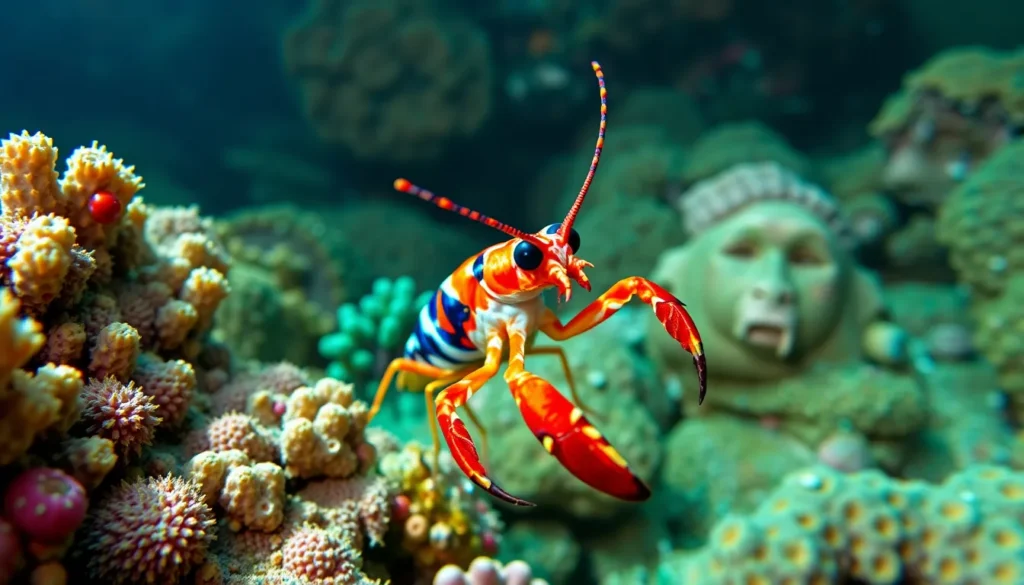
21 Facts About Peacock Mantis Shrimp
- Exceptional Strike Speed: The peacock mantis shrimp can strike prey at speeds of up to 23 meters per second, creating shockwaves that stun or kill its target.
- Powerful Appendages: It uses specialized club-like raptorial appendages to deliver rapid, powerful blows capable of breaking shells and aquarium glass.
- Complex Eyesight: Its eyes have 16 types of photoreceptor cells, compared to humans’ three, enabling it to see polarized light and a broad spectrum of colors, including ultraviolet.
- Independent Eye Movement: Each eye can move independently, allowing the mantis shrimp to have a wide field of vision and depth perception simultaneously.
- Vivid Coloration: The peacock mantis shrimp displays vibrant colors, including greens, blues, reds, and oranges, which may play a role in communication and camouflage.
- Habitat Range: It primarily inhabits shallow tropical and subtropical marine environments, such as coral reefs and rocky crevices in the Indo-Pacific region.
- Burrow Dwellers: These shrimp create and live in burrows, which provide shelter and a strategic location for ambush hunting.
- Diet: Their diet consists of hard-shelled prey like snails, crabs, and mollusks, which they can crack open with their powerful strike.
- Longevity: In the wild, peacock mantis shrimp can live up to 6 years, but lifespan can vary depending on environmental conditions.
- Reproductive Behavior: They engage in complex mating rituals, with some species forming monogamous pairs and sharing burrows.
- Communication: They use body posture, coloration, and possibly polarized light signals to communicate with conspecifics.
- Fastest Limb Movement: The mantis shrimp’s strike is one of the fastest movements in the animal kingdom, generating forces comparable to a bullet fired from a gun.
- Scientific Interest: Their unique biomechanics and vision have inspired research in materials science, robotics, and optical engineering.
- Predator and Prey: While formidable hunters, peacock mantis shrimp are preyed upon by larger fish and cephalopods.
- Molting Process: Like other crustaceans, they periodically molt their exoskeleton to grow, during which they are more vulnerable.
- Social Interactions: Although generally solitary, they can display territorial aggression toward intruders.
- Environmental Sensitivity: They are sensitive to changes in water quality and temperature, making them indicators of reef health.
- Shell Structure: Their raptorial appendages contain a highly mineralized, impact-resistant structure that prevents damage during strikes.
- Evolutionary Adaptations: Their advanced visual system and striking mechanism are results of millions of years of evolutionary specialization.
- Role in Ecosystem: By preying on hard-shelled animals, they help regulate populations and maintain balance within reef communities.
- Captivity Challenges: Due to their aggressive nature and specialized care requirements, keeping peacock mantis shrimp in aquariums can be difficult.
Habitat and Behavior
The peacock mantis shrimp inhabits tropical and subtropical marine environments, predominantly in the Indo-Pacific region, including coral reefs, rocky shores, and sandy bottoms. It creates burrows or occupies crevices where it hides and waits to ambush prey. These shrimp are solitary and territorial, often defending their burrows aggressively against intruders. Their diet mainly consists of hard-shelled invertebrates, which they capture and break open with their powerful raptorial appendages. Their remarkable eyesight allows them to detect prey, predators, and conspecifics with high precision, aiding in hunting and communication. Molting is a critical process for growth but also a vulnerable time for the mantis shrimp.
Why This Animal Matters
The peacock mantis shrimp plays a vital role in marine ecosystems by controlling populations of crustaceans and mollusks, thereby contributing to ecological balance. Its extraordinary visual system offers insights into complex photoreception and inspires scientific advances in imaging technologies. The biomechanics of its striking appendages have influenced materials science and robotic design, particularly in developing durable, impact-resistant materials. Culturally, the mantis shrimp has garnered interest for its vivid appearance and unique behaviors, often featuring in educational and natural history media. Conservation-wise, their sensitivity to environmental changes makes them important indicators of coral reef health in the face of climate change and habitat degradation.
Common Misconceptions
Misconception: The peacock mantis shrimp is a shrimp.
Correction: Although commonly called a shrimp, mantis shrimp belong to the order Stomatopoda and are distinct from true shrimps in the order Decapoda.
Misconception: The mantis shrimp’s punch is just a simple physical strike.
Correction: The strike is a complex biomechanical action involving rapid hydrostatic energy release and cavitation bubbles, making it much more than a simple punch.
Misconception: Mantis shrimp are harmless to humans.
Correction: Their powerful strike can break aquarium glass and cause serious injury if handled improperly.
Misconception: The mantis shrimp sees only in bright colors.
Correction: Their vision extends into ultraviolet and polarized light spectrums, allowing perception beyond human capabilities.
FAQ
How does the peacock mantis shrimp strike so fast?
The mantis shrimp uses a specialized appendage that stores energy like a spring and releases it rapidly, producing a strike speed of up to 23 meters per second, aided by cavitation bubbles that amplify the force.
What makes the mantis shrimp's vision unique?
Its eyes contain 16 types of photoreceptor cells, allowing it to see a spectrum of colors including ultraviolet light and polarized light, which is far beyond human visual capabilities.
Can a peacock mantis shrimp harm humans?
Yes, their powerful strike can cause injury to humans and even break aquarium glass, so handling them requires caution and respect for their strength.



Leave a Reply