
Short Answer
21 Facts About Quetzals
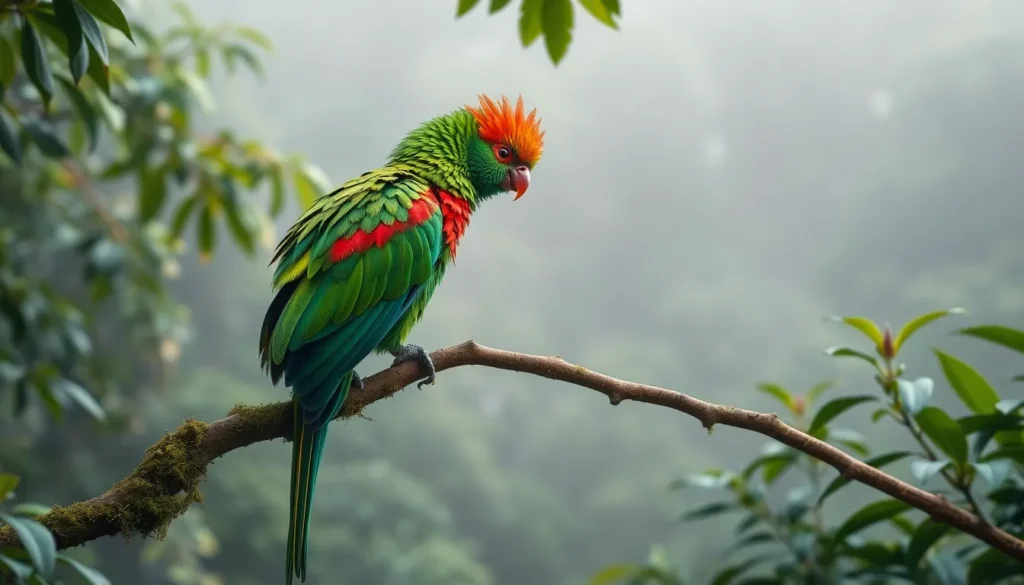
- Vibrant Plumage: Quetzals are famous for their brilliant green, red, and iridescent feathers that shimmer in sunlight due to microscopic structures rather than pigments.
- Genus and Species: The most well-known species is the Resplendent Quetzal (Pharomachrus mocinno), but the genus includes several related species.
- Size: Adult quetzals measure about 36 to 40 cm (14 to 16 inches) in length, with males having long tail feathers that can extend their total length up to 60 cm (24 inches) or more.
- Habitat: Quetzals inhabit cloud forests and montane rainforests in Central America, primarily in countries like Guatemala, Costa Rica, and Panama.
- Diet: They mainly feed on fruits, especially wild avocados, but also consume insects, small amphibians, and lizards.
- Ecological Role: As seed dispersers, quetzals play a key role in maintaining healthy forest ecosystems by spreading seeds of fruiting trees.
- Breeding Behavior: Quetzals nest in tree cavities, often using abandoned woodpecker holes, where they lay two eggs per season.
- Monogamy: They are generally monogamous during the breeding season, with both parents involved in raising the young.
- Cultural Significance: Quetzals hold symbolic importance in Mesoamerican cultures; their feathers were used as royal adornments by the Aztecs and Maya.
- National Symbol: The Resplendent Quetzal is the national bird of Guatemala and appears on the country’s flag and currency.
- Flight: Despite their striking appearance, quetzals are relatively weak fliers and prefer to move through dense forest canopies by hopping and short flights.
- Conservation Status: The Resplendent Quetzal is currently listed as Near Threatened due to habitat loss and fragmentation.
- Unique Tail Feathers: Male quetzals have long, trailing tail feathers that are used in courtship displays and can be three times the length of their body.
- Vocalizations: Their calls are soft and low-pitched, often described as whistles or squeaks, used for communication within dense forests.
- Adaptations: Their feet are heterodactyl, a unique toe arrangement among birds, aiding in gripping branches tightly.
- Activity Patterns: Quetzals are primarily diurnal, active during the day and roosting quietly at night.
- Territoriality: They tend to maintain territories during breeding but can be more tolerant outside of the season.
- Flight Speed: While generally slow, quetzals can make quick bursts of flight to escape predators or capture prey.
- Predators: Common predators include snakes, raptors, and small mammals that may prey on eggs or chicks.
- Scientific Discovery: The Resplendent Quetzal was first formally described in the 19th century by naturalists studying Central American fauna.
- Symbol of Freedom: In some cultures, the quetzal is associated with liberty and is believed to die in captivity, though this is a myth.
Habitat and Behavior
Quetzals primarily inhabit montane cloud forests ranging from southern Mexico through Central America to Panama. These environments are characterized by high humidity, persistent cloud cover, and dense vegetation. They depend heavily on mature forests with abundant fruiting trees, particularly wild avocados, which constitute a major part of their diet.
Behaviorally, quetzals are shy and elusive birds, tending to avoid open spaces and preferring dense canopy cover. They exhibit territoriality during the breeding season, defending nesting sites and surrounding areas. Their flight is relatively weak but agile within forest environments, consisting of short bursts to navigate through dense foliage. Socially, quetzals are mostly solitary or found in pairs during breeding, and they communicate using soft vocalizations suited to their humid forest habitat.
The breeding season varies geographically but usually coincides with the rainy season when food availability is high. Both male and female quetzals participate in incubating eggs and feeding hatchlings. Nesting occurs in natural cavities or holes excavated by other birds, emphasizing the importance of old-growth forests in their reproductive success.
Why This Animal Matters
Quetzals play a vital ecological role as seed dispersers in their forest habitats. By consuming fruits and excreting seeds away from parent trees, they contribute to forest regeneration and biodiversity maintenance. Their presence is an indicator of healthy, undisturbed cloud forest ecosystems.
Culturally, quetzals hold profound significance in indigenous Central American societies. Their resplendent feathers were historically prized for ceremonial uses, symbolizing wealth, power, and spiritual connection. Today, the quetzal remains a national symbol for Guatemala, representing freedom and natural heritage.
From a conservation perspective, quetzals highlight the urgent need to protect cloud forests, which face threats from deforestation, agriculture, and climate change. Preserving quetzal habitats aids broader biodiversity conservation efforts, benefiting numerous other species sharing this environment.
Common Misconceptions
Misconception: Quetzals die if kept in captivity.
Correction: While quetzals are difficult to keep in captivity due to their specialized diet and habitat needs, there is no scientific evidence that they die simply because they are caged.
Misconception: Quetzals are a single species.
Correction: The term “quetzal” refers to a genus (Pharomachrus) that includes several species of brightly colored birds, not just the Resplendent Quetzal.
Misconception: Quetzal feathers are ordinary green or blue pigments.
Correction: Their vibrant colors arise from microscopic feather structures that reflect light, causing iridescence rather than from pigments alone.
FAQ
Where do quetzals live?
Quetzals primarily inhabit montane cloud forests in Central America, including countries such as Guatemala, Costa Rica, and Panama, where the environment is cool and humid with abundant fruiting trees.
Why are quetzals important to the ecosystem?
Quetzals are important seed dispersers, helping to spread the seeds of fruiting trees, which supports forest regeneration and biodiversity in their cloud forest habitats.
Are quetzals endangered?
The Resplendent Quetzal is currently classified as Near Threatened due to habitat loss and fragmentation, highlighting the need for conservation of cloud forest ecosystems.



Leave a Reply