
Short Answer
21 Facts About Red-legged Seriemas
- Scientific Classification: The red-legged seriema (Cariama cristata) is a member of the family Cariamidae, which is unique as it contains only two living species.
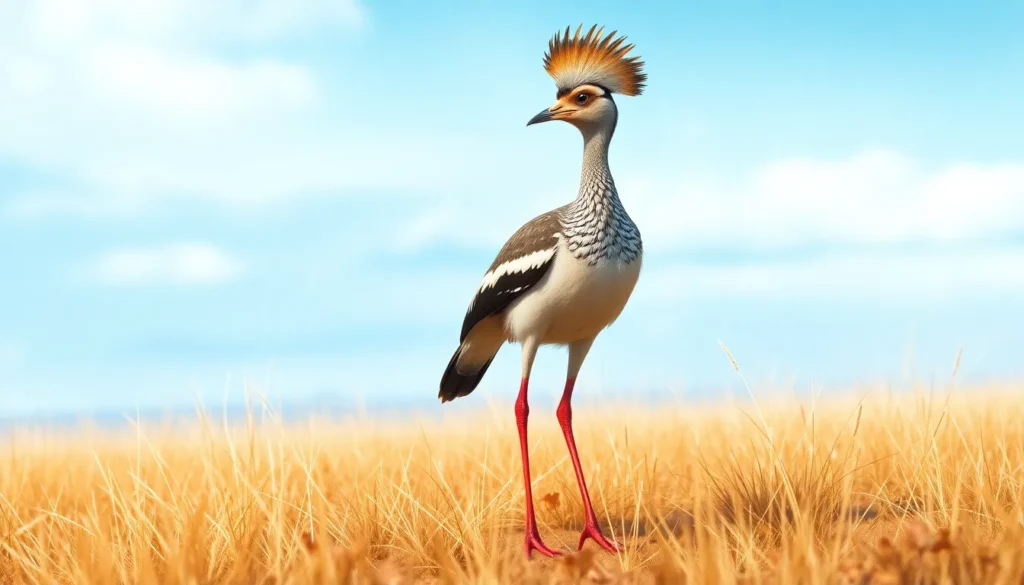
- Distinctive Appearance: It is easily recognizable by its bright red legs and a prominent crest of feathers on its head.
- Geographic Range: These birds are native to central and eastern South America, particularly in countries such as Brazil, Bolivia, Paraguay, and Argentina.
- Habitat Preference: Red-legged seriemas prefer open grasslands, savannas, and scrub forests, often avoiding dense forests and very arid regions.
- Size and Weight: Adult red-legged seriemas typically measure about 75 to 90 centimeters in length and weigh approximately 1.2 to 1.5 kilograms.
- Diet: They are omnivorous, feeding on a variety of small animals such as insects, reptiles, small mammals, as well as fruits and seeds.
- Hunting Technique: Red-legged seriemas often hunt by running on the ground and using their strong legs to catch prey, sometimes striking it with their powerful beaks.
- Vocalization: Their loud, distinctive calls can be heard over long distances and are used for communication between pairs and territorial defense.
- Flight Ability: While capable of flight, red-legged seriemas prefer to run and generally take flight only to escape danger or reach roosting spots.
- Social Behavior: They are often seen alone or in pairs, and sometimes in small family groups outside the breeding season.
- Breeding Season: The breeding season typically occurs in the austral spring and summer months, with nests built on the ground or low shrubs.
- Nesting: Their nests are constructed from sticks and grasses, where females usually lay two to three eggs.
- Parental Care: Both parents participate in incubating the eggs and feeding the chicks until they are capable of independence.
- Adaptations for Ground Living: Their long legs and strong feet are well adapted for running and scratching the ground to find food.
- Role in Ecosystem: By controlling insect and small vertebrate populations, they contribute to maintaining ecological balance.
- Predators: Natural predators include larger birds of prey and terrestrial mammals, though their vigilance and speed help them avoid many threats.
- Conservation Status: Currently, red-legged seriemas are not considered threatened and are classified as Least Concern by the IUCN.
- Relationship with Humans: They are sometimes hunted locally but generally coexist peacefully with human activities.
- Unique Family: The Cariamidae family is considered basal among modern birds, providing insight into avian evolution.
- Use of Crest: The crest feathers are used in display behaviors, especially during mating rituals or territorial disputes.
- Longevity: In the wild, red-legged seriemas can live up to 12 years, though precise lifespan data is limited.
Habitat and Behavior
Red-legged seriemas inhabit open landscapes such as grasslands, savannas, and lightly wooded areas across central and eastern South America. They prefer environments that offer both open ground for foraging and scattered vegetation for cover and nesting. Behaviorally, these birds are primarily terrestrial, relying on their strong legs for running and hunting prey on the ground. They are known for their loud, far-carrying calls that play a significant role in communication and territory establishment. Although capable of flight, they tend to fly only when necessary, favoring running as their main mode of locomotion. Their diet is opportunistic and varied, reflecting their adaptability to changing food availability. During breeding season, they build nests on or near the ground, with both parents participating actively in raising the young.
Why This Animal Matters
Red-legged seriemas play a vital ecological role by controlling populations of insects and small vertebrates, which helps maintain ecosystem balance. Their presence indicates healthy open habitats and they serve as indicators of environmental quality in their native range. From an evolutionary perspective, as one of the few extant members of the Cariamidae family, they provide valuable insight into the evolutionary history of birds. Culturally, while not heavily featured, they are part of the diverse avifauna that enriches South American biodiversity. Currently, their conservation status is stable, but ongoing habitat changes warrant monitoring to ensure their continued survival.
Common Misconceptions
Misconception: Red-legged seriemas cannot fly.
Correction: Although they prefer running, red-legged seriemas are capable of flight and will fly to escape predators or reach roosting sites.

Misconception: They are aggressive towards humans.
Correction: Red-legged seriemas are generally shy and avoid humans, showing aggression only when threatened or cornered.
Misconception: They are closely related to large predatory birds like hawks or eagles.
Correction: Despite their size and hunting habits, seriemas belong to their own distinct family (Cariamidae) and are not closely related to raptors.
FAQ
Can red-legged seriemas fly?
Yes, red-legged seriemas are capable of flight but generally prefer running on the ground. They typically fly to escape predators or to reach roosting locations.
What do red-legged seriemas eat?
They have an omnivorous diet that includes insects, small reptiles and mammals, as well as fruits and seeds.
Where are red-legged seriemas found?
They are native to central and eastern South America, mainly in countries such as Brazil, Bolivia, Paraguay, and Argentina, inhabiting grasslands and savanna regions.


Leave a Reply