
Short Answer
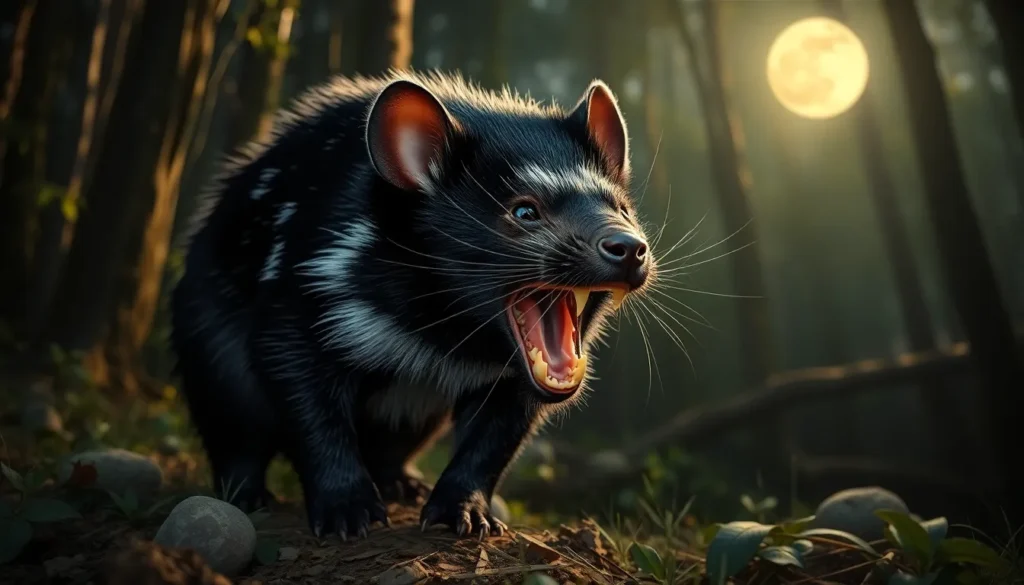
21 Facts About Tasmanian Devils
- Largest Carnivorous Marsupial: Tasmanian devils are the largest carnivorous marsupials currently existing, after the extinction of the thylacine.
- Native to Tasmania: They are found only on the island state of Tasmania, Australia.
- Nocturnal Animals: Tasmanian devils are primarily nocturnal, being most active at night.
- Strong Bite Force: They have one of the strongest bite forces relative to body size among mammals, adapted for crushing bones.
- Distinctive Vocalizations: They produce loud and disturbing screeches and growls, especially when feeding or threatened.
- Black Fur: Their fur is mostly black with occasional white patches on the chest and rump.
- Social Feeders: Despite their solitary nature, they often feed communally on carcasses, sometimes aggressively competing for food.
- Short Gestation Period: Females have a gestation period of about 21 days, after which tiny, underdeveloped young continue development in the pouch.
- Pouch with Four Teats: The female’s pouch contains four teats; typically only four young survive to attachment.
- Strong Scent: They produce a strong musky odor, which is the origin of their name.
- Solitary Outside Feeding: Outside feeding times, Tasmanian devils tend to live and hunt alone.
- Mating Season: Mating occurs once a year during March to April, often involving intense competition among males.
- Life Span: In the wild, Tasmanian devils typically live around 5 to 6 years.
- Diet: They are scavengers and predators, consuming carrion, small mammals, birds, fish, insects, and plants.
- Facial Tumor Disease: Since the 1990s, they have been severely affected by a contagious cancer known as Devil Facial Tumor Disease (DFTD).
- Conservation Status: Because of DFTD, Tasmanian devils are listed as endangered by the IUCN.
- Role in Ecosystem: They help control populations of other animals and clean up carrion, reducing disease spread.
- Communication: They use vocalizations, scent markings, and body language to communicate.
- Origin of Name: Early European settlers named them “devils” due to their fierce behavior and eerie sounds.
- Reintroduction Efforts: Conservation programs are working to breed healthy populations and reintroduce them to mainland Australia.
- Symbol of Tasmania: The Tasmanian devil is a cultural icon and appears on Tasmania’s coat of arms and various logos.
Habitat and Behavior
Tasmanian devils inhabit a variety of environments across Tasmania, including dry sclerophyll forests, coastal scrublands, and agricultural areas. They prefer habitats with dense vegetation or rocky areas that provide shelter. As mostly nocturnal animals, they rest during the day in dens such as hollow logs, caves, or burrows. Their behavior is characterized by solitary hunting and scavenging, although they may gather at large carcasses where fierce competition and vocalization occur. Their strong sense of smell guides them to food sources, and their powerful jaws allow them to consume entire carcasses, including bones. During mating season, males compete aggressively for females, often resulting in loud fights. The species is well-adapted to survive in Tasmania’s temperate climate, but their population has been severely affected by Devil Facial Tumor Disease, which spreads through biting during social interactions.
Why This Animal Matters
Tasmanian devils play a vital ecological role by acting as top scavengers in their environment. By consuming carrion, they help prevent the spread of disease and maintain ecosystem health. Their predation also influences populations of other animals, such as feral cats and invasive species, indirectly benefiting native wildlife. Culturally, the Tasmanian devil is an important symbol for Tasmania and Australia, featuring prominently in local art and conservation messaging. Scientifically, they offer valuable insights into contagious cancers through the study of Devil Facial Tumor Disease, which is one of the few known transmissible cancers. Ongoing conservation efforts aim to preserve their populations, given their endangered status and ecological importance.
Common Misconceptions
Misconception: Tasmanian devils are aggressive and attack humans unprovoked.
Correction: Tasmanian devils are generally shy and avoid humans. They may hiss or growl when threatened but rarely attack unless cornered or handled.
Misconception: Tasmanian devils are related to dogs.
Correction: Despite their name and appearance, Tasmanian devils are marsupials, not canines, and are more closely related to other Australian marsupials.
Misconception: Tasmanian devils caused the extinction of the thylacine.
Correction: The extinction of the thylacine was primarily due to human hunting and habitat loss, not competition from Tasmanian devils.
Misconception: All Tasmanian devils have facial tumors.
Correction: While many have been affected by Devil Facial Tumor Disease, some populations remain disease-free due to isolated habitats and conservation efforts.
FAQ
What is the primary cause of the decline in Tasmanian devil populations?
The primary cause of decline is Devil Facial Tumor Disease (DFTD), a contagious cancer that spreads through biting and causes fatal tumors.
Are Tasmanian devils dangerous to humans?
Tasmanian devils are generally not dangerous to humans and tend to avoid contact. They may hiss or growl if threatened but attacks are very rare.
Why are Tasmanian devils important to the ecosystem?
They serve as top scavengers, cleaning up carrion which helps prevent the spread of disease and maintains ecological balance.



Leave a Reply