
Short Answer
21 Facts About Hawk Moths
- Hawk moths belong to the family Sphingidae. This family contains approximately 1,450 species worldwide, known for their robust bodies and narrow wings.
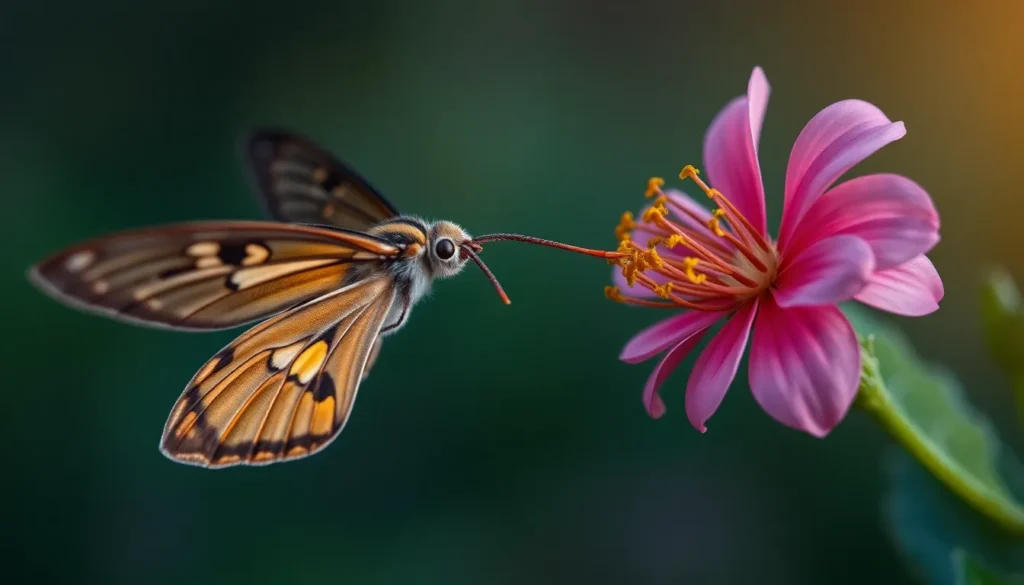
- They are capable of hovering like hummingbirds. This unique ability allows them to feed on nectar while remaining airborne.
- Hawk moths have long proboscises. Some species have proboscises that are several times longer than their body, enabling them to access deep nectar within flowers.
- Many species are crepuscular or nocturnal. They are most active during twilight or nighttime hours, which helps avoid predators.
- Largest hawk moth species can have wingspans up to 15 centimeters. The white-lined sphinx and the giant hawk moth are among the largest members.
- Their larvae are often called hornworms. This is due to the characteristic horn-like structure found on the rear of many caterpillars.
- Hawk moth caterpillars feed on a variety of plants. They often specialize on certain host plants, such as tobacco, tomato, or grapevines.
- Some hawk moths migrate long distances. Species like the silver-striped hawk moth are known for seasonal migrations.
- They play an important role in pollination. Their long proboscises allow them to pollinate flowers that other insects cannot reach.
- Hawk moths can fly at high speeds. Some species reach speeds of up to 50 kilometers per hour.
- They exhibit remarkable camouflage. Many species have wing patterns that mimic leaves or bark to avoid detection.
- Hawk moths use powerful flight muscles. These muscles enable rapid wing beats necessary for hovering and fast flight.
- Some species produce ultrasonic sounds. These sounds may serve as a defense mechanism against echolocating bats.
- The death’s-head hawk moth is famous for its skull-shaped mark. This species has cultural significance and has appeared in literature and film.
- Hawk moths have a global distribution. They are found on every continent except Antarctica.
- Adults typically do not feed on solid food. Instead, they rely on nectar or do not feed at all if their mouthparts are reduced.
- Hawk moths undergo complete metamorphosis. Their life cycle includes egg, larva (caterpillar), pupa, and adult stages.
- Many species are attracted to light. This phototactic behavior can make them vulnerable to artificial lighting.
- Some hawk moth larvae are considered agricultural pests. Their feeding can cause damage to crops such as tomatoes and tobacco.
- Their flight is powered by asynchronous muscles. This means their wing muscles contract multiple times for every nerve impulse, aiding in fast wing beats.
- Hawk moths have specialized sensory organs. These organs help detect floral odors and navigate during flight.
Habitat and Behavior
Hawk moths inhabit a wide range of environments, including forests, grasslands, deserts, and urban areas. They are highly adaptable and found on most continents except Antarctica. Their behavior varies by species, with many being nocturnal or crepuscular to avoid daytime predators. Hawk moths are strong fliers, capable of rapid and sustained flight, often hovering in front of flowers to feed on nectar. Their larvae feed on host plants, sometimes specializing on particular species, which influences their distribution and life cycle. Migration is observed in some species, allowing them to exploit seasonal resources. Their sensory adaptations help them locate food sources and mates even in low light conditions.
Why This Animal Matters
Hawk moths play an essential ecological role as pollinators, especially for flowers with deep corollas that other pollinators cannot access. Their pollination activities support biodiversity and the reproduction of many plant species. Additionally, their larvae serve as a food source for a variety of predators, including birds and small mammals, contributing to food web dynamics. Culturally, certain hawk moths, such as the death’s-head hawk moth, have featured prominently in art, folklore, and literature. From a conservation perspective, some species are indicators of ecosystem health, and their sensitivity to habitat changes draws attention to environmental issues like habitat loss and light pollution.
Common Misconceptions
Misconception: Hawk moths are dangerous to humans.
Correction: Hawk moths do not pose any threat to humans. They are harmless insects that do not bite or sting.
Misconception: All hawk moths are active only at night.
Correction: While many hawk moths are nocturnal or crepuscular, some species are active during the day.
Misconception: Hawk moth caterpillars are always pests.
Correction: Although some larvae can damage crops, many species do not cause significant agricultural harm and are important parts of their ecosystems.
Misconception: Hawk moths are butterflies.
Correction: Hawk moths belong to the moth group, which is distinct from butterflies, despite some similarities in appearance and behavior.
FAQ
What distinguishes hawk moths from other moths?
Hawk moths are distinguished by their robust bodies, narrow wings, and their ability to hover while feeding using a long proboscis.
Are hawk moths harmful to humans?
No, hawk moths are harmless to humans. They do not bite or sting and are generally not considered pests to people.
Why are hawk moths important to ecosystems?
Hawk moths are important pollinators for many plants, especially those with deep flowers. Their larvae also serve as food for various predators, contributing to ecological balance.


Leave a Reply