
Short Answer
21 Facts About Scorpionflies
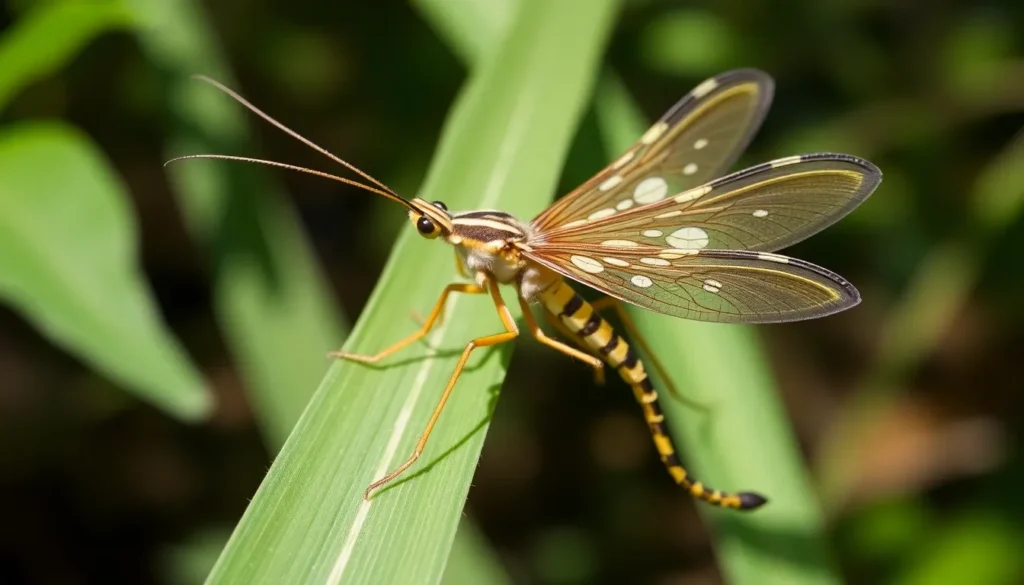
- Scorpionflies belong to the order Mecoptera. They are characterized by elongated faces and unique wing structures.
- They get their name from the male’s tail, which resembles a scorpion’s stinger. However, this tail is harmless and is used during mating.
- Scorpionflies are generally small to medium-sized insects. Their body lengths typically range from 9 to 25 millimeters.
- They possess two pairs of membranous wings. These wings often have distinctive patterns or markings that aid in species identification.
- Unlike true flies, scorpionflies have chewing mouthparts. This allows them to feed on a variety of food sources including dead insects and plant material.
- Many scorpionfly species are scavengers. They primarily consume dead or dying insects, playing a role in decomposition.
- Some species also feed on nectar and pollen. This occasional feeding behavior suggests a degree of ecological flexibility.
- Scorpionflies have complete metamorphosis. Their life cycle includes egg, larva, pupa, and adult stages.
- The larvae resemble caterpillars. They typically live in moist environments such as leaf litter or soil.
- Male scorpionflies often present females with nuptial gifts. These gifts can be prey items or salivary secretions, influencing mating success.
- Scorpionflies are found worldwide but are most diverse in temperate regions. They are especially common in forested habitats.
- Their elongated rostrum (snout) houses the mouthparts. This feature distinguishes them from many other insect groups.
- Scorpionflies have compound eyes and simple eyes (ocelli). These provide them with a wide field of vision and light detection capabilities.
- Adults are generally active during the day. They are often seen resting on vegetation or flying low to the ground.
- Some species exhibit complex mating behaviors. These include elaborate courtship displays and territoriality among males.
- Scorpionflies can serve as bioindicators. Their presence and abundance may reflect the health of forest ecosystems.
- Their fossil record dates back to the Jurassic period. This makes them an ancient group providing insights into insect evolution.
- Scorpionfly wings have a distinctive venation pattern. This is used by entomologists for species identification and classification.
- They are not harmful to humans. Scorpionflies do not bite or sting and are generally considered harmless.
- Some species can be mistaken for other insects such as crane flies or mayflies. This is due to superficial similarities in wing shape and size.
- Despite their name, scorpionflies are not related to scorpions. They belong to an entirely different class of animals (insects vs. arachnids).
Habitat and Behavior
Scorpionflies are predominantly found in temperate forested areas across the globe. They thrive in moist environments where leaf litter and decaying organic matter are abundant, as these conditions provide ample food resources and suitable sites for larval development. Adults are typically active during daylight hours and can often be observed resting on vegetation or flying near the ground. Their behavior includes scavenging on dead insects and occasionally feeding on nectar or pollen. Male scorpionflies display interesting reproductive behaviors, often offering nuptial gifts to females to increase mating success. Larvae live in soil or leaf litter and resemble caterpillars, feeding on decomposing material. Scorpionflies contribute to nutrient recycling through their scavenging activities and are sensitive to environmental changes, making them useful ecological indicators.
Why This Animal Matters
Scorpionflies play an important ecological role as scavengers, helping to decompose and recycle nutrients from dead insects and organic matter. This contributes to soil health and the maintenance of forest ecosystems. Their presence can indicate environmental quality, as they are sensitive to habitat disturbance and pollution. Moreover, scorpionflies add to biodiversity and provide insights into insect evolution due to their ancient lineage. While they have limited direct cultural significance, their unique morphology and behaviors make them subjects of scientific interest and education. Conservation of their habitats supports overall ecosystem health and the many species that depend on similar environmental conditions.
Common Misconceptions
Misconception: Scorpionflies can sting or are dangerous because of their name.
Correction: Despite their name and the male’s tail resembling a scorpion’s stinger, scorpionflies cannot sting and are harmless to humans.
Misconception: Scorpionflies are closely related to scorpions.
Correction: Scorpionflies are insects in the order Mecoptera, whereas scorpions are arachnids; the two are unrelated.
FAQ
Are scorpionflies dangerous to humans?
No, scorpionflies are not dangerous to humans. Despite their name and the male's tail resembling a scorpion's stinger, they do not sting or bite.
What do scorpionflies eat?
Scorpionflies primarily scavenge dead or dying insects, but some species also feed on nectar, pollen, and occasionally plant material.
Where are scorpionflies commonly found?
Scorpionflies are commonly found in temperate forested regions worldwide, especially in areas with moist environments such as leaf litter and soil.

Leave a Reply