
Short Answer
21 Facts About Animal Intelligence
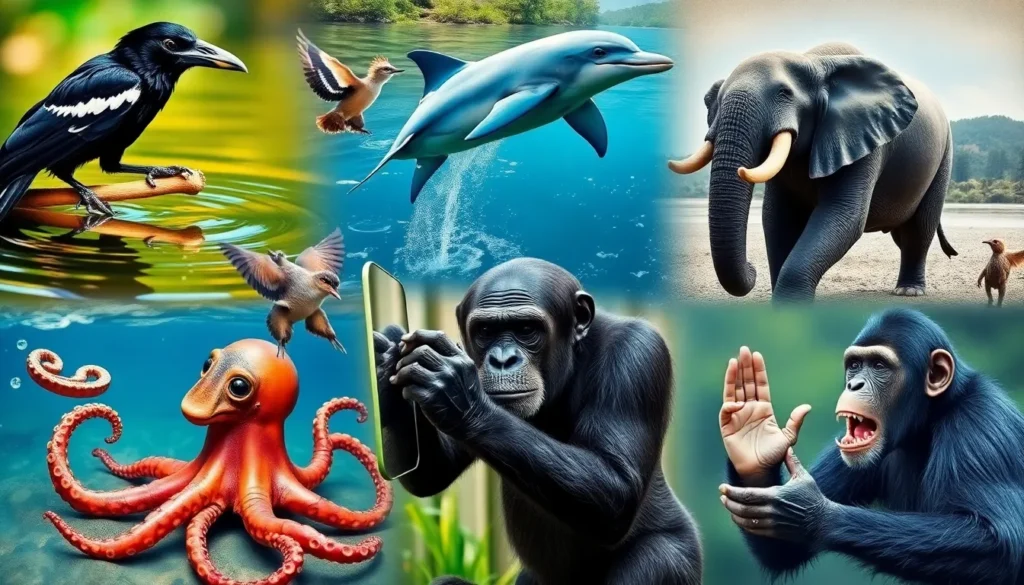
- Some birds use tools to obtain food. For example, New Caledonian crows manufacture and use sticks to extract insects from tree bark, demonstrating advanced problem-solving skills.
- Dolphins exhibit complex social behaviors. They use signature whistles to identify individuals and coordinate group hunting, indicating sophisticated communication abilities.
- Elephants demonstrate self-awareness. They recognize themselves in mirrors, a trait linked to higher cognitive functions and empathy.
- Octopuses can solve puzzles. These invertebrates navigate mazes and open jars to access food, showcasing remarkable learning and memory.
- Some primates use sign language. Chimpanzees and bonobos have been taught to use symbols or signs to communicate with humans, indicating capacity for symbolic thought.
- Ravens remember human faces. They can recognize and react differently to humans who have previously threatened them, suggesting advanced memory and social cognition.
- Bees communicate through dances. The waggle dance conveys information about the direction and distance of food sources to other bees.
- Parrots can mimic human speech. Beyond mimicry, some parrots understand context and use words meaningfully.
- Dogs understand human gestures. They can follow pointing cues better than even our closest primate relatives in some studies.
- Whales have complex vocalizations. Some species like humpback whales produce structured songs that may serve social or mating functions.
- Crows plan for future events. They cache food in anticipation of scarcity, indicating foresight and future planning.
- Orangutans use tools in the wild. They fashion sticks to extract insects or seeds, demonstrating cultural transmission of knowledge.
- Some fish display problem-solving skills. Cleaner wrasse fish recognize themselves in mirrors, a rare example of self-awareness in fish.
- Dogs can detect human emotions. They respond to human facial expressions and vocal tones, showing emotional intelligence.
- Chimpanzees engage in deception. They may hide food or mislead others, illustrating complex social strategies.
- Sea otters use stones as tools. They crack open shellfish on their chests, a learned behavior passed across generations.
- Some ants farm fungi. Leafcutter ants cultivate fungal gardens for food, indicating sophisticated agriculture-like behavior.
- Elephants mourn their dead. They show behaviors interpreted as grief, such as touching bones and staying near deceased individuals.
- Some animals exhibit metacognition. Research suggests monkeys can reflect on their own knowledge or uncertainty.
- Octopuses exhibit individual personalities. Different octopuses show consistent behavioral differences, such as boldness or shyness.
- Birds such as pigeons can learn abstract concepts. They can distinguish between artistic styles or recognize human faces after training.
Habitat and Behavior
Animal intelligence is observed across a wide variety of habitats, from oceans and forests to urban environments. Species exhibiting advanced cognitive abilities adapt their behaviors to survive and thrive in their specific ecosystems. For example, crows in urban areas use human-made objects as tools, while dolphins in coastal waters develop cooperative hunting techniques. Social animals like elephants and primates often form complex groups with established hierarchies and communication systems. Adaptability, learning, and problem-solving enhance their ability to find food, avoid predators, and reproduce successfully.
Why This Animal Matters
Understanding animal intelligence provides insights into the evolution of cognition and behavior across species, including humans. Intelligent animals often play critical ecological roles, such as pollination by bees or controlling pest populations by birds. They also contribute to cultural and scientific knowledge, inspiring conservation efforts. Many intelligent species face threats from habitat destruction, climate change, and human activity, making their study important for biodiversity preservation. Furthermore, recognizing animal intelligence challenges ethical considerations surrounding their treatment and welfare.
Common Misconceptions
Misconception: Intelligence is unique to humans.
Correction: Many animal species exhibit complex cognitive abilities, including problem-solving, communication, and self-awareness, demonstrating intelligence beyond humans.
Misconception: Tool use is exclusive to primates.
Correction: Various animals such as birds, octopuses, and sea otters use tools, illustrating that this ability is more widespread than previously thought.
Misconception: Animals act purely on instinct without learning.
Correction: Many animals learn from experience, adapt behavior, and can even pass knowledge culturally within groups.
FAQ
Which animals are considered the most intelligent?
Species such as dolphins, elephants, great apes, corvids (crows and ravens), and octopuses are often regarded as highly intelligent due to their demonstrated problem-solving skills, communication, and social complexity.
How do scientists measure animal intelligence?
Animal intelligence is studied through behavioral experiments assessing problem-solving, memory, communication, social learning, tool use, and sometimes self-recognition tests.
Can all animals learn from experience?
While the capacity for learning varies, many animals demonstrate the ability to learn from experience and adapt behaviors accordingly, though the complexity of learning differs across species.


Leave a Reply