
Short Answer
21 Facts About Xiphiidae
- Unique Bill Structure
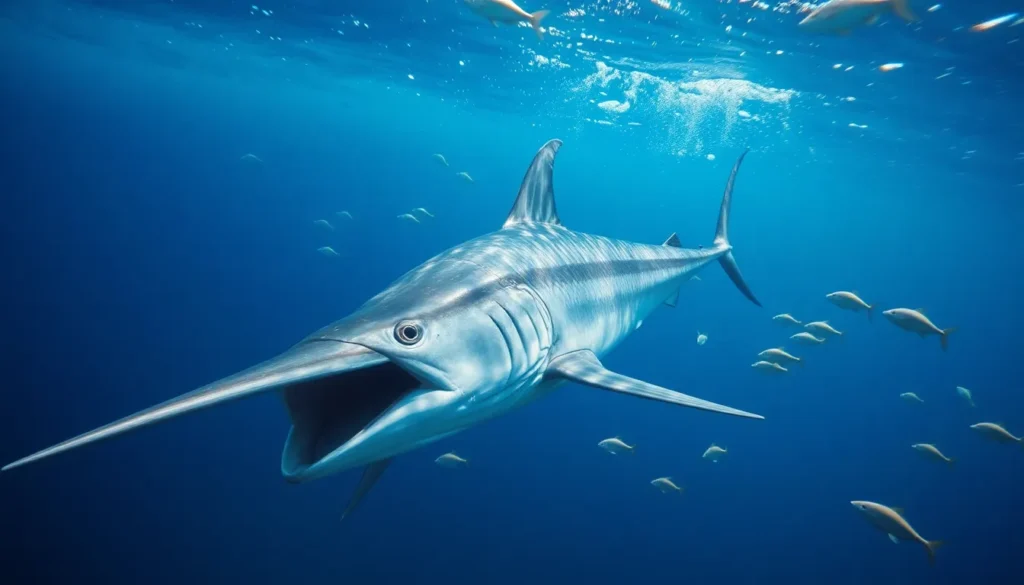
The swordfish’s most notable feature is its elongated, flat bill, which can be as long as one-third of its body length. This bill is used for slashing prey and defense. - Single Species Family
Xiphiidae consists primarily of one species, Xiphias gladius, commonly known as the swordfish, making it a monotypic family. - Wide Distribution
Swordfish are found in tropical and temperate waters worldwide, from the surface to depths of about 550 meters. - Fast Swimmers
Swordfish are among the fastest fish in the ocean, capable of speeds up to 60 miles per hour (97 km/h), aiding in catching swift prey. - Large Size
Adult swordfish can grow up to 4.5 meters (15 feet) in length and weigh over 500 kilograms (1100 pounds). - Thermoregulation
Swordfish have specialized blood vessels that allow parts of their brain and eyes to stay warmer than surrounding water, enhancing vision in deep, cold environments. - Diet
They are carnivorous predators feeding mainly on fish such as mackerel, herring, and squid. - Reproduction
Swordfish spawn in warm waters, releasing millions of eggs that hatch into larvae drifting with ocean currents. - Longevity
They can live up to 9 years in the wild, though exact lifespan data varies. - Solitary Behavior
Swordfish are usually solitary hunters but may occasionally be found in small groups during migration or spawning. - Highly Migratory
They undertake seasonal migrations to follow prey and spawning grounds across vast ocean areas. - Commercial Importance
Swordfish are a valuable target for commercial and recreational fisheries worldwide. - Conservation Concerns
Overfishing and bycatch have led to population declines in some regions, prompting international management efforts. - Bill Use in Hunting
They use their bill to stun or injure prey before consuming it, a unique predatory technique among fish. - Coloration
Adults typically exhibit a dark blue or brownish coloration on the dorsal side and a white underside, aiding in camouflage. - Rapid Growth
Young swordfish grow rapidly during their first year, reaching up to 1 meter in length. - Eye Adaptations
Swordfish eyes have a heat exchange system to improve visual acuity in cold, deep waters. - Historical Significance
Swordfish have been known since ancient times and are depicted in classical art and literature. - Food Source
They are prized for their firm, flavorful flesh, commonly used in steaks and sushi. - Predators
Natural predators include larger sharks and killer whales, especially targeting juveniles. - Research Subject
Swordfish are studied for their physiology, especially their thermoregulation and swimming mechanics.
Habitat and Behavior
Swordfish inhabit a broad range of oceanic environments, primarily warm and temperate surface waters worldwide. They are pelagic, living in the open sea rather than close to the seabed or coastlines. Swordfish exhibit diel vertical migration, diving to depths up to 550 meters during the day to hunt and returning to warmer surface waters at night. Their ability to regulate brain and eye temperature enhances hunting efficiency in cooler, deeper waters. Typically solitary, swordfish are active predators using their speed and sharp bill to capture fast-moving prey such as squid and small fish. They migrate seasonally to follow prey abundance and move to spawning areas.
Why This Animal Matters
Swordfish play a significant ecological role as apex predators, helping to maintain the balance of marine food webs by controlling populations of mid-level predatory fish and cephalopods. Economically, swordfish are important to commercial fisheries and recreational anglers, contributing to livelihoods and food supply in various coastal communities. Their presence also has cultural value in some societies, symbolizing strength and agility. Conservation concerns have arisen due to overfishing, leading to international regulations to ensure sustainable populations. Studying swordfish physiology provides insights into marine adaptation mechanisms, especially thermoregulation and high-speed swimming.
Common Misconceptions
Misconception: Swordfish use their bills to impale and kill prey instantly.
Correction: Swordfish primarily use their bills to slash or stun prey rather than impale it, allowing them to catch fish and squid more effectively.
Misconception: All swordfish live near the ocean surface.
Correction: Swordfish perform deep dives during the day, often reaching depths of several hundred meters to hunt, surfacing mainly at night.
Misconception: Swordfish are closely related to marlins.
Correction: While swordfish and marlins share a similar appearance and belong to the same order (Istiophoriformes), swordfish belong to their own distinct family (Xiphiidae), separate from marlins (Istiophoridae).
Misconception: Swordfish are invulnerable due to their size and speed.
Correction: Despite their size and agility, swordfish face natural predation from large sharks and orcas, especially when young.
FAQ
What distinguishes swordfish from other billfish?
Swordfish are unique among billfish for their flat, elongated bill and their ability to thermoregulate parts of their brain and eyes, which improves vision in cold, deep waters.
How do swordfish use their bills when hunting?
They use the bill to slash at prey, stunning or injuring fish and squid to make capture easier rather than impaling them.
Are swordfish endangered?
Swordfish are not globally endangered but are considered vulnerable in some regions due to overfishing and bycatch. Various international regulations aim to manage and conserve their populations.




Leave a Reply