
Short Answer
21 Facts About Lancelets
- Lancelets belong to the subphylum Cephalochordata. They are primitive chordates that share key features with vertebrates but lack a true backbone.
- Lancelets have a notochord that extends the length of their body. This flexible rod supports their body and acts as a precursor to the vertebral column in higher animals.
- They possess a dorsal nerve cord. Unlike the ventral nerve cords of many invertebrates, lancelets have a nerve cord located along their back, a defining feature of chordates.
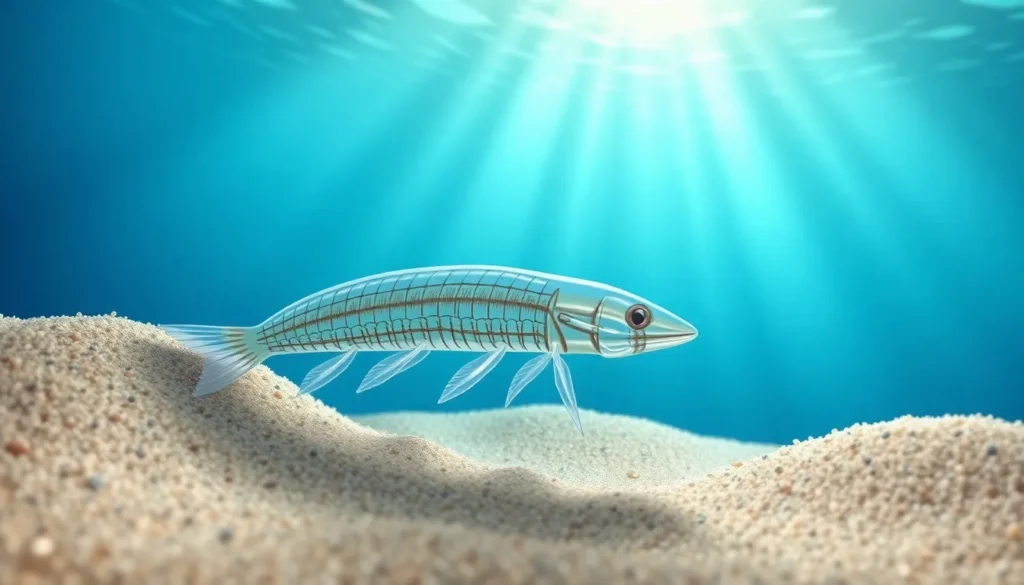
- Lancelets are small, typically ranging from 2 to 7 centimeters in length. Their slender, translucent bodies resemble blades or lancets, which gives them their common name.
- They have segmented muscles called myomeres. These V-shaped muscle blocks enable their undulating swimming motion.
- Lancelets lack a true head and paired fins. Their body plan is simple and elongated without the specialized structures seen in fish.
- Lancelets feed by filter feeding. They use cilia to draw water into their mouths and trap food particles in mucus on their pharyngeal slits.
- They have numerous pharyngeal slits used for feeding and respiration. These slits allow water to pass while capturing plankton and also facilitate gas exchange.
- Lancelets exhibit a notochord throughout their entire lives. Unlike vertebrates where the notochord is replaced by the vertebral column, lancelets retain it permanently.
- They reproduce sexually, with separate sexes. Fertilization is external, and lancelet larvae resemble miniature adults.
- Lancelets lack a true heart. Instead, blood is circulated by contractile vessels without a chambered heart.
- They have a simple circulatory system without red blood cells. Their blood carries oxygen dissolved in plasma rather than bound to hemoglobin.
- They exhibit a simple excretory system consisting of protonephridia. These structures help remove metabolic wastes from their bodies.
- Lancelets have a primitive immune system. They rely on innate immune responses rather than the adaptive immunity found in vertebrates.
- They inhabit sandy or muddy substrates in shallow marine environments. Lancelets burrow tail-first into the sediment with only their anterior end exposed for feeding.
- Lancelets are widely distributed in tropical and temperate seas around the world. They are often found in coastal waters but generally avoid freshwater habitats.
- The fossil record of lancelets dates back to at least the Cambrian period. This makes them one of the oldest known chordate lineages.
- Lancelets serve as important model organisms in evolutionary biology. Their simple body plan helps scientists understand the origins of vertebrate structures.
- They exhibit a slow locomotion style, primarily through swimming and burrowing. Their movement is achieved by undulating body motions driven by segmented muscles.
- Lancelets are not commercially significant but have ecological roles as filter feeders. They contribute to nutrient cycling in benthic marine ecosystems.
- Despite their simplicity, lancelets possess complex developmental genes. These genes reveal the evolutionary conservation of key regulatory pathways in chordates.
Habitat and Behavior
Lancelets are marine animals typically found in shallow coastal waters, often buried in sandy or muddy substrates. They prefer temperate and tropical regions where they can partially bury themselves tail-first in sediment while keeping their anterior end exposed. This positioning allows them to filter plankton and organic particles from passing water using their pharyngeal slits. Lancelets swim by undulating their body in a wave-like motion generated by their segmented muscles, but they are generally slow movers, relying mostly on burrowing and minimal swimming to avoid predators. Their filter-feeding behavior plays a role in the benthic ecosystem by cycling nutrients and maintaining water clarity.
Why This Animal Matters
Lancelets hold significant scientific importance due to their position as one of the most primitive chordates, providing key insights into vertebrate evolution. Their simple morphology and retention of ancestral traits make them important model organisms for studying the development and genetics underlying complex vertebrate features. Ecologically, lancelets contribute to marine benthic environments by filtering organic particles, thus supporting nutrient cycles. While they have no direct commercial value, their conservation helps maintain the integrity of coastal ecosystems. Understanding lancelets also helps clarify evolutionary relationships among chordates, aiding both biological research and education.
Common Misconceptions
Misconception: Lancelets are fish.
Correction: Although lancelets share some features with fish, such as a notochord and dorsal nerve cord, they lack true vertebrae, paired fins, and other defining characteristics of fish.
Misconception: Lancelets have a backbone.
Correction: Lancelets possess a notochord, a flexible rod-like structure, but do not have a true vertebral column or backbone.
Misconception: Lancelets are closely related to worms.
Correction: Despite a superficial resemblance to worms, lancelets belong to the phylum Chordata, whereas worms are distributed among several unrelated phyla.
FAQ
What are lancelets?
Lancelets are small, fish-like marine animals classified in the subphylum Cephalochordata. They possess primitive chordate features such as a notochord and dorsal nerve cord but lack a true backbone.
Where do lancelets live?
Lancelets typically inhabit shallow coastal waters, burrowing into sandy or muddy substrates where they filter feed by drawing water through their pharyngeal slits.
Why are lancelets important to science?
Lancelets provide valuable insights into the evolutionary origins of vertebrates due to their retention of primitive features and simple body plan, making them key model organisms in developmental and evolutionary biology.





Leave a Reply