
Short Answer
21 Facts About Saber-toothed Tigers
- Not true tigers: Despite their common name, saber-toothed tigers were not closely related to modern tigers but belonged to a distinct group of prehistoric carnivores known as machairodontine felids.
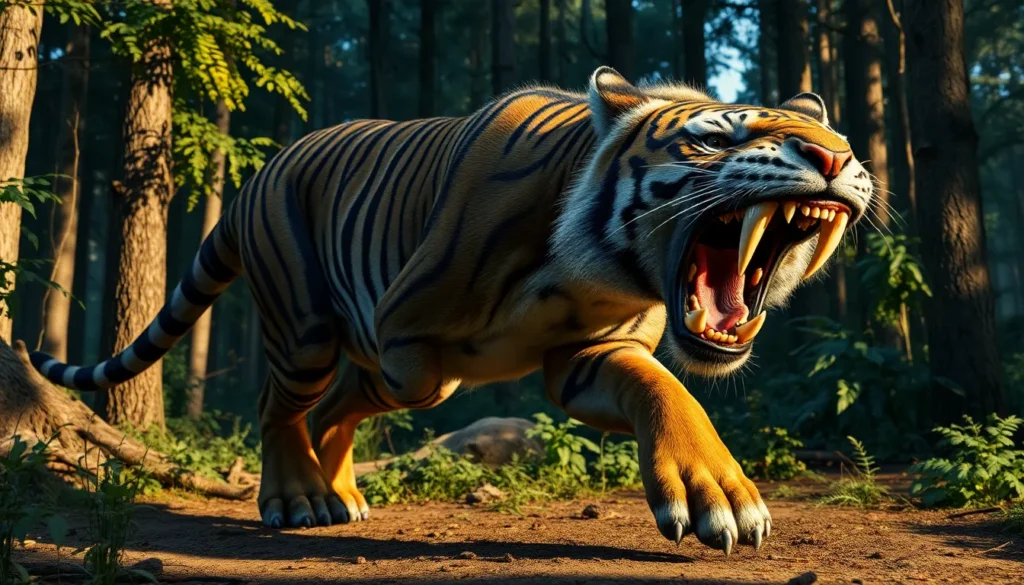
- Long upper canine teeth: Their most notable feature was their elongated, curved canine teeth, which could grow up to 7 inches (18 cm) long, used primarily for hunting large prey.
- Multiple species: Saber-toothed cats were diverse, with more than 40 different species identified, including the famous Smilodon genus.
- Time period: They lived from the Eocene epoch (about 56 million years ago) to the end of the Pleistocene epoch (around 10,000 years ago).
- Geographic range: Saber-toothed tigers inhabited parts of North and South America, Eurasia, and Africa, adapting to various environments.
- Robust build: Unlike modern big cats, many saber-toothed species had stocky, muscular bodies designed for power rather than speed.
- Strong forelimbs: Their forelimbs were particularly strong, facilitating grappling and subduing prey before delivering a killing bite.
- Hunting technique: They likely used their powerful jaws and canine teeth to deliver precise, fatal bites to the neck or throat of prey animals.
- Prey preference: Saber-toothed cats primarily hunted large herbivores such as mammoths, mastodons, and giant ground sloths.
- Social behavior: Some evidence suggests that certain species, like Smilodon, may have lived and hunted in social groups, though this remains debated.
- Extinction: Most saber-toothed cats went extinct around 10,000 years ago, possibly due to climate change and the disappearance of their prey.
- Fossil record: Their fossils are well-preserved in sites like the La Brea Tar Pits in California, offering valuable insights into their life and extinction.
- Jaw mechanics: Their jaws could open extremely wide, up to 120 degrees, allowing space for their long canine teeth when biting.
- Not scavengers: Unlike some misconceptions, saber-toothed tigers were active predators rather than scavengers.
- Brain size: Relative to body size, saber-toothed cats had smaller braincases compared to modern big cats, suggesting different hunting strategies.
- Sexual dimorphism: Some species exhibited sexual dimorphism, with males being larger or having more pronounced canine teeth than females.
- Coexistence with humans: Early humans and saber-toothed tigers coexisted in some regions, though interactions remain poorly understood.
- Popular culture: Saber-toothed tigers have become iconic prehistoric animals often featured in films, literature, and art.
- Scientific classification: They belong to the subfamily Machairodontinae within the Felidae family.
- Dietary habits: They were obligate carnivores, relying entirely on meat for sustenance.
- Legacy in evolution: Saber-toothed cats represent a unique evolutionary experiment in carnivore morphology, illustrating the diversity of prehistoric life.
Habitat and Behavior
Saber-toothed tigers inhabited a range of environments including forests, grasslands, and open plains across multiple continents. Their robust bodies and strong forelimbs suggest they were ambush predators that relied on stealth and power rather than endurance running. They hunted large herbivorous mammals, using their saber-like teeth to inflict deep, disabling wounds. Fossil evidence from sites such as the La Brea Tar Pits indicates that at least some species may have lived in social groups, possibly cooperating to hunt or care for young. However, the full extent of their social behavior remains subject to ongoing research. Their extinction coincided with climatic shifts at the end of the last Ice Age and the decline of megafaunal prey species.
Why This Animal Matters
Saber-toothed tigers play an important role in understanding prehistoric ecosystems and the evolution of carnivorous mammals. They exemplify how specialized adaptations can arise to exploit particular ecological niches. Their fossils provide insights into predator-prey dynamics of the Pleistocene epoch and the impact of environmental changes on large predators. Culturally, saber-toothed tigers have fascinated humans for centuries, symbolizing prehistoric wilderness and the concept of extinction. Studying them helps paleontologists and evolutionary biologists trace the lineage and diversity of the Felidae family and informs conservation biology by illustrating species’ responses to environmental pressures.
Common Misconceptions
Misconception: Saber-toothed tigers were direct ancestors of modern tigers.
Correction: Saber-toothed tigers belonged to a separate lineage of felids and are not direct ancestors of modern tigers or other big cats.
Misconception: Saber-toothed tigers used their long canine teeth for defense.
Correction: Their elongated canines were primarily hunting tools designed to deliver killing bites rather than for defense against predators or rivals.
Misconception: Saber-toothed tigers were fast runners like modern big cats.
Correction: Their build suggests they were ambush predators relying on strength and stealth, not pursuit speed.
Misconception: All saber-toothed cats looked like the popular Smilodon.
Correction: There was considerable diversity among saber-toothed cats, with variations in size, shape, and hunting adaptations.
Misconception: Saber-toothed tigers went extinct solely because of human hunting.
Correction: While human activity may have contributed, climate change and loss of prey also played significant roles in their extinction.
FAQ
Were saber-toothed tigers related to modern tigers?
No, saber-toothed tigers belonged to a different subfamily (Machairodontinae) and are not direct ancestors of modern tigers or other big cats.
Why did saber-toothed tigers have such long canine teeth?
Their elongated canine teeth were specialized hunting tools used to deliver fatal bites to large prey, likely targeting the throat or neck to quickly immobilize animals.
Did saber-toothed tigers live in groups?
Some evidence, such as fossil assemblages and healed injuries, suggests that certain species like Smilodon may have exhibited social behavior, but this is still debated among scientists.




Leave a Reply