
Short Answer
21 Facts About Tuataras
- Ancient lineage: Tuataras are often described as “living fossils” because their lineage dates back to the Mesozoic era, around 200 million years ago, making them one of the oldest surviving reptile groups.
- Not true lizards: Although tuataras resemble lizards, they belong to a distinct order called Rhynchocephalia, which diverged from lizards and snakes over 200 million years ago.
- Third eye: Tuataras possess a parietal eye on the top of their head, a light-sensitive organ that is visible in hatchlings but becomes covered by scales in adults. It helps regulate circadian rhythms and hormone production.
- Slow growth and longevity: Tuataras grow very slowly and can live for over 100 years in the wild.
- Temperature-dependent sex determination: The sex of tuatara hatchlings is determined by the incubation temperature of their eggs, with warmer temperatures typically producing males and cooler temperatures females.
- Cold tolerance: Tuataras can remain active at lower temperatures than most reptiles, even being active in temperatures as low as 5°C (41°F).
- No external ears: They lack external ear openings, relying on vibrations and ground conduction to detect sounds.
- Unique teeth structure: Tuataras have two rows of teeth on the upper jaw overlapping a single row on the lower jaw, allowing them to shear food effectively.
- Diet: They are carnivorous, feeding on insects, spiders, small lizards, birds’ eggs, and hatchlings.
- Slow reproduction: Females lay eggs only once every 2 to 5 years, with incubation periods lasting about 12 to 15 months.
- Restricted habitat: Tuataras are native only to New Zealand and primarily inhabit offshore islands where they are protected from introduced predators.
- Nocturnal and crepuscular activity: They are mostly active at night or during twilight hours, which helps them avoid predators and extreme temperatures.
- Territorial behavior: Male tuataras establish and defend territories, particularly during the breeding season.
- Conservation status: Tuataras are classified as vulnerable due to habitat loss and introduced predators such as rats and cats.
- Unique reproductive system: Unlike most reptiles, tuataras have a cloaca but lack a copulatory organ; males reproduce via cloacal apposition.
- Slow metabolism: Their metabolism is unusually slow, which correlates with their slow growth and long lifespan.
- Role in Maori culture: Tuataras hold cultural significance for the indigenous Maori people of New Zealand, symbolizing longevity and resilience.
- Scientific importance: Tuataras provide valuable insight into reptilian evolution and ancient ecosystems due to their primitive characteristics.
- Fossil record: Fossils of tuatara ancestors have been found worldwide, indicating their once extensive distribution before becoming restricted to New Zealand.
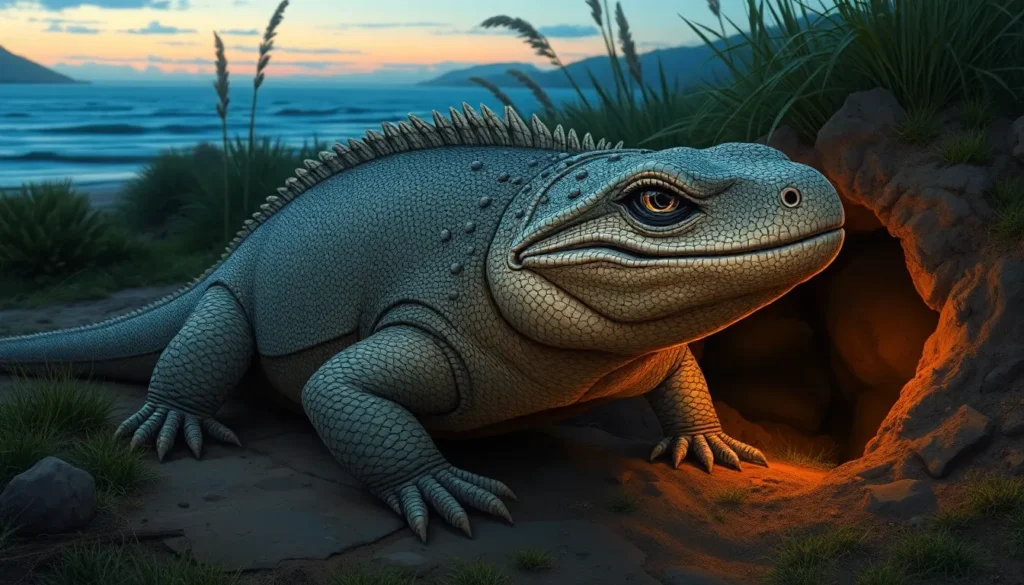
- Adaptations for burrowing: Tuataras dig burrows to shelter and regulate temperature, often sharing them with seabirds.
- Population monitoring: Conservationists closely monitor tuatara populations to ensure their survival and manage recovery efforts.
Habitat and Behavior
Tuataras are endemic to New Zealand, primarily inhabiting offshore islands where introduced mammalian predators are absent. Their habitat consists of coastal forests, scrublands, and rocky areas where they can burrow and find shelter. Tuataras are mostly nocturnal or active during low light periods, which helps them avoid predation and harsh environmental conditions. They are territorial animals, especially males during breeding season, and communicate through body language such as head bobbing and territorial displays. With a carnivorous diet, tuataras prey on insects, spiders, small lizards, and bird eggs. Their ability to tolerate low temperatures allows them to remain active in cooler climates compared to most reptiles. Slow growth, delayed sexual maturity, and infrequent reproduction characterize their life history, factors that influence their population dynamics and conservation needs.
Why This Animal Matters
Tuataras are ecologically significant as one of the few surviving members of an ancient reptile lineage, offering a unique window into reptilian evolution. They play a role as both predator and prey within their island ecosystems, helping control insect and small vertebrate populations. Culturally, tuataras are important to New Zealand’s Maori heritage, symbolizing endurance and natural heritage. Conservation-wise, tuataras are vulnerable due to habitat loss and invasive species, making them a focus of preservation efforts that highlight the importance of protecting native biodiversity. Their survival and continued study contribute to understanding evolutionary biology, climate adaptability, and the impacts of human activity on isolated ecosystems.
Common Misconceptions
Misconception: Tuataras are lizards.
Correction: Tuataras are not true lizards; they belong to a separate and ancient order of reptiles called Rhynchocephalia, distinct from lizards and snakes.
Misconception: Tuataras are extinct or only known from fossils.
Correction: Tuataras are extant reptiles still living in New Zealand, although they have a very limited distribution compared to their ancient relatives.
Misconception: Tuataras have a third eye that functions like a normal eye.
Correction: The parietal “third eye” is a light-sensitive organ used mainly for regulating biological rhythms and hormone production, not for vision.
Misconception: Tuataras reproduce every year.
Correction: Female tuataras reproduce infrequently, typically every 2 to 5 years, with a long incubation period for eggs.
Misconception: Tuataras are active only in warm weather.
Correction: Tuataras are adapted to cooler temperatures and can be active at temperatures as low as 5°C (41°F), which is unusual for reptiles.
FAQ
Are tuataras endangered?
Tuataras are classified as vulnerable due to their limited distribution and threats from introduced predators. Conservation efforts focus on protecting habitats and controlling invasive species.
How long do tuataras live?
Tuataras can live for over 100 years, making them one of the longest-lived reptiles.
Do tuataras have a third eye?
Yes, tuataras possess a parietal eye on the top of their heads, which is light-sensitive and helps regulate their circadian rhythms but does not function like a typical eye.



Leave a Reply