
Short Answer
21 Facts About Naked Mole Rats
- They are nearly hairless. Naked mole rats have very little hair, which gives them their distinctive appearance and name.
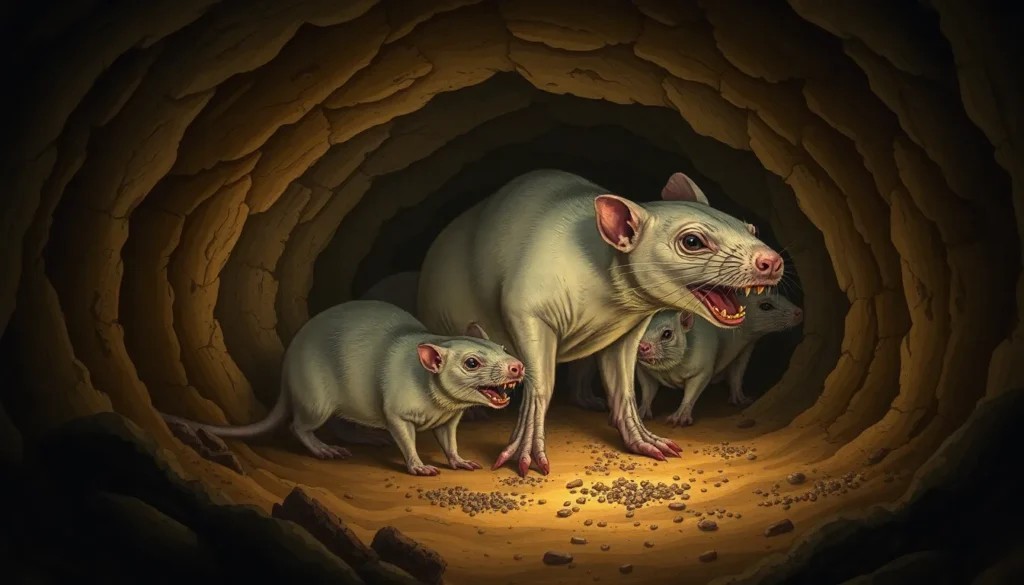
- They live underground. These rodents are fossorial, spending most of their lives in complex underground tunnel systems.
- They are eusocial animals. Naked mole rats have a social structure similar to that of some insects, with a single breeding queen and non-reproductive workers.
- They have a very long lifespan for rodents. They can live up to 30 years, much longer than typical rodents of comparable size.
- They show resistance to cancer. Naked mole rats exhibit a remarkable resistance to cancer, which has been a subject of scientific research.
- They have low metabolic rates. Their metabolism is slower than many other small mammals, which helps them survive in low-oxygen environments.
- They can survive low oxygen conditions. Naked mole rats can tolerate environments with very low oxygen levels that would be lethal to most mammals.
- They maintain stable body temperature. Unlike most mammals, naked mole rats are poikilothermic, meaning their body temperature varies with the environment.
- They have specialized teeth. Their large incisors protrude outside their mouths and are used for digging without ingesting soil.
- They communicate through vocalizations. Naked mole rats use a variety of sounds to communicate within their colonies.
- They practice cooperative breeding. Only the queen and a few males reproduce, while others assist in colony maintenance and care for young.
- They are native to East Africa. Their natural range includes parts of Kenya, Ethiopia, and Somalia.
- They feed primarily on tubers. Naked mole rats consume underground tubers, which they harvest and cultivate within their tunnels.
- They have poor vision. Living underground, they rely more on tactile and auditory senses than on sight.
- They display remarkable pain insensitivity. They are less sensitive to certain types of pain, such as acid and capsaicin-induced pain.
- They have a low heart rate. Their heart rate is significantly lower than that of other rodents of similar size.
- They reproduce slowly. The queen produces relatively few offspring compared to other rodents, but colony survival depends on cooperative care.
- They are used in aging and cancer research. Due to their longevity and cancer resistance, naked mole rats are important model organisms in scientific studies.
- They have a high tolerance for carbon dioxide. Their burrows can have elevated CO2 levels, which they can endure better than many mammals.
- They are considered a keystone species. Their burrowing activity influences soil structure and ecosystem health.
- They exhibit unique social grooming behaviors. Grooming helps maintain colony hygiene and social bonds.
Habitat and Behavior
Naked mole rats inhabit arid and semi-arid regions of East Africa, where they live in underground colonies within extensive tunnel networks. These tunnels protect them from predators and harsh environmental conditions. Their social structure is highly organized and eusocial, with a single breeding queen and a caste system of workers that maintain the colony, forage for food, and care for the young. Being subterranean, they have adapted to low oxygen and high carbon dioxide environments by evolving low metabolic rates and specialized respiratory and cardiovascular systems. They primarily feed on underground tubers and roots, which they cultivate and harvest without destroying the entire plant, ensuring a sustainable food source. Communication among colony members occurs through a complex system of vocalizations and tactile signals, facilitating cooperation and coordination of their daily activities.
Why This Animal Matters
Naked mole rats play an important ecological role by aerating soil through their extensive burrowing, which improves soil quality and promotes nutrient cycling. Their unique biology, including cancer resistance and longevity, makes them valuable models for scientific research, particularly in studies of aging, pain, hypoxia tolerance, and cancer biology. Understanding their physiological adaptations may contribute to medical advances for humans. Additionally, their social structure provides insight into the evolution of eusociality outside of insects. Conservation-wise, while they are not currently endangered, their specialized habitat requirements make them sensitive to environmental changes, highlighting the importance of habitat preservation.
Common Misconceptions
Misconception: Naked mole rats are blind.
Correction: Although their eyesight is poor due to living underground, naked mole rats are not completely blind and can detect light and dark.
Misconception: They are completely hairless.
Correction: Despite their name, naked mole rats have sparse, fine hairs distributed over their bodies.
Misconception: All members of the colony reproduce.
Correction: Only the queen and a few select males reproduce; the rest of the colony members are non-reproductive workers.
Misconception: Naked mole rats are rodents like mice or rats in behavior.
Correction: While they are rodents taxonomically, their social structure and physiological adaptations are highly specialized and differ significantly from typical rodents.
Misconception: They are pests or harmful animals.
Correction: Naked mole rats rarely come into contact with humans and play beneficial roles in their ecosystems.
FAQ
Why are naked mole rats considered eusocial?
Naked mole rats live in colonies with a single breeding queen and a caste system where non-breeding individuals cooperate in tasks such as foraging and caring for the young, similar to social insects like bees and ants.
How do naked mole rats survive in low oxygen environments?
They have adapted with a low metabolic rate, efficient oxygen utilization, and tolerance to high carbon dioxide levels, allowing them to live in poorly ventilated underground burrows.
What makes naked mole rats resistant to cancer?
Research suggests that naked mole rats have unique cellular mechanisms, including early contact inhibition and production of high-molecular-mass hyaluronan, which prevent uncontrolled cell growth and tumor formation.





Leave a Reply