
Short Answer
21 Facts About Hoverflies
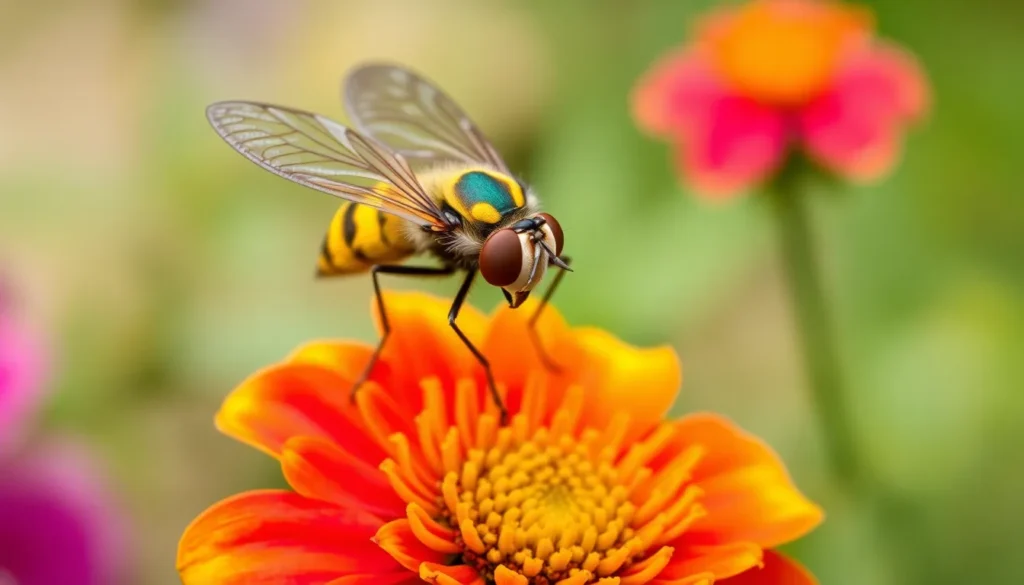
- Hoverflies belong to the family Syrphidae. They are a large family of flies characterized by their ability to hover in mid-air.
- Many hoverflies mimic bees and wasps. This mimicry is a defensive adaptation to avoid predators by resembling stinging insects.
- Hoverflies are beneficial pollinators. They visit flowers to feed on nectar and pollen, contributing significantly to pollination in various ecosystems.
- They are found worldwide. Hoverflies inhabit diverse environments across all continents except Antarctica.
- Hoverflies have large compound eyes. Their eyes provide a wide field of vision, aiding in navigation and locating flowers.
- The larvae of many hoverfly species are aphid predators. This makes them natural pest controllers in gardens and agriculture.
- Some hoverfly larvae are aquatic. They live in water or moist environments and feed on decaying organic matter.
- Hoverflies exhibit remarkable flight skills. They can hover, fly backward, and make rapid directional changes.
- Adult hoverflies feed on nectar and pollen. This diet provides energy for flight and protein for reproduction.
- Hoverfly larvae have diverse feeding habits. Depending on the species, they can be predators, saprophages, or plant feeders.
- Hoverflies play a role in the biological control of pests. Their larvae often consume aphids, thrips, and other soft-bodied insects harmful to crops.
- The mimicry of hoverflies is an example of Batesian mimicry. Harmless hoverflies gain protection by imitating more dangerous insects.
- Hoverflies have short life cycles. This allows rapid population growth in favorable conditions.
- They have a complete metamorphosis. Their life stages include egg, larva, pupa, and adult.
- Hoverflies contribute to ecosystem biodiversity. They serve as prey for birds and other insects while maintaining plant pollination.
- Some hoverfly species exhibit migratory behavior. They travel significant distances seasonally to find suitable habitats.
- Hoverflies are often used as indicators of environmental health. Their presence and diversity can reflect habitat quality.
- The name “hoverfly” comes from their ability to hover. They can remain motionless in the air unlike many other flies.
- Hoverflies have diverse coloration patterns. These patterns help them blend into their environments or mimic other insects.
- They are generally harmless to humans. Unlike bees or wasps, hoverflies do not sting or bite.
- Hoverflies have been observed using flowers’ UV patterns for navigation. This helps them efficiently locate nectar sources.
Habitat and Behavior
Hoverflies occupy a wide range of habitats including gardens, forests, wetlands, meadows, and agricultural fields. They are highly adaptable and can be found from sea level to mountainous regions. Adult hoverflies are diurnal and are often seen hovering near flowers, where they feed on nectar and pollen. The larvae display varied behavior depending on the species; some are voracious predators of aphids and other pests, while others feed on decaying plant material or live in aquatic environments. Hoverflies exhibit complex flight maneuvers, enabling them to hover and dart quickly, which aids in feeding and avoiding predators. Seasonal migration is noted in certain species, particularly those in temperate regions.
Why This Animal Matters
Hoverflies play a crucial ecological role primarily through pollination, supporting the reproduction of many flowering plants and thus contributing to biodiversity and crop production. Their larvae provide natural pest control by consuming aphids and other harmful insects, reducing the need for chemical pesticides. Hoverflies also serve as an important food source for birds, spiders, and other predators, integrating them into the food web. Additionally, their sensitivity to environmental changes makes them valuable bioindicators for monitoring ecosystem health. Hoverflies have cultural significance in some regions as symbols of mimicry and harmlessness, and their presence often encourages interest in insect diversity and conservation.
Common Misconceptions
Misconception: Hoverflies can sting like bees or wasps.
Correction: Hoverflies do not have stingers and are completely harmless to humans. Their resemblance to stinging insects is purely a defensive mimicry.
Misconception: All hoverfly larvae feed on aphids.
Correction: While many larvae are aphid predators, others have different diets, including feeding on decaying matter or living in aquatic environments.
Misconception: Hoverflies are just another type of bee.
Correction: Hoverflies are true flies (order Diptera), not bees (order Hymenoptera), despite their similar appearance.
Misconception: Hoverflies only live in warm climates.
Correction: Hoverflies inhabit diverse climates worldwide, including temperate and cooler regions.
FAQ
Do hoverflies sting or bite humans?
No, hoverflies do not have stingers and do not bite humans. They are harmless and rely on mimicry to deter predators.
How can you tell a hoverfly apart from a bee?
Hoverflies have only one pair of wings (typical of flies), large compound eyes, and lack the hairy bodies and stingers characteristic of bees.
Why are hoverflies important for gardens?
Hoverflies pollinate flowers and their larvae often feed on pest insects like aphids, making them beneficial for maintaining garden health.


Leave a Reply