
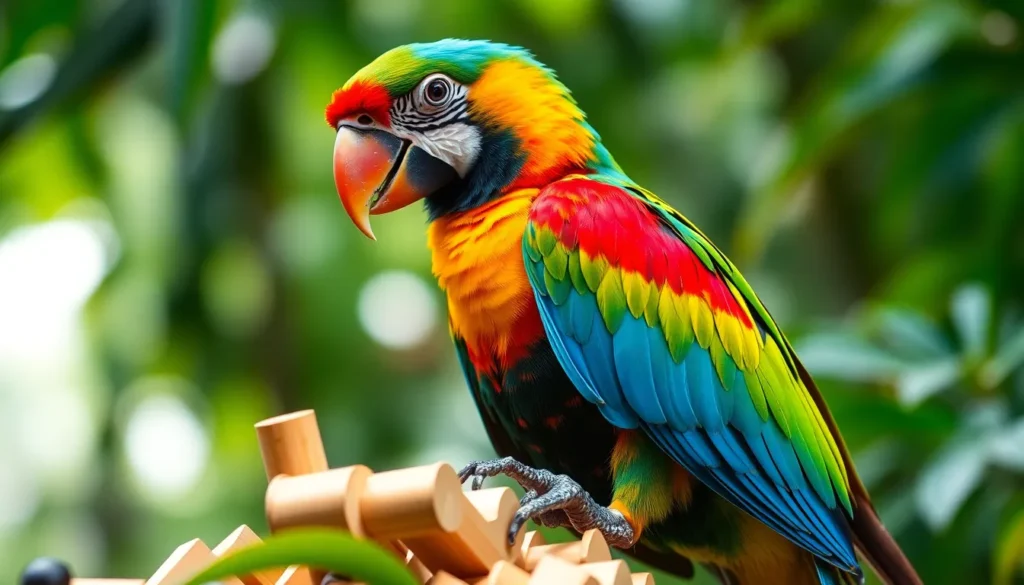
Short Answer
21 Facts About Problem-Solving in Parrots
- Parrots exhibit advanced cognitive skills. They can understand cause and effect relationships, allowing them to solve complex problems.
- Use of tools is documented in some parrot species. For example, the palm cockatoo uses sticks to drum on tree trunks as a form of communication, which indicates a level of tool manipulation.
- Parrots can solve puzzles involving multiple steps. Experiments show they can complete sequences of actions to achieve a desired result, such as opening a container to access food.
- They demonstrate insight learning. Unlike trial-and-error learning, parrots sometimes solve novel problems suddenly without prior experience.
- Some parrots use their beaks and feet in coordinated ways. This coordination helps in manipulating objects to solve tasks.
- Parrots can remember solutions to problems over long periods. This long-term memory enhances their ability to apply learned problem-solving strategies.
- They show flexibility in problem-solving. When one approach fails, parrots can try alternative methods to reach a goal.
- Parrots can learn by observation. They sometimes acquire problem-solving techniques by watching other parrots or even humans.
- Social context influences problem-solving. Parrots in groups may collaborate or learn socially, improving their problem-solving success.
- Parrots can understand abstract concepts. Some studies suggest they grasp concepts like same/different or numerical quantity, which support problem-solving.
- They display curiosity-driven problem-solving. Parrots often investigate new objects or environments, which supports learning and adaptation.
- Vocal learning and mimicry relate to cognitive abilities. Their capacity to imitate sounds is linked to neural complexity that also supports problem-solving.
- Parrots’ problem-solving is not uniform across species. Different species show varying levels of complexity in cognitive tasks.
- Some parrots use causal reasoning. They appear to understand how their actions influence outcomes rather than relying solely on associative learning.
- Problem-solving skills help parrots in foraging. They can extract food from difficult-to-access places using learned techniques.
- They can solve problems involving physical barriers. Parrots have been observed moving objects or manipulating locks to access resources.
- Parrots’ intelligence has been compared to that of primates. Though different in nature, their problem-solving abilities are considered highly advanced among birds.
- Environmental enrichment in captivity enhances problem-solving. Providing puzzles and challenges improves parrots’ cognitive health.
- Parrots’ problem-solving may involve emotional components. They can show frustration or persistence when faced with difficult tasks.
- Research on parrots contributes to understanding animal intelligence. Studying their problem-solving informs broader questions about cognition across species.
- Conservation efforts benefit from understanding parrots’ cognitive needs. Recognizing their intelligence helps design better habitats and care strategies.
Habitat and Behavior
Parrots are primarily found in tropical and subtropical regions, inhabiting forests, savannas, and grasslands across continents such as South America, Africa, Asia, and Australasia. They are highly social birds, often living in flocks, which facilitates social learning and communication. Their behaviors include vocal mimicry, complex mating rituals, and foraging strategies that demonstrate their intelligence. Parrots use their strong beaks and dexterous feet to manipulate objects, aiding in feeding and problem-solving. They are generally diurnal and rely on their cognitive skills to adapt to changing environments, find food, avoid predators, and interact within their social groups.
Why This Animal Matters
Parrots play significant ecological roles as seed dispersers and pollinators, contributing to forest regeneration and biodiversity maintenance. Their intelligence and social behaviors have made them subjects of scientific study, revealing insights about avian cognition and evolution. Culturally, parrots have symbolic value in various societies and are popular in aviculture due to their vibrant colors and mimicry abilities. From a conservation perspective, many parrot species face threats from habitat loss and the pet trade, making understanding their cognitive needs crucial for effective conservation strategies and welfare in captivity.
Common Misconceptions
Misconception: Parrots simply mimic sounds without understanding.
Correction: While parrots are skilled mimics, research shows they can associate sounds with meanings and use vocalizations contextually, indicating comprehension beyond mere imitation.

Misconception: All parrots have the same cognitive abilities.
Correction: Cognitive skills vary widely among parrot species, influenced by ecological niches, social structures, and evolutionary history.
FAQ
How do parrots solve problems involving tools?
Certain parrot species show the ability to select, modify, and use tools to achieve goals such as accessing food or communicating. This involves understanding the properties of objects and the steps required to use them effectively.
Are all parrots equally intelligent?
No, intelligence and problem-solving abilities vary among parrot species depending on ecological demands and evolutionary history. Some species exhibit more complex behaviors and cognitive skills than others.
Can parrots learn problem-solving skills from humans?
Parrots can learn by observing humans, especially in captive or research settings, which demonstrates their social learning capacity and adaptability to novel tasks.




Leave a Reply