
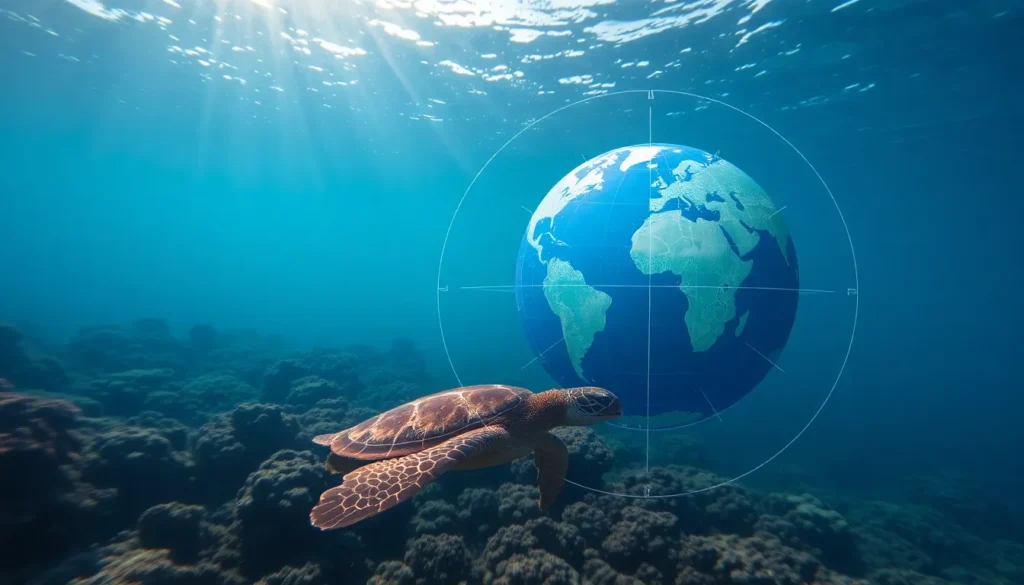
Short Answer
21 Facts About Sea Turtle Navigation
- Magnetic Field Detection
Sea turtles can detect the Earth’s magnetic field, using it as a natural compass to orient themselves during long-distance migrations. - Magnetic Imprinting
Hatchlings imprint on the magnetic signature of their natal beach, which helps adults return to the same location years later to nest. - Use of Celestial Cues
Sea turtles may use the position of the sun and moon to help navigate during their oceanic journeys. - Wave Orientation
Young turtles use the direction of ocean waves to orient themselves when entering the sea after hatching. - Olfactory Navigation
Some evidence suggests turtles use their sense of smell to detect chemical cues from coastal waters related to their nesting sites. - Inherited Navigational Skills
Navigation abilities in sea turtles have a genetic component, with hatchlings instinctively moving toward the ocean upon emerging from nests. - Long-Distance Migrations
Sea turtles travel thousands of kilometers between feeding grounds and nesting beaches, demonstrating exceptional navigational precision. - Use of Visual Landmarks
When close to shore, turtles can recognize visual landmarks to assist in locating nesting beaches. - Multiple Navigation Mechanisms
Sea turtles combine several navigational cues, including magnetic, olfactory, and visual information, to ensure accuracy. - Magnetic Map Sense
Turtles appear to have a magnetic map sense that allows them to detect both the intensity and inclination angle of Earth’s magnetic field to determine their geographic location. - Orientation Experiments
Scientific studies have shown that altering magnetic fields can disrupt turtle navigation, confirming their reliance on geomagnetic cues. - Learning Over Time
While some navigation is innate, turtles may refine their migratory routes with experience over their lifespan. - Hatchling ‘Swim Frenzy’
After emerging, hatchlings swim continuously in a frenzy for hours to reach open water, using environmental cues to orient outward. - Influence of Ocean Currents
Sea turtles take advantage of prevailing ocean currents to facilitate long-distance travel and conserve energy. - Role of Star Navigation
Though less studied, some research suggests turtles might use star patterns to aid nocturnal navigation. - Impact of Human Activity
Artificial lights near nesting beaches can disorient hatchlings, interfering with their natural navigation toward the sea. - Magnetic Anomalies
Areas with unusual magnetic fields can confuse turtles and alter their migration paths. - Temperature Influence
Temperature gradients may provide additional environmental information that affects turtle behavior during migrations. - Return to Natal Beach
Adult females exhibit strong site fidelity, returning to the beach where they hatched to lay eggs. - Multi-Species Navigation Differences
Different sea turtle species show variations in navigation strategies depending on their habitats and migratory distances. - Navigation Research Importance
Understanding sea turtle navigation helps in conservation efforts to protect critical habitats and migratory corridors.
Habitat and Behavior
Sea turtles inhabit tropical and subtropical oceans worldwide, often migrating between feeding grounds and nesting beaches separated by thousands of kilometers. They spend most of their lives in the ocean, coming ashore primarily to nest. Their behavior includes long-distance migration, deep diving, and seasonal movements influenced by water temperature and food availability. Navigation is crucial to these behaviors, enabling turtles to locate specific beaches for reproduction and to find productive feeding areas. They survive by feeding on a range of marine life, including jellyfish, seagrasses, and crustaceans, depending on the species.
Why This Animal Matters
Sea turtles play an essential ecological role by maintaining healthy seagrass beds and coral reefs, which benefits other marine species. Their nesting activity helps stabilize beach ecosystems. Culturally, sea turtles are significant in many coastal communities as symbols of endurance and navigation. Conservation of sea turtles is vital, as many species face threats from habitat loss, pollution, and fishing bycatch. Understanding their navigation mechanisms supports efforts to mitigate human impacts and preserve their migratory routes and nesting sites.
Common Misconceptions
Misconception: Sea turtles navigate solely by instinct without any environmental cues.
Correction: Sea turtles use a combination of innate abilities and environmental cues such as the Earth’s magnetic field, wave direction, and chemical signals to navigate.

Misconception: All sea turtles return to the exact same nest every year.
Correction: While females show strong site fidelity to their natal beaches, they do not necessarily return to the exact same nest but generally nest within the same local area.
Misconception: Sea turtles rely only on magnetic fields for navigation.
Correction: Although magnetic fields are crucial, sea turtles integrate multiple sensory inputs, including visual and chemical cues, to navigate effectively.
FAQ
How do sea turtles find their way back to the same beach?
Sea turtles use a combination of geomagnetic cues, such as the Earth's magnetic field intensity and inclination angle, along with environmental factors like chemical signals and visual landmarks, to locate their natal beaches for nesting.
Can human activities affect sea turtle navigation?
Yes, artificial lighting near nesting sites can disorient hatchlings, leading them away from the sea. Additionally, magnetic anomalies caused by human infrastructure may interfere with their geomagnetic navigation.
Do all sea turtles use the same navigation methods?
While magnetic navigation is common, different species may rely on varying combinations of navigational cues depending on their environment and migration patterns.



Leave a Reply