
Short Answer
21 Facts About Bilbies
- Bilbies are marsupials. They belong to the family Thylacomyidae and carry their young in pouches like kangaroos and koalas.
- There are two species of bilbies. The greater bilby (Macrotis lagotis) is the more well-known species, while the lesser bilby (Macrotis leucura) is believed to be extinct since the mid-20th century.
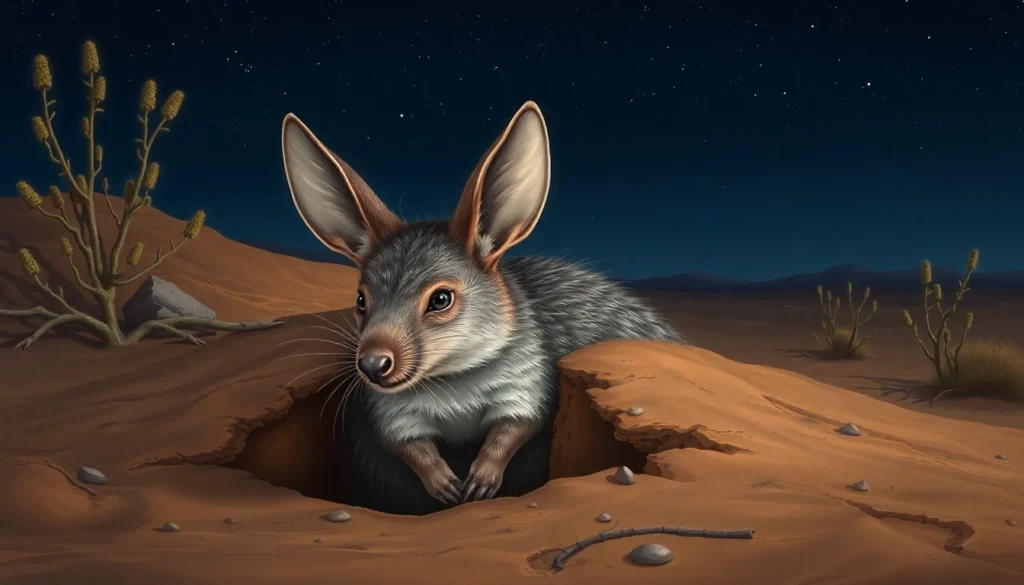
- Bilbies have long, rabbit-like ears. These ears help with thermoregulation, allowing them to dissipate heat in the arid environments they inhabit.
- They are nocturnal animals. Bilbies are active at night to avoid the extreme heat of the Australian daytime and to reduce predation risk.
- Bilbies are omnivorous. Their diet includes insects, seeds, bulbs, fruit, fungi, and small animals.
- They are skilled diggers. Bilbies dig extensive burrow systems that provide shelter, protection, and a cool environment during the day.
- Bilbies use their long ears for hearing. Their acute sense of hearing aids in detecting predators and prey in the dark.
- They have a pointed snout. This helps them forage by probing the soil for insects and roots.
- Bilbies are solitary animals. They primarily live and forage alone, except during mating periods.
- They have a gestation period of about 12–14 days. After birth, the tiny underdeveloped young crawl into the mother’s pouch to continue development.
- Bilbies can live up to 5 years in the wild. Their lifespan is longer in captivity, sometimes reaching up to 10 years.
- They are found mainly in arid and semi-arid regions of Australia. Their habitat includes deserts, grasslands, and open forests.
- Bilbies are important ecosystem engineers. Their digging aerates the soil and helps with seed dispersal and nutrient cycling.
- They face threats from introduced predators. Feral cats, foxes, and habitat destruction have significantly reduced their populations.
- Conservation efforts have increased in recent decades. Programs include captive breeding, reintroduction, and predator control.
- Bilbies are sometimes called “rabbit-bandicoots.” This nickname arises from their physical resemblance to rabbits and bandicoots.
- They have a specialized diet that can include termites. Termites are a significant protein source in their diet.
- Bilbies are mostly silent but may produce soft clicking sounds. These vocalizations are used in communication, especially during mating.
- They are crepuscular as well as nocturnal. Bilbies tend to be most active during the twilight periods of dawn and dusk.
- Bilbies have been culturally significant to Indigenous Australians. They appear in Aboriginal stories and art, reflecting their ecological and cultural importance.
- The Easter Bilby is a conservation symbol. In Australia, the bilby has been promoted as an alternative to the Easter Bunny to raise awareness about native wildlife conservation.
Habitat and Behavior
Bilbies are native to arid and semi-arid regions of Australia, including deserts, dry shrublands, and grasslands. They construct complex burrow systems that provide refuge from extreme temperatures and predators. As nocturnal animals, bilbies emerge at night to forage for a diverse diet consisting of insects, seeds, fungi, and small animals. Their powerful forelimbs and claws allow them to dig effectively, contributing to soil health and aeration. Bilbies generally lead solitary lives, coming together only to mate. They have adapted to survive with limited water, obtaining moisture primarily from their food. Their long ears not only aid in thermoregulation but also help them detect predators and prey, making them well-suited for their harsh environment.
Why This Animal Matters
Bilbies play an important ecological role as ecosystem engineers by digging burrows that improve soil quality and facilitate seed dispersal. Their presence supports biodiversity by maintaining healthy habitats. Culturally, bilbies are significant to Indigenous Australian communities and have become symbols in conservation efforts across Australia. Due to habitat loss and predation by introduced species, bilbies have experienced population declines, making them a focus of conservation programs. Protecting bilbies helps preserve Australia’s unique biodiversity and raises awareness of the broader challenges faced by native wildlife in arid environments.
Common Misconceptions
Misconception: Bilbies are a type of rabbit.
Correction: Although bilbies have rabbit-like ears, they are marsupials, not rabbits. Their reproductive system and biological classification are distinct from rabbits.
Misconception: Bilbies are widespread and common across Australia.
Correction: Bilbies are now restricted to limited arid regions and are considered vulnerable due to habitat loss and introduced predators.
Misconception: Bilbies are related to bandicoots.
Correction: While bilbies and bandicoots are both marsupials and share some similarities, bilbies belong to their own family, Thylacomyidae, separate from bandicoots.
FAQ
What do bilbies eat?
Bilbies are omnivores that primarily feed on insects, seeds, bulbs, fruit, fungi, and occasionally small animals such as termites and ants.
Why are bilbies endangered?
Bilbies face threats from habitat destruction, predation by introduced species like foxes and feral cats, and competition for food resources, leading to population declines.
How do bilbies survive in the desert?
Bilbies survive by being nocturnal to avoid daytime heat, obtaining moisture from their food, and using burrows to shelter from extreme temperatures and predators.




Leave a Reply