
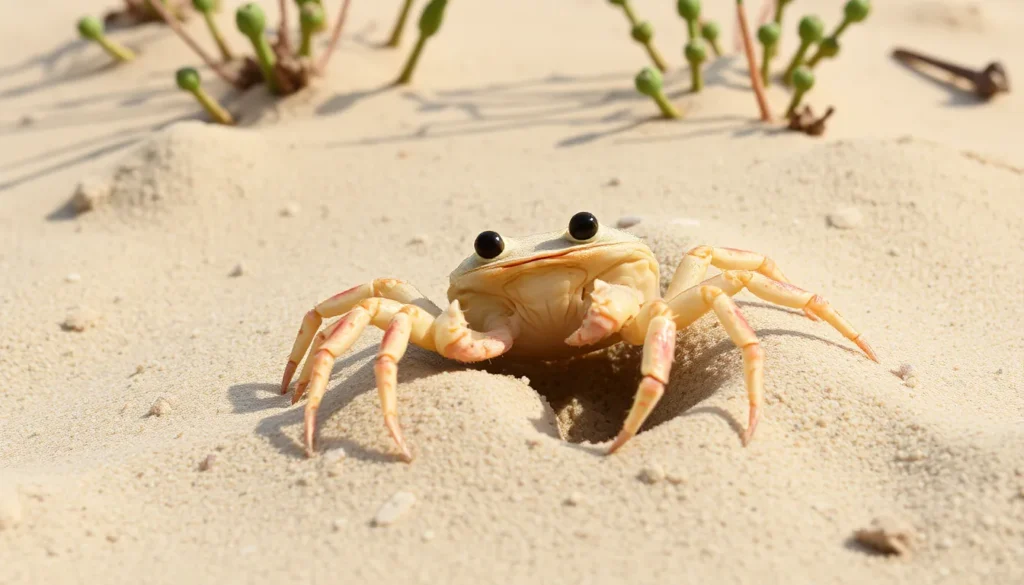
Short Answer
21 Facts About Ghost Crab Burrowing Speed
- Ghost crabs can burrow at impressive speeds.
These crabs are capable of digging at speeds of up to 3 meters per minute under optimal conditions.
- Their burrowing technique is highly efficient.
Ghost crabs utilize their strong claws and legs to swiftly remove sand while creating tunnels, which can be several feet deep.
- Burrowing helps regulate their body temperature.
By digging into the sand, ghost crabs can escape the heat of the sun and maintain a stable body temperature.
- They are primarily nocturnal.
Ghost crabs are more active during the night, which helps them avoid predators and extreme heat while burrowing.
- Burrowing is essential for nesting.
Female ghost crabs dig burrows to lay their eggs, providing a protective environment for the developing young.
- They use their eyes to survey surroundings.
Ghost crabs have large eyes that allow them to spot potential threats while burrowing or foraging.
- Burrow structure varies by environment.
The design of their burrows can differ based on factors like soil type and tidal patterns.
- Ghost crabs communicate while burrowing.
They use visual signals and body language to communicate with other crabs during mating and territorial disputes.
- They can burrow both horizontally and vertically.
Depending on the circumstances, ghost crabs can create extensive horizontal tunnels or deep vertical burrows.
- Burrowing speed can be affected by temperature.
Higher temperatures generally increase their burrowing speed, while cooler temperatures can slow them down.
- Burrows can serve as shelters from predators.
By retreating into their burrows, ghost crabs can evade threats from birds and other predators.
- Juvenile crabs exhibit faster burrowing speeds.
Young ghost crabs tend to burrow faster than adults, possibly due to their smaller size and agility.
- They can re-dig collapsed burrows quickly.
If a burrow collapses, ghost crabs can often restore it in a short amount of time.
- Burrowing behavior varies by species.
Different species of ghost crabs exhibit unique burrowing behaviors and speeds.
- Burrowing is influenced by tidal cycles.
Ghost crabs often time their burrowing activities with the tide, as they are intertidal animals.
- They can travel significant distances to find suitable burrowing sites.
Ghost crabs may cover large areas in search of optimal locations for burrowing.
- Burrowing aids in feeding.
By digging, ghost crabs can access various food sources buried in the sand.
- They exhibit territorial behavior near their burrows.
Ghost crabs are known to defend their burrows against intruders, using their speed and agility.
- Burrowing can impact sand ecosystem dynamics.
Their burrowing activity helps aerate the sand and contributes to the overall health of coastal ecosystems.
- Ghost crabs are an important food source.
They serve as prey for various birds and fish, linking them to broader marine food webs.
- Some ghost crab species are considered invasive.
In certain regions, ghost crabs have been introduced and can negatively impact local ecosystems.
Habitat and Behavior
Ghost crabs inhabit sandy beaches and coastal regions, primarily in tropical and subtropical environments. They are adapted to life above and below the sand, where they create extensive burrows. Their burrowing behavior helps them escape from predators and extreme temperatures. Ghost crabs are known for their agility and speed, which serve as crucial survival traits in their sandy habitats.
Why This Animal Matters
Ghost crabs play a vital role in their ecosystems, contributing to sand aeration and nutrient cycling. They are also an important food source for various predators, including birds and fish. Their burrowing activities help maintain the health of coastal ecosystems, and they are indicators of environmental changes in their habitats.
Common Misconceptions
Misconception: Ghost crabs only burrow during the night.
Correction: While they are primarily nocturnal, ghost crabs can also be seen burrowing during the day, especially in cooler conditions.
Misconception: All ghost crabs have the same burrowing speed.
Correction: Burrowing speed varies among species and is influenced by factors such as age, temperature, and habitat.
FAQ
What do ghost crabs eat?
Ghost crabs are omnivorous and primarily feed on detritus, small invertebrates, and plant material.
How do ghost crabs adapt to their environment?
They have specialized adaptations such as strong limbs for digging and large eyes for spotting predators.
Are ghost crabs endangered?
Most ghost crab species are not considered endangered, but specific populations may face threats from habitat loss and pollution.



Leave a Reply