
Short Answer
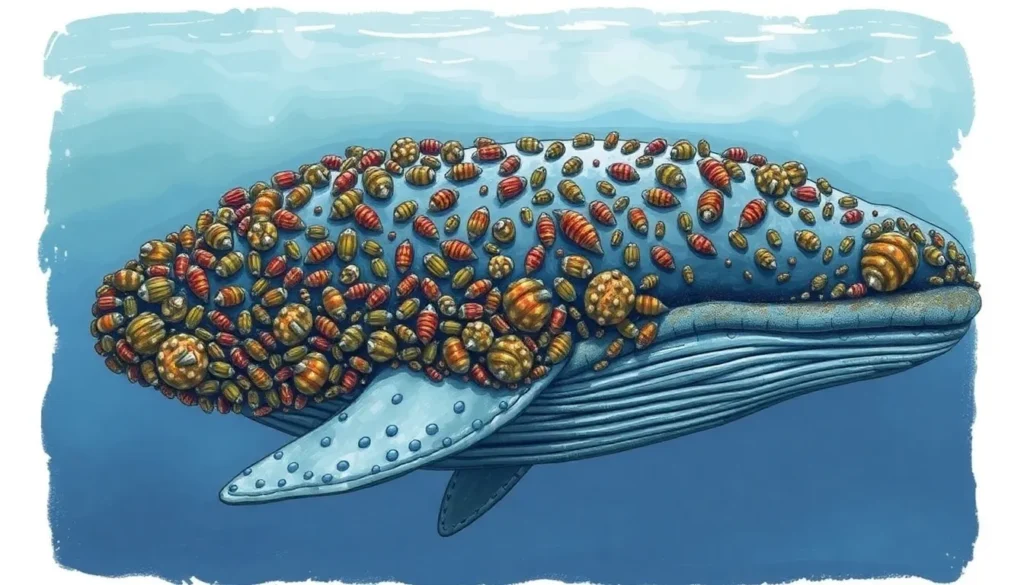
21 Facts About Whale Barnacle Commensalism
- Whale barnacles are crustaceans. They belong to the subclass Cirripedia, which includes barnacles that attach to various substrates, including whales.
- They exhibit a commensal relationship. Whale barnacles benefit from the host whale, gaining access to nutrient-rich waters without harming the whale.
- Whale barnacles can grow quite large. Some species can reach sizes of up to 15 centimeters (6 inches) in diameter.
- They are found on various whale species. Common hosts include humpback whales, gray whales, and blue whales.
- Whale barnacles have specialized appendages. They use their feathery appendages, known as cirri, to filter feed on plankton and other small particles in the water.
- They attach themselves using a strong adhesive. Barnacles secrete a glue-like substance that allows them to firmly attach to the skin of their whale hosts.
- They can live for many years. Some whale barnacles can survive for decades if they remain attached to their hosts.
- Whale barnacle populations can be quite dense. A single whale can host thousands of barnacles, forming dense colonies.
- They do not harm their hosts. Unlike parasites, whale barnacles do not feed on the whale’s tissues or blood.
- Whale barnacles have a limited distribution. They are primarily found in temperate and polar waters, where their host whales migrate.
- They can be indicators of whale health. The presence and condition of barnacle colonies can reflect the health of their host whales.
- Whale barnacles have a complex life cycle. They start as free-swimming larvae before settling on a suitable host.
- They are not closely related to true barnacles. Despite their name, whale barnacles are more closely related to crabs and lobsters.
- Whale barnacles can influence whale behavior. Their weight can affect the buoyancy and swimming patterns of their hosts.
- They have a unique reproductive strategy. Most whale barnacles are hermaphroditic, possessing both male and female reproductive organs.
- They can be found in various marine environments. Whale barnacles thrive in coastal, offshore, and open ocean habitats.
- Climate change may impact barnacle populations. Changes in ocean temperatures and currents can affect the distribution of both whales and barnacles.
- They have been studied for their ecological role. Researchers are investigating how whale barnacles contribute to marine ecosystems.
- Whale barnacles can be affected by pollution. Contaminants in the water can harm their development and survival.
- They have been depicted in art and culture. Their unique appearance has inspired various artistic representations over the years.
- Whale barnacles are a subject of scientific research. Studies focus on their biology, ecology, and interactions with their hosts.
Habitat and Behavior
Whale barnacles inhabit the skin of large marine mammals, primarily whales. They are typically found in temperate and polar regions of the world’s oceans, where their host species migrate for feeding and breeding. Whale barnacles thrive in areas where nutrient availability is high, allowing them to filter feed effectively. Once attached to their hosts, they remain stationary, using their cirri to capture food particles from the water.
Why This Animal Matters
Whale barnacles play a significant role in marine ecosystems as part of the complex food web. They provide insights into the health of whale populations and the overall marine environment. Additionally, their unique adaptation to a life of commensalism highlights the intricate relationships that exist in nature. Understanding barnacles can contribute to broader ecological research, including the impacts of climate change on marine life.
Common Misconceptions
Misconception: Whale barnacles are parasites that harm whales.
Correction: Whale barnacles are commensals; they benefit from the whale without causing harm.
Misconception: All barnacles are the same species.
Correction: There are many species of barnacles, including those that live on whales and those that attach to hard surfaces.
FAQ
What are whale barnacles?
Whale barnacles are crustaceans that attach to the skin of whales, benefiting from their movement through nutrient-rich waters.
Do whale barnacles harm whales?
No, whale barnacles are commensals and do not harm their whale hosts.
How do barnacles attach to whales?
They secrete a strong adhesive that allows them to firmly attach to the whale's skin.


Leave a Reply