
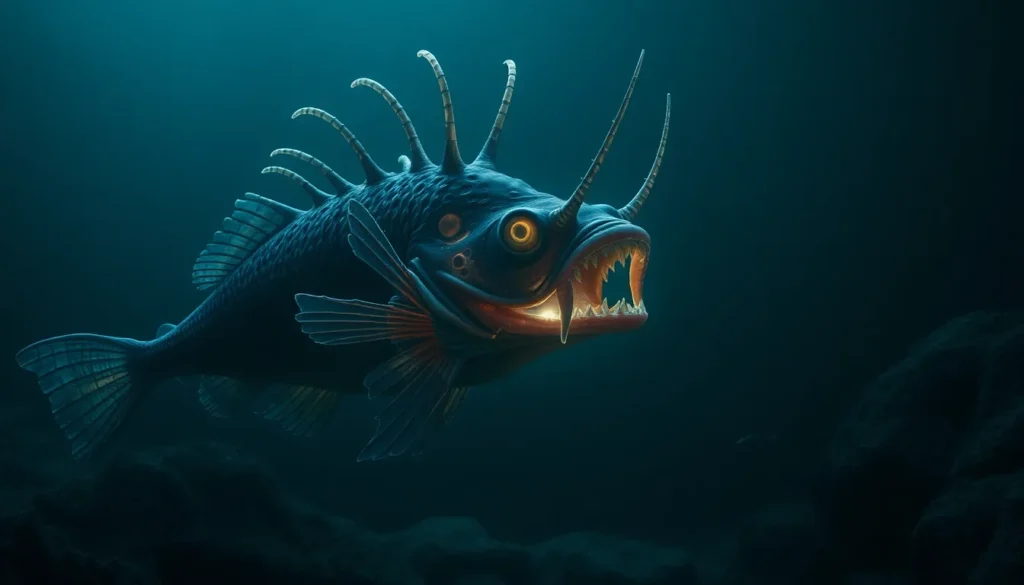
Short Answer
21 Facts About Anglerfish
- Bioluminescent lure: Anglerfish possess a fleshy growth called an esca at the end of a modified dorsal spine, which they use as a glowing lure to attract prey in the dark depths of the ocean.
- Deep-sea habitat: Most anglerfish species live at depths ranging from 200 to over 2,000 meters, where sunlight does not penetrate.
- Sexual dimorphism: Female anglerfish are significantly larger than males, sometimes by a factor of 10 or more.
- Parasitic males: In some species, tiny males permanently attach themselves to females, relying on them for nutrients while providing sperm for reproduction.
- Diverse species: There are over 200 known species of anglerfish, distributed across various ocean regions worldwide.
- Camouflage: Many anglerfish have dark, rough skin that helps them blend into the ocean floor or open water, aiding in ambush predation.
- Large mouths: Their mouths are disproportionately large with sharp, inward-pointing teeth, allowing them to consume prey almost as large as themselves.
- Expandable stomachs: Anglerfish can stretch their stomachs to accommodate large meals, a useful adaptation in an environment where food is scarce.
- Slow metabolism: Adapted to low-energy environments, anglerfish have slow metabolic rates, helping them survive long periods without food.
- Unique reproduction: The permanent fusion of males to females in some species is one of the most extreme examples of sexual parasitism in the animal kingdom.
- Varied diet: Anglerfish primarily prey on smaller fish and invertebrates attracted by their lure but can consume a wide range of organisms.
- Global distribution: While mostly deep-sea dwellers, anglerfish are found in oceans worldwide, from tropical to polar regions.
- Slow swimmers: They rely on stealth rather than speed to catch prey, often remaining motionless for long periods.
- Bioluminescence produced by bacteria: The light of the esca is generated by symbiotic bioluminescent bacteria housed within the lure.
- Rarely seen: Due to their deep-sea habitat, anglerfish are rarely observed in their natural environment, making them the subject of scientific fascination.
- Skeleton adaptations: Some species have soft, flexible bones to withstand the pressure of deep waters.
- Reproductive strategy: Males locate females by their bioluminescent lure and attach to them to ensure reproductive success in the vast ocean.
- Role in folklore and media: Anglerfish have inspired various fictional creatures due to their eerie appearance and bizarre behavior.
- Conservation status: Most anglerfish species are not currently threatened, but deep-sea fishing and habitat disruption could impact populations.
- Scientific importance: Studying anglerfish helps scientists understand deep-sea ecosystems and extreme adaptations.
- Unique evolutionary lineage: Anglerfish belong to the order Lophiiformes, which evolved specialized predatory adaptations distinct from other fish groups.
Habitat and Behavior
Anglerfish predominantly inhabit the deep ocean, typically residing on or near the seafloor at depths ranging from 200 meters to more than 2,000 meters, where sunlight is minimal or absent. These environments are characterized by cold temperatures, high pressure, and scarce food sources. Anglerfish are ambush predators; they rely on their bioluminescent lure to attract smaller fish and other prey close enough to capture. Their behavior is generally slow and energy-efficient, conserving resources by remaining motionless and using camouflage. The unique reproductive behavior of some anglerfish species involves tiny males attaching themselves permanently to much larger females, a strategy that ensures mating opportunities in the vast and sparsely populated deep sea.
Why This Animal Matters
Anglerfish play a significant ecological role as mid-level predators in deep-sea ecosystems, helping to regulate populations of smaller fish and invertebrates. Their bioluminescent adaptations provide valuable insight into symbiotic relationships between animals and bacteria. Culturally, anglerfish have fascinated humans due to their unusual appearance and behaviors, influencing folklore, literature, and media. Scientifically, they serve as important models for studying evolutionary biology, deep-sea adaptation, and reproductive strategies. Conservation-wise, while most anglerfish species are not currently endangered, their deep-sea habitats are sensitive to human activities such as deep-sea fishing and mining, which could affect their populations in the future.
Common Misconceptions
Misconception: All anglerfish males are free-living and similar in size to females.
Correction: In many anglerfish species, males are much smaller and become permanently attached to females as sexual parasites, relying on them for nutrients.
Misconception: Anglerfish use their lure to attract humans or large animals.
Correction: The bioluminescent lure is adapted to attract smaller prey fish and invertebrates in the deep sea, not large animals or humans.
Misconception: Anglerfish are aggressive and actively chase their prey.
Correction: Anglerfish are ambush predators that rely on camouflage and their lure to attract prey rather than chasing them.
Misconception: Anglerfish are common and frequently seen creatures.
Correction: Due to their deep-sea habitat, anglerfish are rarely observed in nature, and many species remain poorly studied.
Misconception: All anglerfish species look alike.
Correction: There is significant diversity among anglerfish species in size, shape, and coloration, adapted to various deep-sea environments.
FAQ
Why do anglerfish have a glowing lure?
Anglerfish use their bioluminescent lure to attract prey in the deep ocean where sunlight does not reach. The light mimics small organisms, drawing curious fish close enough to be captured.
How do male anglerfish find females in the vast deep sea?
Male anglerfish have highly developed olfactory organs that detect pheromones and the bioluminescent light emitted by females, enabling them to locate and attach to a mate.
Are anglerfish dangerous to humans?
Anglerfish are not dangerous to humans. They live in deep ocean habitats rarely visited by people and are not aggressive towards humans.





Leave a Reply