
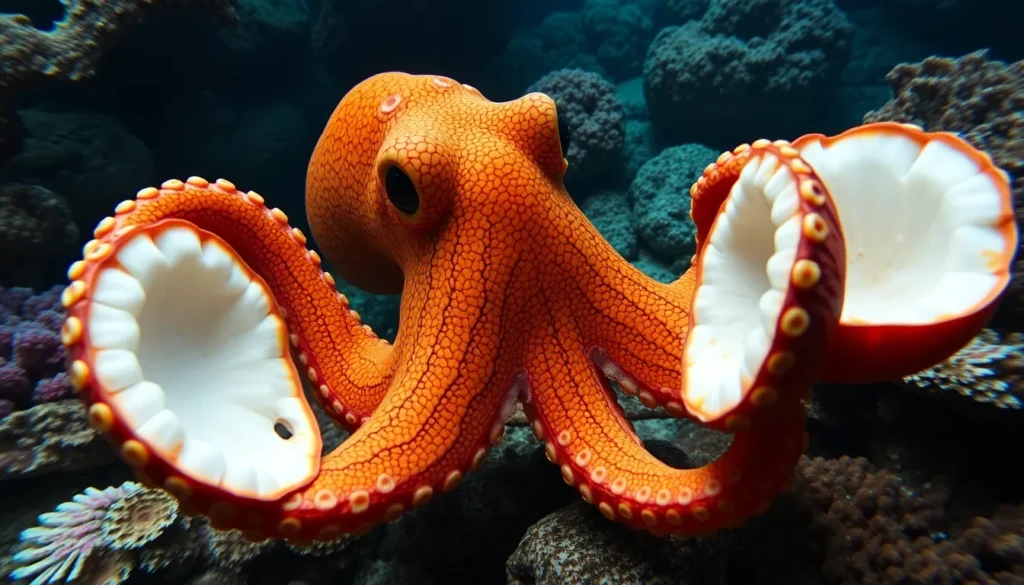
Short Answer
21 Facts About Tool Use in Octopuses
- Octopuses are among the few invertebrates that use tools. Tool use is relatively rare in invertebrates, but octopuses have demonstrated the ability to manipulate objects in their environment effectively.
- Veined octopuses use coconut shells as portable shelters. These octopuses collect and carry empty coconut shells to build protective shelters, showcasing foresight and planning.
- Tool use in octopuses suggests advanced cognitive abilities. Using tools involves complex behaviors such as problem-solving, memory, and motor control.
- Octopuses use rocks and shells to block den entrances. This behavior protects them from predators and environmental hazards.
- Tool use varies among octopus species. Not all octopus species have been observed using tools; it appears to be more common in some than others.
- Octopuses can manipulate objects with their flexible arms and suckers. Their anatomy allows precise and varied manipulation of tools and materials.
- Tool use in octopuses was first documented in the early 2000s. Scientific studies began to detail these behaviors relatively recently compared to vertebrates.
- Octopuses display individual differences in tool use behavior. Some octopuses show preferences for certain tools or strategies, indicating personality traits or learned behavior.
- Tool use may provide protection from predators. Using shelters or blocking dens reduces vulnerability in their natural habitat.
- Octopuses sometimes use discarded human objects as tools. They can repurpose items like bottle caps or debris found in their environment.
- Tool use improves octopus survival and fitness. Access to shelter and enhanced defense mechanisms increase their chances of survival.
- Octopus tool use is an example of convergent evolution. Similar behaviors have evolved independently in distant species such as some birds and primates.
- Tool use in octopuses challenges previous assumptions about invertebrate intelligence. It expands understanding of cognition beyond vertebrates.
- Octopuses may learn tool use through observation and experience. Some evidence suggests social and individual learning mechanisms.
- Tool use is often linked to problem-solving in octopuses. They adapt their use of tools to specific environmental challenges.
- Octopuses have been observed using tools both in the wild and in captivity. Controlled experiments help document and analyze these behaviors.
- Tool use behaviors can be context-dependent. Octopuses may use tools more frequently when predators are nearby or when suitable shelter is scarce.
- Research into octopus tool use helps inform robotics and biomimicry. Their dexterity inspires designs for flexible robotic arms and grasping mechanisms.
- Octopus tool use contributes to their reputation as highly intelligent invertebrates. It supports their classification among the most cognitively complex marine animals.
- Environmental changes may affect the availability of tools for octopuses. Habitat degradation could impact their ability to find or use natural materials.
- Studying octopus tool use provides insights into the evolution of intelligence. It offers a comparative perspective on how complex behaviors arise in different animal lineages.
Habitat and Behavior
Octopuses are marine animals found in diverse oceanic habitats worldwide, ranging from shallow coastal waters to deep-sea environments. They typically reside in dens or crevices, which they often modify or protect using available materials. Their behavior is characterized by remarkable adaptability, curiosity, and problem-solving capabilities. Octopuses are solitary creatures, relying on camouflage, ink expulsion, and the use of tools or shelters to evade predators. Their flexible arms, equipped with numerous suckers, allow them to manipulate objects, capture prey, and interact with their surroundings in complex ways.
Why This Animal Matters
Octopuses play an important ecological role as both predators and prey within marine ecosystems. Their predation helps regulate populations of crustaceans, mollusks, and small fish. The use of tools reflects their advanced cognitive abilities, making them subjects of scientific interest for understanding intelligence evolution outside vertebrates. Culturally, octopuses have fascinated humans for centuries, symbolizing mystery and adaptability in various mythologies and art. Conservation-wise, some octopus species are affected by overfishing and habitat degradation, prompting efforts to better understand and protect their populations.
Common Misconceptions
Misconception: Only vertebrates use tools.
Correction: While tool use is more common in vertebrates, octopuses—an invertebrate group—also use tools, demonstrating complex behaviors previously thought exclusive to vertebrates.
Misconception: All octopuses use tools.
Correction: Tool use has been observed primarily in certain octopus species and is not a universal behavior across all octopuses.
Misconception: Octopus tool use is instinctual and not learned.
Correction: Evidence suggests octopus tool use involves learning and problem-solving, and may include individual experiences or observational learning.
FAQ
Do all octopus species use tools?
No, tool use has been observed primarily in certain species like the veined octopus, and not all octopuses exhibit this behavior.
What types of tools do octopuses use?
Octopuses use natural items such as coconut shells, rocks, and shells, as well as occasionally repurposed human debris, mainly for shelter and defense.
How is tool use in octopuses studied?
Scientists study octopus tool use through direct observation in the wild, controlled laboratory experiments, and video documentation to analyze their behavior and cognitive abilities.


Leave a Reply