
Short Answer
21 Facts About Animal Records and Extremes
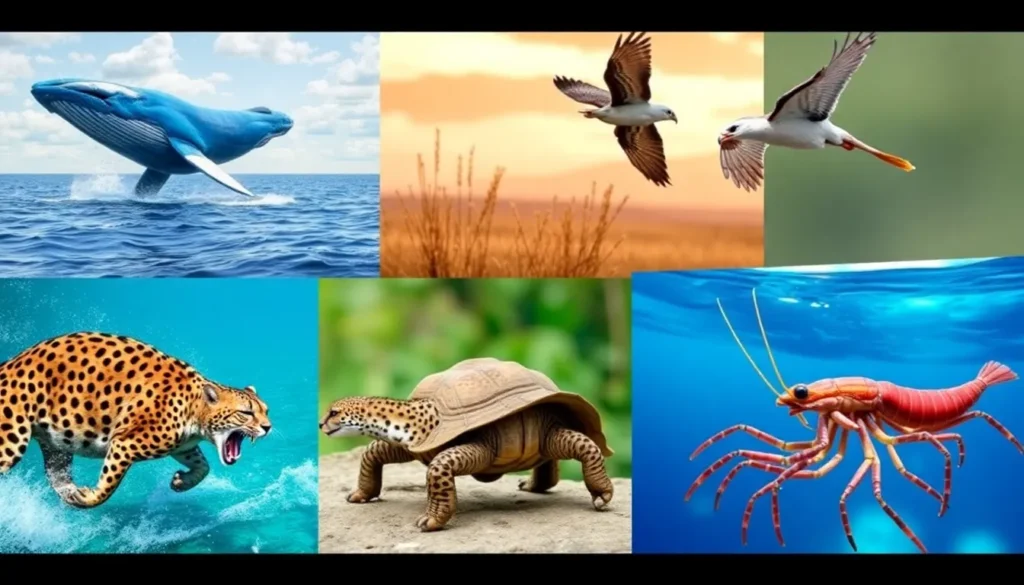
- The Blue Whale is the largest animal on Earth. It can reach lengths of up to 100 feet and weigh as much as 200 tons, making it the biggest known animal to have ever existed.
- The Peregrine Falcon is the fastest animal in a dive. It can reach speeds over 240 miles per hour when hunting prey from high altitudes.
- The Cheetah is the fastest land animal. It can sprint up to 60-70 miles per hour in short bursts, enabling it to catch swift prey.
- The Giant Tortoise holds records for longevity. Some individuals have lived over 150 years, making them among the longest-lived vertebrates.
- The Australian Box Jellyfish is one of the most venomous animals. Its sting can cause heart failure and death in humans if untreated.
- The Elephant is the largest land mammal. African elephants can weigh up to 14,000 pounds and stand over 10 feet tall at the shoulder.
- The Goliath Frog is the largest frog species. It can grow up to 13 inches in length and weigh over 7 pounds.
- The Antarctic Krill is one of the most abundant animals on Earth. Its biomass exceeds that of all humans combined, playing a crucial role in the oceanic food chain.
- The Mantis Shrimp has the fastest punch. It can strike prey with a speed of 50 miles per hour, generating shockwaves underwater.
- The Arctic Tern migrates the longest distance annually. It travels up to 44,000 miles between Arctic breeding grounds and Antarctic wintering areas.
- The Komodo Dragon is the largest living lizard. It can grow up to 10 feet long and weigh around 150 pounds.
- The Harpy Eagle has among the strongest talons relative to body size. It can exert a grip force comparable to that of a large mammal of similar weight.
- The Leafcutter Ant can carry objects many times its own weight. These ants transport leaf fragments up to 50 times their body weight back to their nests.
- The Ostrich lays the largest eggs of any living land bird. Their eggs can weigh up to 3 pounds and measure about 6 inches in length.
- The Velvet Worm has a unique hunting method using sticky slime. It ejects a glue-like substance to trap prey before consuming it.
- The Axolotl exhibits remarkable regenerative abilities. It can regenerate entire limbs, spinal cord, and even parts of its brain.
- The Leafy Seadragon showcases extraordinary camouflage. Its leaf-like appendages help it blend seamlessly with seaweed and kelp.
- The Dragonfly is one of the most efficient and agile flyers. It can hover, fly backwards, and change direction rapidly while hunting.
- The African Bullfrog can survive droughts by burrowing underground. It estivates in a cocoon of dried skin until rains return.
- The Horseshoe Crab has blue blood used in medical testing. It contains a substance that detects bacterial endotoxins, vital for ensuring sterile medical equipment.
- The Blue Dragon sea slug can store and use stinging cells from its prey. It incorporates toxin-bearing cells from jellyfish for its own defense.
Habitat and Behavior
Animals holding records and extremes inhabit diverse ecosystems ranging from oceans and forests to deserts and polar regions. Their behaviors often reflect adaptations to survive and thrive in these environments. For example, the Arctic Tern migrates vast distances to exploit seasonal food availability, while the African Bullfrog estivates to survive dry periods. Predatory animals like the Peregrine Falcon and Mantis Shrimp have evolved extraordinary hunting techniques to capture prey efficiently. Many record-holding species exhibit remarkable physiological or anatomical traits, such as the Blue Whale’s enormous size or the Axolotl’s regenerative capabilities, enabling them to fulfill unique ecological niches.
Why This Animal Matters
Animals with record-breaking traits play vital roles in their ecosystems, often acting as key predators, prey, or ecosystem engineers. For instance, the Antarctic Krill supports a vast marine food web, feeding whales, seals, and seabirds. The conservation of large animals like elephants and blue whales is crucial, as they influence habitat structure and nutrient cycling. Additionally, species like the Horseshoe Crab contribute to human health through biomedical applications. Understanding these animals helps scientists study evolutionary biology, ecology, and environmental changes. Moreover, many of these animals hold cultural significance and inspire conservation efforts worldwide.
Common Misconceptions
Misconception: The cheetah is the fastest animal overall.
Correction: While the cheetah is the fastest land animal, the peregrine falcon holds the record for the fastest animal when diving.
Misconception: Blue whales are the heaviest animals ever to live.
Correction: Blue whales are the heaviest known animals currently, and likely the heaviest ever, though some prehistoric dinosaurs may have approached or exceeded their weight.
Misconception: All jellyfish are harmless to humans.
Correction: Some jellyfish, such as the Australian box jellyfish, are among the most venomous animals and can cause serious injury or death.
Misconception: The horseshoe crab is a true crab.
Correction: Despite its name, the horseshoe crab is more closely related to spiders and scorpions than to true crabs.
Misconception: The axolotl is a typical salamander.
Correction: The axolotl is unique among salamanders for retaining its larval features throughout life, a phenomenon called neoteny.
FAQ
What is the largest animal on Earth?
The blue whale holds the record as the largest animal, reaching lengths up to 100 feet and weights of 200 tons.
Which animal is the fastest?
The peregrine falcon is the fastest animal when diving, capable of speeds exceeding 240 miles per hour.
How do some animals survive extreme conditions?
Many animals have adapted behaviors such as estivation, migration, or physiological traits like antifreeze proteins to survive harsh environments.


Leave a Reply