
Short Answer
21 Facts About Fleas
- Exceptional Jumping Ability
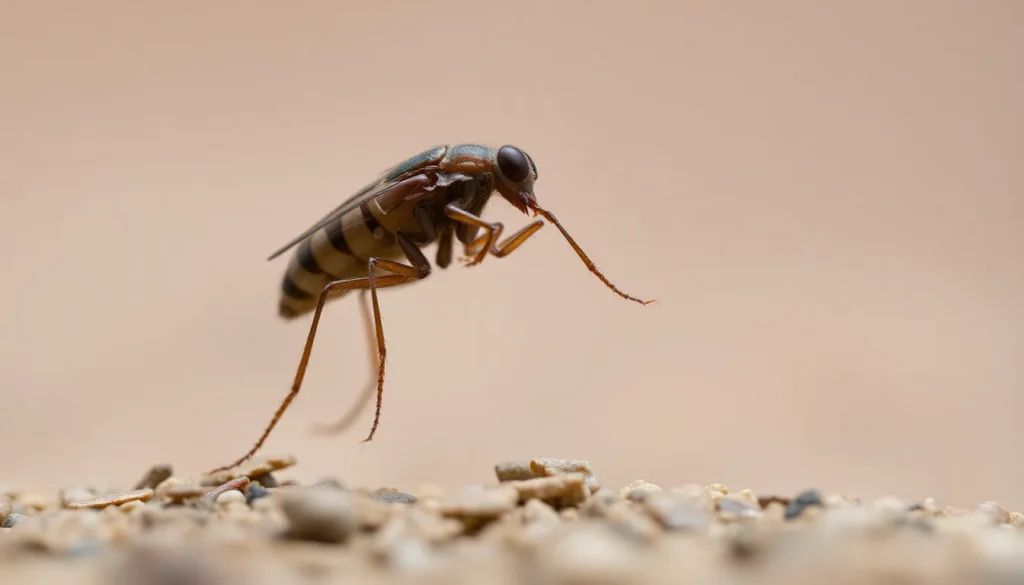
Fleas can jump up to 200 times their own body length, allowing them to move quickly between hosts or escape threats. - Use of Resilin
Their powerful jumps are enabled by a protein called resilin, which acts like a biological spring storing and releasing energy efficiently. - Body Size and Jump Height
Despite their small size, typically 1.5 to 3.3 mm, fleas can jump vertical distances of up to 18 cm (about 7 inches). - Jumping Mechanism
Fleas do not rely solely on muscle power; they compress resilin in their leg joints before releasing it rapidly to propel themselves. - Leg Structure
Their hind legs are specially adapted and elongated to maximize jumping force and distance. - Multiple Jumps
Fleas can perform multiple jumps in succession, aiding in their ability to find new hosts. - Host Detection
Fleas use sensory organs to detect warmth, vibrations, and carbon dioxide, helping them locate potential hosts to jump onto. - Jumping Speed
The acceleration of a flea’s jump can reach up to 100 times the acceleration of gravity, making their leap nearly instantaneous. - Evolutionary Advantage
Their jumping ability is critical for survival, enabling rapid movement from host to host and evasion of predators. - Diverse Species
There are over 2,500 species of fleas, but all share the characteristic of powerful jumping ability. - Parasitic Lifestyle
Fleas are ectoparasites feeding on the blood of mammals and birds, and their jumps help them maintain contact with hosts. - Reproduction and Jumping
Female fleas often use jumping to disperse and find new hosts where they lay eggs. - Jumping and Disease Transmission
Fleas’ ability to jump between hosts has historically contributed to the spread of diseases such as the bubonic plague. - Jumping Compared to Other Insects
While other insects like grasshoppers also jump far, fleas hold the record relative to their size. - Energy Efficiency
The resilin protein is extremely efficient, allowing fleas to conserve energy during repeated jumps. - Jumping in Water
Some flea species can jump from wet surfaces, although their performance decreases compared to dry conditions. - Jumping Control
Fleas can control the direction and force of their jumps to land precisely on hosts. - Predator Avoidance
Their rapid jumps are an effective defense mechanism against predators like spiders and ants. - Jumping and Locomotion
Besides jumping, fleas crawl using their legs but rely mainly on jumps for long-distance movement. - Jump Height Variability
Jump heights vary among flea species depending on size, leg morphology, and environmental conditions. - Scientific Study
Flea jumping mechanics have inspired biomimetic research, influencing designs in robotics and material science.
Habitat and Behavior
Fleas are found worldwide in a variety of environments but primarily inhabit areas close to their hosts, which include mammals and birds. They thrive in warm, humid climates and are commonly found in nests, burrows, animal fur, and even human dwellings. Behaviorally, fleas are nocturnal and exhibit host-seeking behavior driven by sensory cues like body heat and carbon dioxide. Their survival depends on their ability to jump onto hosts for feeding and reproduction, making their jumping ability a vital adaptation. Fleas undergo complete metamorphosis with egg, larval, pupal, and adult stages, with adults being the jumping parasitic form.
Why This Animal Matters
Fleas play a significant ecological role as parasites, influencing the population dynamics of their hosts and serving as prey for various predators. They are vectors for several diseases, most notably the bubonic plague, which historically had profound impacts on human populations. Understanding flea biology, especially their jumping mechanism, has relevance for pest control and public health. Additionally, their jumping ability has inspired scientific research in biomechanics and materials science, highlighting their importance beyond ecological impact.
Common Misconceptions
Misconception: Fleas jump by muscle power alone.
Correction: Fleas use a combination of muscle contraction and the elastic protein resilin to store and release energy, enabling their powerful jumps.
Misconception: Fleas can jump very high compared to large animals.
Correction: Fleas’ jumping height is impressive only relative to their small size; large animals can jump higher in absolute terms but not proportionally.
Misconception: All fleas jump the same height.
Correction: Jump height varies among flea species depending on size, leg structure, and environmental factors.
Misconception: Fleas can survive long periods without hosts.
Correction: While fleas can survive for some time off-host, their survival and reproduction depend on finding a host.
Misconception: Flea jumps are random.
Correction: Fleas can control the direction and force of their jumps to effectively reach hosts or escape threats.
FAQ
How high can a flea jump compared to its body size?
A flea can jump up to 200 times its own body length, which is an extraordinary feat relative to its size.
What enables fleas to jump so high?
Fleas use a highly elastic protein called resilin in their leg joints that stores and releases energy, allowing for powerful jumps beyond what muscle alone could produce.
Do all flea species jump the same distance?
No, jump height varies among flea species depending on their size, leg morphology, and environmental conditions.





Leave a Reply