
Short Answer
21 Facts About Scorpions
- Ancient lineage: Scorpions have existed for over 430 million years, making them one of the oldest terrestrial arthropods.
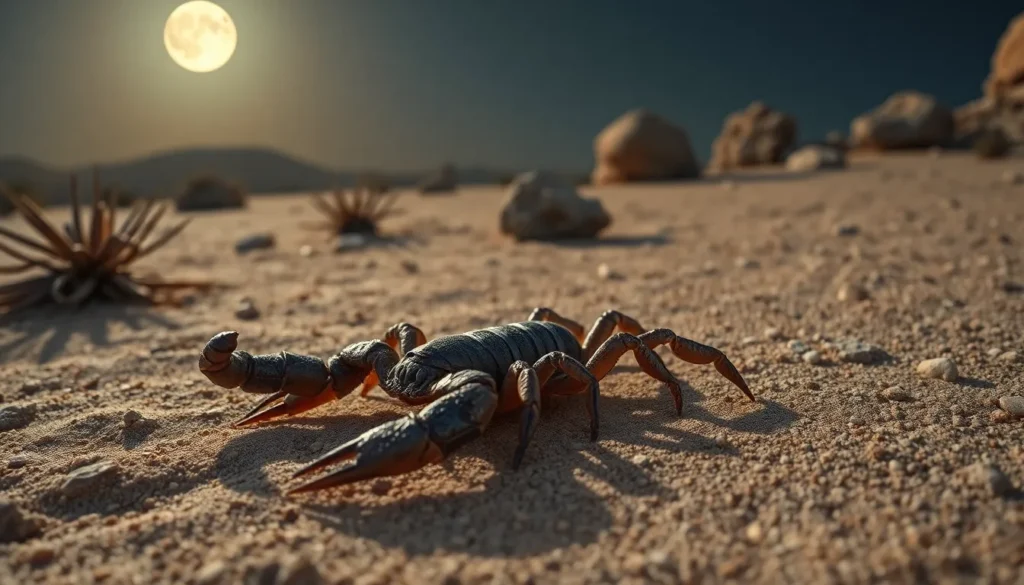
- Nocturnal hunters: Most desert scorpions are active at night, avoiding daytime heat and predation.
- Water conservation: Scorpions can survive on minimal water, obtaining moisture primarily from their prey.
- Exoskeleton adaptation: Their thick, waxy exoskeleton reduces water loss in hot, dry environments.
- Burrowing behavior: Many desert scorpions dig burrows to escape extreme temperatures and conserve moisture.
- Temperature tolerance: Some species can withstand surface temperatures exceeding 50°C (122°F) during the day.
- Specialized sensory hairs: Scorpions have fine hairs and slit sensilla that detect vibrations and air currents, aiding in prey detection.
- Fluorescence: Scorpions glow under ultraviolet light due to compounds in their exoskeleton, though the exact purpose remains uncertain.
- Venom variability: Desert scorpion venom varies widely; some species have potent neurotoxins, while others have milder venom used primarily for prey capture.
- Slow metabolism: Scorpions can survive months without food due to a low metabolic rate.
- Efficient hunters: They use their pincers to capture prey and inject venom through their stinger to immobilize it.
- Reproductive strategy: Some desert scorpions give birth to live young, which climb onto the mother’s back until their first molt.
- Camouflage: Their coloration often blends with desert sand and rocks, providing protection from predators.
- Adaptation to salt flats: Certain species can survive in saline desert environments by tolerating high salt concentrations.
- Respiratory system: Scorpions breathe through book lungs, which are efficient for gas exchange in dry conditions.
- Energy storage: They can store fat in their tail segments, helping them endure periods of food scarcity.
- Behavioral thermoregulation: Scorpions adjust their activity patterns and microhabitat selection to regulate body temperature.
- Predators and defense: Despite their venom, scorpions are preyed upon by birds, mammals, and reptiles; their pincers and stinger provide defense.
- Locomotion: Their legs have adaptations for moving efficiently over sand and rocky surfaces.
- Social behavior: While mostly solitary, some desert species show limited social interactions during mating or communal sheltering.
- Global distribution: Desert scorpions are found on every continent except Antarctica, illustrating their wide ecological success.
Habitat and Behavior
Scorpions predominantly inhabit arid and semi-arid regions such as deserts, where they are well-adapted to extreme environmental conditions. They typically seek shelter under rocks, within crevices, or in self-dug burrows to escape the intense daytime heat and conserve moisture. Being primarily nocturnal, scorpions emerge at night to hunt insects and other small invertebrates, using their acute sensory hairs to detect prey movements. Their burrowing behavior and physiological adaptations, including a waxy exoskeleton and slow metabolism, enable them to survive prolonged droughts and resource scarcity. In deserts, temperature fluctuations are dramatic; scorpions navigate this by altering their microhabitat preferences and activity timing to avoid lethal heat or cold.
Why This Animal Matters
Scorpions play a vital ecological role as both predators and prey in desert ecosystems. By controlling insect populations, they help maintain environmental balance. Their presence indicates healthy desert habitats and biodiversity. Additionally, scorpion venom is of scientific interest due to its complex compounds, some of which have potential medical applications in pain management and cancer research. Culturally, scorpions have featured in folklore, art, and symbolism across many desert-dwelling human societies. Conservation-wise, while many scorpion species are not currently threatened, habitat destruction and climate change pose risks to some localized populations.
Common Misconceptions
Misconception: All scorpions are deadly to humans.
Correction: While some scorpion species possess venom dangerous to humans, the vast majority have venom that causes only mild symptoms or is harmless.
Misconception: Scorpions aggressively attack humans.
Correction: Scorpions generally avoid humans and only sting in self-defense when threatened.
Misconception: Scorpions can live forever without food.
Correction: Though scorpions have a slow metabolism and can survive months without food, they do require nourishment to live and reproduce.
FAQ
Are all scorpion stings dangerous to humans?
No, only a small number of scorpion species have venom potent enough to be medically significant to humans. Most stings cause mild pain or irritation.
How do scorpions survive in harsh desert environments?
Scorpions have physiological adaptations like a waxy exoskeleton to reduce water loss, nocturnal behavior to avoid heat, and burrowing habits to escape extreme temperatures.
Why do scorpions glow under ultraviolet light?
Scorpions fluoresce under UV light due to certain chemicals in their exoskeleton. The exact biological purpose is not fully understood but may relate to protection from sunlight or communication.




Leave a Reply