
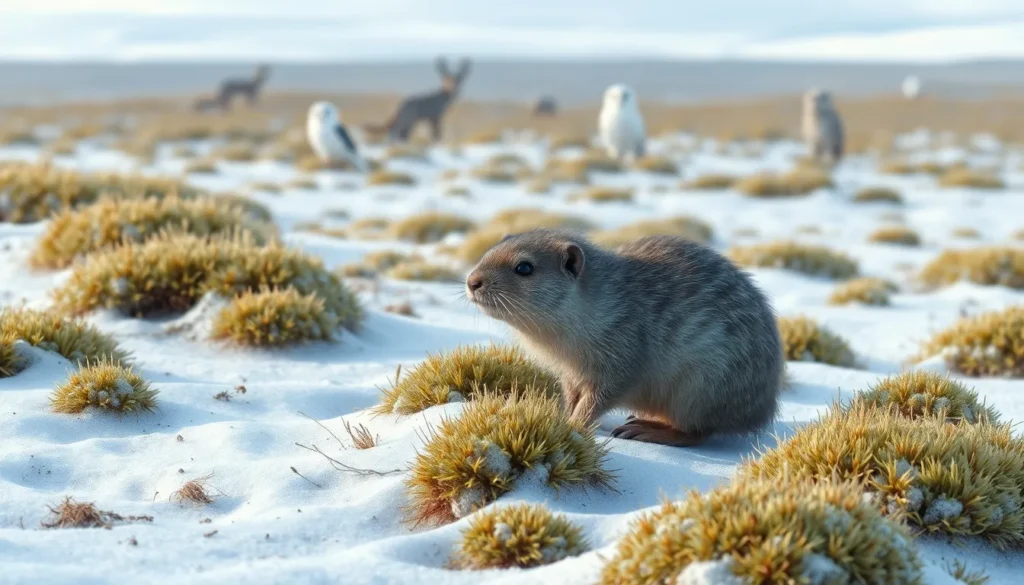
Short Answer
21 Facts About Lemming Population Cycles
- Population cycles are periodic: Lemming populations exhibit cyclical fluctuations, typically peaking every three to four years before sharply declining.
- Amplitude of fluctuations can be extreme: During peak years, lemming populations can increase up to tenfold compared to low years.
- Cycles vary by species and location: Different lemming species and populations show variations in cycle length and intensity depending on environmental conditions.
- Food availability influences cycles: The abundance and quality of vegetation are key factors driving population growth and decline.
- Predation pressure affects population dynamics: Predators such as arctic foxes and owls respond numerically to lemming abundance, contributing to population crashes.
- Social stress may contribute to declines: Increased density during peaks can lead to aggressive behavior and stress, reducing reproductive success.
- Dispersal behavior increases at peak densities: Overcrowding prompts lemmings to migrate to new areas, sometimes leading to mass movements.
- Mass migrations are not suicidal: Contrary to popular myth, lemmings do not deliberately jump off cliffs to commit mass suicide.
- Climate influences cycle regularity: Harsh winters or early springs can disrupt typical population cycles.
- Cycles impact predator populations: Predator species often show population increases lagging behind lemming peaks due to food availability.
- Lemming burrowing affects soil and vegetation: Their activities influence tundra ecosystems by aerating soil and affecting plant communities.
- Population crashes can lead to local extinctions: In some areas, severe declines can reduce lemming numbers to critically low levels temporarily.
- Reproductive rates fluctuate with population density: High density can suppress reproduction, while low density encourages breeding.
- Genetic diversity varies over cycles: Bottlenecks during population lows can reduce genetic variation.
- Research on lemming cycles has advanced population ecology: Studies of lemmings have contributed to understanding predator-prey dynamics and population regulation.
- Historical myths stem from misunderstandings of lemming behavior: Cultural stories often exaggerate or misinterpret natural dispersal events.
- Human activities can impact lemming populations: Habitat alteration and climate change may influence cycle patterns and survival.
- Population cycles are less pronounced in southern populations: Lemmings in less extreme climates tend to have more stable numbers.
- Not all small rodents exhibit similar cycles: Lemming population dynamics are distinct compared to other rodents like voles or mice.
- Monitoring lemming populations helps predict ecosystem changes: Because of their key ecological role, lemming numbers serve as indicators of tundra health.
- Conservation status varies among species: Some lemming species are stable, while others face threats from environmental changes.
Habitat and Behavior
Lemmings are small rodents primarily found in Arctic and sub-Arctic tundra regions of North America, Europe, and Asia. They inhabit cold environments with sparse vegetation including grasses, mosses, and lichens. Lemmings are well adapted to these harsh climates, utilizing dense burrow systems for shelter and protection from predators and extreme weather. Their behavior includes seasonal variations in activity and social structure. During population peaks, lemmings may exhibit increased aggression and dispersal tendencies, seeking new territories when crowded. They are primarily herbivorous, feeding on available tundra plants, and are prey for a variety of arctic predators. Lemmings have high reproductive rates during favorable conditions, enabling rapid population growth in peak years.
Why This Animal Matters
Lemmings play a critical ecological role in tundra ecosystems. As primary consumers, they influence plant community composition through grazing and help cycle nutrients by their burrowing and feeding activities. Their population cycles directly affect predator populations, such as foxes, owls, and weasels, which depend on lemmings as a major food source. These predator-prey interactions contribute to the complex dynamics of Arctic food webs. Culturally, lemmings have captured human imagination, inspiring myths and media portrayals that often misrepresent their natural behavior. Scientifically, studying lemming population cycles has advanced the understanding of population ecology, predator-prey relationships, and the effects of environmental factors on wildlife. Conservation efforts monitor lemming populations as indicators of ecosystem health amid changing climates.
Common Misconceptions
Misconception: Lemmings commit mass suicide by jumping off cliffs.
Correction: This myth arose from misinterpretations of natural dispersal behavior and was popularized by staged footage. Lemmings disperse to find new habitats when populations peak but do not intentionally kill themselves.
Misconception: Lemming population cycles occur everywhere at the same frequency.
Correction: Cycle length and intensity vary widely depending on species, geographic location, climate, and environmental conditions.
FAQ
What causes lemming population cycles?
Lemming population cycles are driven by a combination of food availability, predation pressure, social stress from overcrowding, and environmental factors such as climate.
Do lemmings really commit mass suicide?
No, the myth that lemmings commit mass suicide by jumping off cliffs is false. This misconception originated from misinterpreted natural dispersal behavior and staged media footage.
How do lemming population cycles affect other animals?
Fluctuations in lemming numbers impact predator populations, which often increase in response to abundant food during peaks and decline when lemming numbers fall, influencing overall ecosystem dynamics.


Leave a Reply