
Short Answer
21 Facts About Mud Daubers
- Solitary Wasps: Unlike social wasps, mud daubers live solitary lives, constructing individual nests.
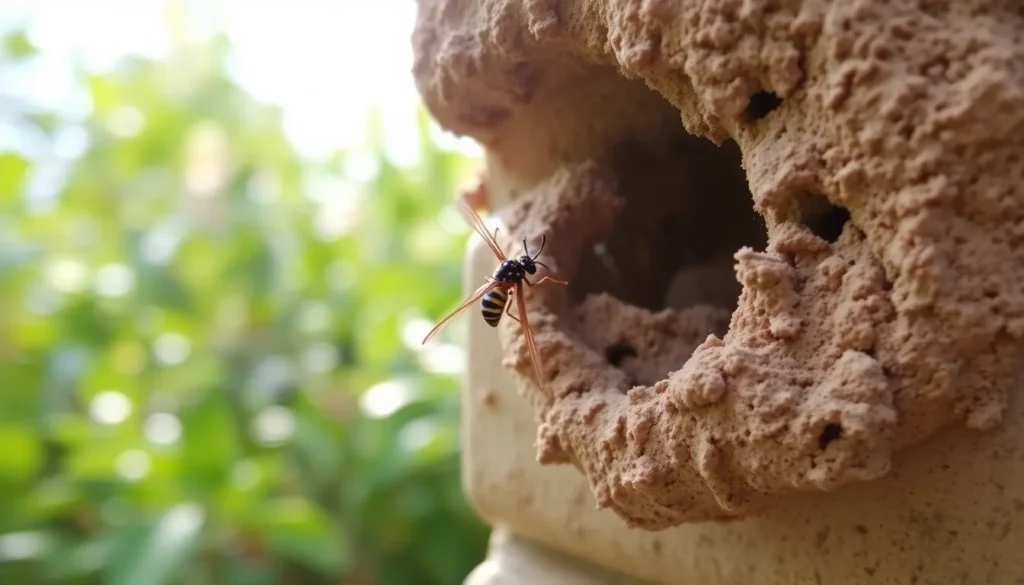
- Nest Construction: They build nests from mud, often attaching them to walls, ceilings, or sheltered outdoor structures.
- Varied Species: There are several species of mud daubers, including the black and yellow mud dauber (Sceliphron caementarium) and the organ pipe mud dauber (Trypoxylon politum).
- Prey on Spiders: Mud daubers primarily hunt spiders, paralyzing them to provision their nests as food for their larvae.
- Non-aggressive Nature: They are generally non-aggressive towards humans and rarely sting unless provoked.
- Larval Development: After the female lays eggs in the mud cells, the larvae feed on the paralyzed spiders before pupating.
- Wing Structure: Mud daubers have long, slender wings that fold longitudinally when at rest.
- Seasonal Activity: They are most active during warmer months and typically disappear in colder seasons.
- Sexual Dimorphism: Females are usually larger and responsible for nest building and hunting.
- Flight Ability: Mud daubers are strong fliers, capable of carrying prey back to their nests despite their size.
- Nest Reuse: Some species may reuse or expand existing mud nests rather than building new ones each time.
- Predators and Parasites: Mud dauber nests can be parasitized by other insects such as cuckoo wasps, which lay their eggs in the mud dauber’s nest cells.
- Global Distribution: Mud daubers are found worldwide, with species adapted to various climates and regions.
- Role in Pest Control: By preying on spiders and some insects, they help control pest populations naturally.
- Distinctive Nest Shapes: Nests vary in shape; for example, organ pipe mud daubers create long tubes resembling organ pipes.
- Life Span: Adult mud daubers typically live for a few weeks to a couple of months, depending on species and environmental conditions.
- Communication: As solitary wasps, mud daubers do not use complex communication methods seen in social wasps or bees.
- Flight Season: Their flight season varies by region but usually peaks in late spring through summer.
- Use of Mud: The mud used in nest building is carefully gathered and molded by the female using her mandibles and legs.
- Pollination: While not primary pollinators, mud daubers can incidentally contribute to pollination when visiting flowers for nectar.
- Scientific Importance: Mud daubers are studied for their unique nesting behavior, prey selection, and evolutionary adaptations within solitary wasps.
Habitat and Behavior
Mud daubers inhabit a wide range of environments, from urban areas to forests and grasslands. They prefer sheltered locations for nest building, such as under eaves, inside garages, or on rock faces. Their solitary nature means each female works alone to construct nests, hunt prey, and provision her offspring. The nests are made from mud gathered near water sources. Females paralyze spiders with their sting and place them in individual cells within the nest, where they lay a single egg. The larvae feed on the immobilized spiders until they pupate and emerge as adults. Mud daubers are most active during warmer months, and their activity declines as temperatures drop.
Why This Animal Matters
Mud daubers play a significant ecological role by controlling spider and insect populations, which can benefit human environments by reducing pest species. Their solitary nesting and hunting behaviors contribute to biodiversity and provide opportunities for scientific research into wasp behavior and evolution. In some cultures, mud daubers have been observed as symbols of industriousness or natural balance due to their role in ecosystems. While not endangered, understanding their ecology helps maintain the health of habitats where they are present.
Common Misconceptions
Misconception: Mud daubers are aggressive and will sting humans frequently.
Correction: Mud daubers are generally non-aggressive and rarely sting unless directly threatened or handled.
Misconception: All wasps live in large social colonies.
Correction: Mud daubers are solitary wasps and do not form colonies like yellowjackets or hornets.
Misconception: Mud daubers cause structural damage by building nests.
Correction: Their mud nests are small and typically do not cause damage to buildings or structures.
Misconception: Mud daubers are harmful pests.
Correction: They are beneficial predators that help control spider populations and do not pose significant risks to humans.
FAQ
Are mud daubers dangerous to humans?
Mud daubers are generally not dangerous to humans. They are solitary and non-aggressive, rarely stinging unless directly threatened.
What do mud daubers eat?
Adult mud daubers primarily feed on nectar, while their larvae feed on paralyzed spiders provided in the mud nests by the female.
Why do mud daubers build nests out of mud?
Mud daubers use mud to create sturdy, protective cells for their eggs and larvae, providing a safe environment and food supply for their offspring.





Leave a Reply