
Short Answer
21 Facts About Tapirs
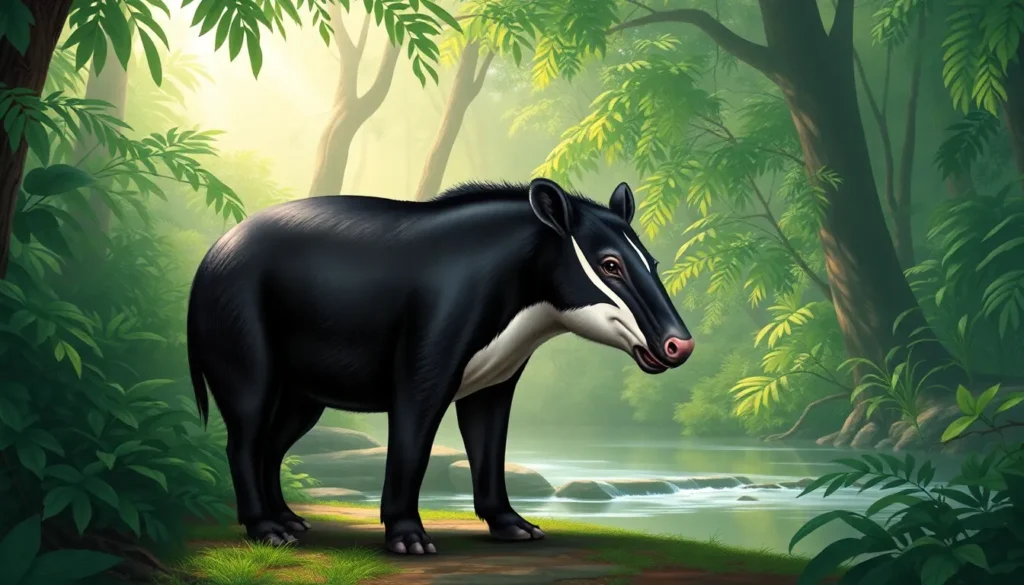
- Tapirs belong to the family Tapiridae. They are large, herbivorous mammals closely related to horses and rhinoceroses.
- There are four recognized species of tapirs. These include the Brazilian tapir, Malayan tapir, Baird’s tapir, and mountain tapir.
- Tapirs have a distinctive elongated, flexible snout. This prehensile snout helps them grab leaves and fruit.
- Tapirs are primarily nocturnal animals. They are mostly active during the night and twilight hours.
- They have a robust, barrel-shaped body. Their sturdy build helps them navigate dense forests and muddy terrain.
- Tapirs are excellent swimmers. They often enter water to feed, cool down, or escape predators.
- The Malayan tapir is the largest species. It can weigh up to 540 kg (1,190 pounds).
- Tapirs inhabit forested regions and grasslands. Their habitat ranges from tropical rainforests to mountainous cloud forests.
- Tapirs are solitary animals. They mostly live alone except during mating or when females care for their young.
- They have a slow reproduction rate. Female tapirs give birth to a single calf after a gestation of about 13 months.
- Tapirs use scent marking for communication. They leave urine and feces marks to establish territory.
- Their diet consists mainly of leaves, fruits, and twigs. They play an important role in seed dispersal in their ecosystems.
- Tapirs have poor eyesight but a keen sense of smell and hearing. These senses help them detect predators and navigate the forest.
- Tapirs have few natural predators. Jaguars and crocodiles are among the few animals that prey on them.
- Tapirs are considered living fossils. Their lineage dates back over 20 million years with little evolutionary change.
- Tapirs’ skin is thick and tough. This protects them from thorny vegetation and insect bites.
- The Baird’s tapir is the national animal of Belize. It holds cultural significance in some Central American countries.
- Tapirs have a unique pattern of stripes and spots during infancy. This camouflage helps protect young tapirs from predators.
- All tapir species are listed as vulnerable or endangered. Habitat loss and hunting are primary threats to their survival.
- Tapirs contribute to forest regeneration. By dispersing seeds through their feces, they help maintain forest diversity.
- Tapirs have been featured in various indigenous myths and folklore. They often symbolize forest spirits or guardians in native cultures.
Habitat and Behavior
Tapirs are native to the tropical forests and grasslands of Central and South America, with one species, the Malayan tapir, found in Southeast Asia. They prefer dense, moist environments near water sources such as rivers and swamps. Tapirs are primarily nocturnal and solitary, using scent marking to communicate and establish territory. Their flexible, prehensile snout allows them to browse on leaves, fruits, and aquatic vegetation efficiently. Tapirs are strong swimmers and often use water to evade predators or regulate body temperature. Despite their large size, tapirs are elusive and tend to avoid human contact.
Why This Animal Matters
Tapirs play a vital ecological role as seed dispersers, contributing to the health and regeneration of tropical forests. Because they consume a variety of fruits and plants, they help maintain plant diversity and forest structure. Ecologically, they serve as prey for large predators, fitting into the food web. Culturally, tapirs hold significance in indigenous folklore and are symbols in some Central and South American societies. Conservation-wise, tapirs are indicators of healthy forest ecosystems, and their declining populations highlight environmental threats such as deforestation and habitat fragmentation.
Common Misconceptions
Misconception: Tapirs are related to pigs.
Correction: Although tapirs may appear pig-like, they belong to a distinct family (Tapiridae) and are more closely related to horses and rhinoceroses than to pigs.
Misconception: Tapirs are aggressive animals.
Correction: Tapirs are generally shy and avoid confrontation, only becoming aggressive if threatened or cornered.
Misconception: Tapirs are common animals.
Correction: All tapir species are classified as vulnerable or endangered, facing threats primarily from habitat loss and hunting.
Misconception: Tapirs only live in South America.
Correction: While most tapirs are native to Central and South America, the Malayan tapir lives in Southeast Asia.
FAQ
What do tapirs eat?
Tapirs are herbivores that primarily feed on leaves, fruits, twigs, and aquatic vegetation. Their flexible snout helps them grasp food in dense forest environments.
Where do tapirs live?
Tapirs inhabit tropical forests and grasslands in Central and South America, with the Malayan tapir species found in Southeast Asia. They prefer moist environments near water sources.
Are tapirs endangered?
Yes, all four tapir species are classified as vulnerable or endangered due to habitat destruction, hunting, and fragmentation of their natural habitats.




Leave a Reply