
Short Answer
21 Facts About Starling Murmurations
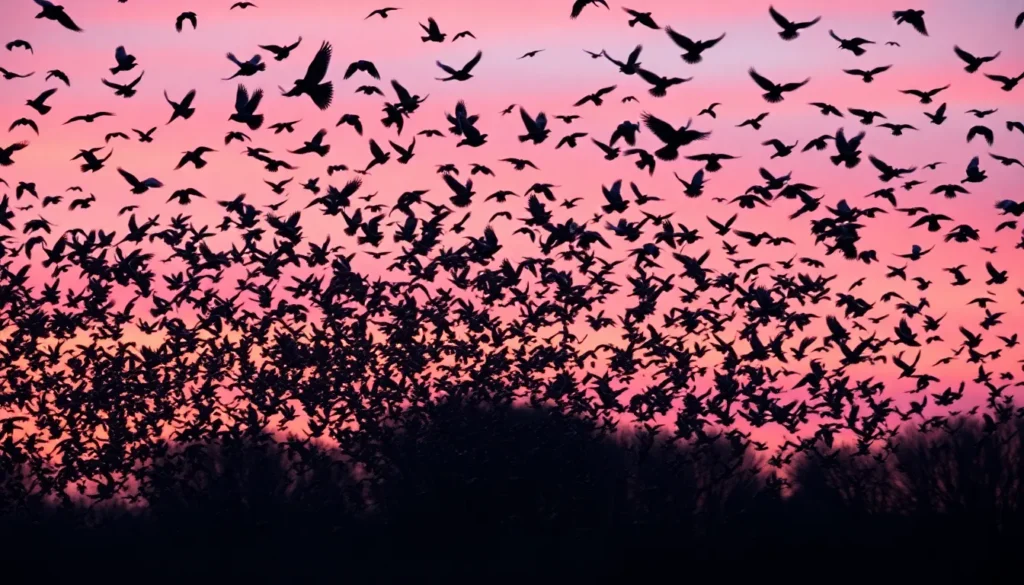
- Definition of Murmuration: A murmuration is a large flock of starlings flying in synchrony, creating dynamic, shifting shapes in the sky.
- Size of Flocks: Murmurations can include thousands to hundreds of thousands of individual starlings.
- Flight Patterns: The birds move in highly coordinated patterns, appearing as if the flock is a single organism.
- Communication: Starlings use visual cues and rapid position adjustments to maintain the flock’s shape.
- Speed and Agility: The flock can change direction quickly, with individual birds reacting in less than a tenth of a second.
- Predator Avoidance: Murmurations help protect starlings from predators by confusing and deterring attacks.
- Energy Efficiency: Flying in a murmuration reduces wind resistance and conserves energy for individual birds.
- Roosting Behavior: Murmurations often form before starlings settle to roost for the night.
- Seasonal Occurrence: They are most commonly seen during autumn and winter months.
- Locations: Murmurations occur in many parts of Europe, especially the UK, and in some parts of North America.
- Origin of Term: The word “murmuration” derives from the Latin “murmurare,” meaning to murmur or hum.
- Visual Spectacle: The fluid shapes can resemble clouds, waves, or even abstract art in motion.
- Scientific Interest: Murmurations are studied to understand collective animal behavior and swarm intelligence.
- Individual Interactions: Each starling coordinates with approximately seven neighbors to maintain the flock’s cohesion.
- Flight Altitude: Murmurations typically occur at varying heights, often starting higher and descending near roost sites.
- Impact of Weather: Weather conditions such as wind and light influence the size and visibility of murmurations.
- Social Structure: Starlings form complex social networks that influence murmuration dynamics.
- Conservation Status: While starlings are widespread, changes in habitat can impact murmuration sites.
- Human Fascination: Murmurations inspire art, photography, and cultural symbolism.
- Research Advances: Recent studies use computational models and drones to analyze murmuration mechanics.
- Predator Species: Birds of prey such as falcons and hawks often hunt starlings during murmurations.
Habitat and Behavior
Starlings (Sturnus vulgaris) are native to Europe, Asia, and North Africa but have been introduced to other continents including North America and Australia. They typically inhabit open woodlands, farmlands, urban areas, and parks. Starlings are highly adaptable birds and form large communal roosts, especially in colder months. Their murmuration behavior is primarily linked to these roosting sites, where thousands gather at dusk. The birds display remarkable social coordination during flight, adjusting their speed and direction to maintain cohesion and avoid collisions. These murmurations serve functions such as predator avoidance, information exchange, and energy conservation. Starlings are omnivorous, feeding on insects, seeds, and fruit, which supports their survival across diverse environments.
Why This Animal Matters
Starling murmurations are ecologically significant as they represent a key survival strategy against predation, enhancing individual safety through collective behavior. The starlings’ capacity for synchronized flight offers researchers insights into swarm intelligence, collective decision-making, and complex systems in nature. Culturally, murmurations have become symbols of natural beauty and complexity, inspiring art and literature. Additionally, starlings impact ecosystems by controlling insect populations and dispersing seeds. However, as an invasive species in some regions, they can also affect native bird populations and agriculture. Conservation efforts focus on understanding habitat requirements to preserve the natural contexts where murmurations occur.
Common Misconceptions
Misconception: Murmurations are choreographed performances.
Correction: Murmurations are spontaneous and arise from simple local interactions among birds without a central coordinator.
Misconception: All large flocks of birds are murmurations.
Correction: Murmurations specifically describe starling flocks performing coordinated aerial displays, not just any large bird group.
Misconception: Murmurations are a sign of distress or impending disaster.
Correction: Murmurations are normal social and survival behavior, not linked to negative environmental events.
FAQ
What causes starlings to form murmurations?
Murmurations occur due to local interactions between individual starlings who adjust their flight based on their nearest neighbors, resulting in large coordinated flock movements.
Why do starlings perform murmurations?
Murmurations serve to protect starlings from predators by confusing attackers, to conserve energy during flight, and to facilitate social communication before roosting.
Are murmurations unique to starlings?
While murmurations specifically refer to starling flock behavior, other bird species also form large flocks or coordinated groups, but the specific fluid aerial displays are characteristic of starlings.





Leave a Reply