
Short Answer
21 Facts About Phoronids (Horseshoe Worms)
- Phoronids belong to their own phylum, Phoronida. They are a small group of worm-like marine animals distinct from other worm phyla.
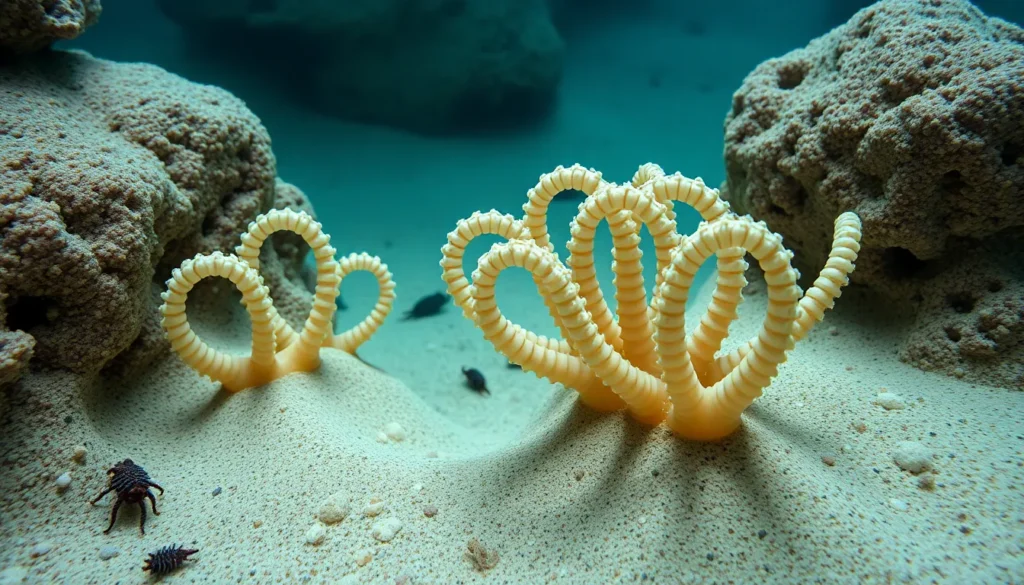
- They are commonly called horseshoe worms. This name comes from the horseshoe-shaped lophophore, a feeding structure covered with cilia.
- Phoronids possess a lophophore, a characteristic feeding organ shared with brachiopods and bryozoans. The lophophore is used to filter food particles from the water.
- Phoronids are tube-dwelling organisms. They secrete a chitinous tube in which they live, extending their lophophore outside to feed.
- They have a simple, unsegmented, elongated body. Their body plan is generally worm-like and cylindrical.
- Phoronids have a closed circulatory system. This is relatively rare among invertebrates and helps transport nutrients and gases.
- Their nervous system is relatively simple but includes a cerebral ganglion. This ganglion acts as a basic brain coordinating sensory and motor functions.
- Phoronids reproduce sexually and asexually. They can release free-swimming larvae or reproduce by budding in some species.
- Their larvae are called actinotrocha and are planktonic. These larvae disperse in the water column before settling and metamorphosing into adults.
- Phoronids are marine animals found worldwide. They inhabit shallow waters, often in soft sediments or attached to hard substrates.
- Most species of phoronids are small, typically less than 20 centimeters long. Their size varies but they are usually inconspicuous.
- They feed primarily on microscopic plankton and organic particles. Their lophophore captures food by creating water currents.
- Phoronids are benthic, meaning they live on or near the sea floor. Their tubes anchor them in place while they feed.
- They have a relatively low metabolic rate compared to other marine invertebrates. This may be an adaptation to their sedentary lifestyle.
- Phoronids are important members of marine benthic communities. Their tubes provide microhabitats for other small organisms.
- They are sometimes used as bioindicators. Because they are sensitive to pollution and environmental changes, their presence or absence can indicate ecosystem health.
- Phoronids have been studied for their unique evolutionary position. They help scientists understand the relationships between lophophorate animals and other invertebrates.
- Despite their intriguing biology, phoronids are often overlooked due to their small size and hidden lifestyle. They are not well-known outside scientific circles.
- The fossil record of phoronids is sparse. Their soft bodies and chitinous tubes do not fossilize well, making their evolutionary history difficult to trace.
- Phoronids contribute to sediment stabilization. Their tubes bind sediments and influence the structure of the benthic environment.
- Some species of phoronids can regenerate lost body parts. This ability aids in survival after predation or injury.
Habitat and Behavior
Phoronids are marine benthic invertebrates that typically inhabit shallow coastal waters worldwide. They live in chitinous tubes embedded in soft sediments such as sand or mud, or occasionally attached to hard substrates like rocks or shells. Their sedentary lifestyle involves extending their horseshoe-shaped lophophore above the sediment surface to filter feed on plankton and organic particles suspended in the water. The lophophore generates water currents that draw food particles toward the ciliated tentacles. Phoronids have a planktonic larval stage called actinotrocha, which disperses through the water column before settling to the benthos and metamorphosing into the adult form. Their behavior is largely influenced by environmental conditions such as water temperature, salinity, and sediment composition. While generally solitary, their tubes can aggregate in dense populations, providing microhabitats for other organisms.
Why This Animal Matters
Phoronids play an important ecological role in marine benthic ecosystems. By filtering plankton and organic matter, they contribute to nutrient cycling and energy flow within marine food webs. Their chitinous tubes stabilize sediments, helping to prevent erosion and influencing sediment structure. Furthermore, these tubes create habitats for a variety of small invertebrates, increasing local biodiversity. Due to their sensitivity to environmental changes, phoronids are considered useful bioindicators for monitoring marine ecosystem health and pollution levels. Scientifically, phoronids are valuable for understanding evolutionary relationships among lophophorate animals and provide insights into the development and diversity of marine invertebrates. Despite their ecological importance, conservation concerns specific to phoronids are limited, largely due to their cryptic nature and limited study.
Common Misconceptions
Misconception: Phoronids are closely related to earthworms.
Correction: Despite their worm-like appearance, phoronids belong to the phylum Phoronida and are more closely related to brachiopods and bryozoans via the lophophorate group than to annelids (earthworms).
Misconception: Phoronids are harmful or parasitic.
Correction: Phoronids are harmless filter feeders that do not parasitize other animals. They play a beneficial role in marine ecosystems by filtering water and stabilizing sediments.
Misconception: Phoronids are a type of mollusk.
Correction: Phoronids are not mollusks. They constitute their own distinct phylum and possess unique anatomical features such as the lophophore, which mollusks do not have.
FAQ
What are phoronids?
Phoronids are small marine invertebrates belonging to the phylum Phoronida, commonly known as horseshoe worms due to their distinctive lophophore shape.
Where do phoronids live?
Phoronids live in shallow marine environments, typically embedded in soft sediments or attached to hard substrates on the seafloor.
How do phoronids feed?
Phoronids feed by filtering microscopic plankton and organic particles from the water using their ciliated lophophore, which creates water currents to capture food.



Leave a Reply