
Short Answer
21 Facts About Scorpions
- Ancient Lineage: Scorpions have existed for over 430 million years, making them one of the oldest terrestrial arthropods known from the fossil record.
- Global Distribution: They inhabit every continent except Antarctica, adapting to a wide range of environments from deserts to rainforests.
- Size Variation: Scorpion species range in size from about 9 millimeters to 23 centimeters in length.
- Venom Diversity: Scorpion venom contains a complex mixture of toxins, with some species possessing venom potent enough to be dangerous to humans, while others have venom primarily effective on their prey.
- Nocturnal Hunters: Most scorpions are nocturnal, hunting insects and other small animals at night using their sensitive pectines to detect vibrations.
- Fluorescence Under UV Light: Scorpions glow a blue-green color when exposed to ultraviolet light due to substances found in their exoskeleton.
- Unique Respiratory System: They breathe through book lungs, which are layered structures that facilitate gas exchange.
- Reproductive Behavior: Scorpions practice complex mating dances and some species give live birth, with mothers carrying young on their backs until the first molt.
- Longevity: Some scorpion species can live up to 6-8 years in captivity, though lifespan varies in the wild.
- Slow Metabolism: Scorpions can survive for months without food due to their low metabolic rate.
- Defense Mechanisms: They use their pincers to grasp and crush prey or deter predators, complementing their stinger’s venomous defense.
- Habitat Adaptations: Desert species have developed behaviors such as burrowing and nocturnality to avoid daytime heat.
- Silk Production: Some species produce silk from glands in their pincers, used to line burrows or wrap prey.
- Species Diversity: There are over 2,500 known species of scorpions worldwide.
- Predators: Scorpions face predation from birds, reptiles, mammals, and even other scorpions.
- Role in Ecosystems: As predators of insects and small animals, they help control pest populations.
- Venom Research: Scorpion venom is studied for potential medical applications including cancer treatment and pain management.
- Some Are Parthenogenetic: A few scorpion species can reproduce without mating, through parthenogenesis.
- Molting Process: Scorpions molt several times during their development to grow, shedding their exoskeleton.
- Scorpion Stings: Most scorpion stings cause localized pain and swelling, but a small number of species have venom that can be life-threatening to humans.
- Cultural Symbolism: Scorpions appear in mythology, art, and symbolism across many cultures, often representing danger or protection.
Habitat and Behavior
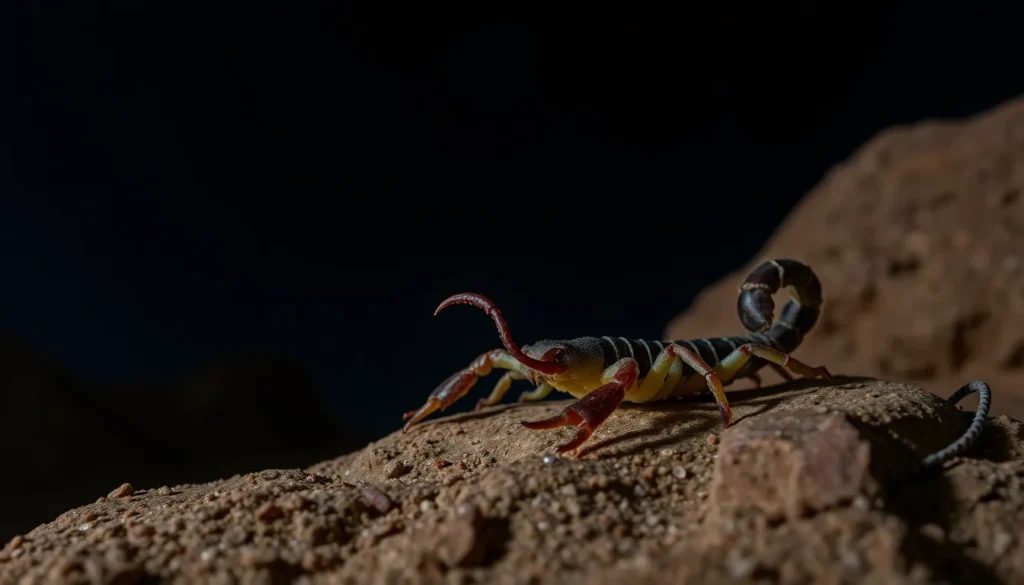
Scorpions are versatile creatures inhabiting a wide array of terrestrial environments, from arid deserts and rocky outcrops to tropical forests and grasslands. They typically seek shelter during the day under rocks, bark, or in burrows, emerging at night to hunt. Their nocturnal behavior helps them avoid predators and extreme temperatures. Scorpions use their pincers to capture prey and their venomous stinger to immobilize or kill it. They rely on sensory organs called pectines to detect chemical cues and vibrations in their surroundings. Reproduction involves intricate courtship rituals, and females often exhibit parental care by carrying young scorpions on their backs until their first molt.
Why This Animal Matters
Scorpions play an important ecological role as both predators and prey, helping to regulate populations of insects and other small animals. Their presence contributes to the balance of terrestrial ecosystems. Scientifically, scorpion venom has attracted considerable research interest for its potential in developing new pharmaceuticals, including painkillers and cancer therapies. Additionally, scorpions hold cultural significance in many societies, symbolizing various concepts from protection to danger in mythology and folklore. Conservation of scorpion species is important as habitat loss and environmental changes threaten some populations, although many species remain widespread and adaptable.
Common Misconceptions
Misconception: All scorpions are deadly to humans.
Correction: While some species have venom potent enough to cause serious harm, most scorpion stings result in mild symptoms similar to a bee sting.
Misconception: Scorpions only live in deserts.
Correction: Scorpions inhabit diverse environments including forests, grasslands, and caves, not just deserts.
Misconception: Scorpions are insects.
Correction: Scorpions are arachnids, related to spiders and ticks, not insects.
Misconception: Scorpions always sting their prey.
Correction: Many scorpions use their pincers primarily to capture prey and may sting only when necessary.
Misconception: Scorpions are aggressive and will attack humans unprovoked.
Correction: Scorpions are generally shy and avoid humans, stinging mostly in self-defense.
FAQ
Are all scorpion stings dangerous to humans?
No, only a small number of scorpion species have venom potent enough to cause serious harm to humans. Most stings cause localized pain and swelling.
Why do scorpions glow under ultraviolet light?
Scorpions have substances in their exoskeleton that fluoresce under UV light, although the exact biological function of this fluorescence is still debated.
How do scorpions hunt their prey?
Scorpions use their pincers to grasp prey and their venomous stinger to immobilize or kill it. They rely on sensory organs to detect vibrations and chemical signals at night.

Leave a Reply