
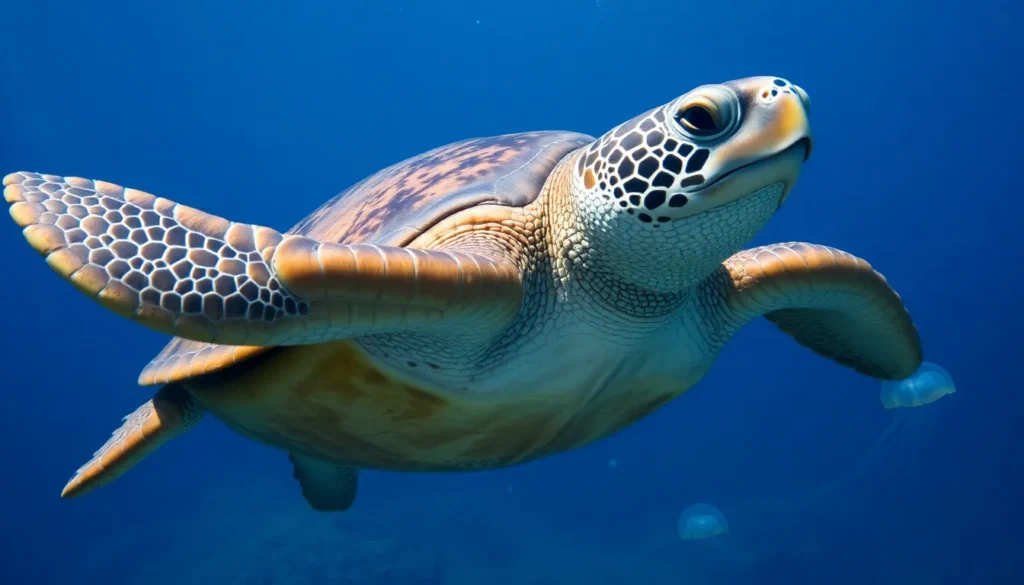
Short Answer
21 Facts About Leatherback Turtles
- Largest Sea Turtle Species. Leatherback turtles (Dermochelys coriacea) are the largest of all living sea turtles, reaching lengths of up to 2 meters (6.6 feet) and weights of over 700 kilograms (1,500 pounds).
- Unique Shell Structure. Unlike other sea turtles, leatherbacks have a flexible, leathery carapace instead of a hard bony shell, made of connective tissue and embedded with small bones.
- Ancient Lineage. Leatherbacks are considered a primitive species that have existed in their current form for over 100 million years, making them some of the oldest reptiles on Earth.
- Global Distribution. They inhabit tropical and subtropical oceans worldwide, migrating across entire ocean basins.
- Deep Divers. Leatherbacks are capable of diving to depths exceeding 1,200 meters (3,900 feet), deeper than any other sea turtle species.
- Cold Tolerance. They can regulate their body temperature through a combination of large body size, thick fat layers, and countercurrent heat exchangers, allowing them to survive in colder waters.
- Diet Specialized in Jellyfish. Their primary diet consists of jellyfish and other soft-bodied invertebrates, helping control jellyfish populations.
- Long-Distance Migrations. Leatherbacks undertake extensive migrations between feeding grounds and nesting beaches, sometimes traveling thousands of kilometers annually.
- Nesting Behavior. Females return to the exact beaches where they were born to lay eggs, a behavior known as natal homing.
- Clutch Size and Incubation. Each clutch can contain up to 100 eggs, with incubation lasting around 60 days, influenced by sand temperature.
- Temperature-Dependent Sex Determination. The sex of hatchlings is determined by the temperature of the sand where eggs incubate; warmer temperatures generally produce females.
- Vulnerable Conservation Status. Leatherbacks are listed as Vulnerable globally, with some subpopulations classified as Critically Endangered due to threats like habitat loss and bycatch.
- Threats from Plastic Pollution. Leatherbacks often mistake plastic bags for jellyfish, leading to ingestion that can cause injury or death.
- Predators of Eggs and Hatchlings. Eggs and young turtles are preyed upon by various animals, including raccoons, birds, and crabs, contributing to high mortality rates.
- Adult Predators. Large sharks and orcas are known predators of adult leatherback turtles.
- Role in Marine Ecosystems. By preying on jellyfish, leatherbacks help maintain the balance of marine food webs and prevent jellyfish blooms.
- Navigation Abilities. They use Earth’s magnetic field and environmental cues to navigate vast ocean distances.
- Low Reproductive Rate. Leatherbacks have relatively low reproductive rates compared to other marine animals, making population recovery challenging.
- Legal Protections. Many countries have enacted laws and international agreements to protect leatherback turtles and their nesting sites.
- Indicator Species. Their health reflects broader ocean ecosystem conditions, making them important for marine conservation monitoring.
- Scientific Research Importance. Leatherbacks are subjects of numerous scientific studies focusing on physiology, navigation, and climate change impacts.
Habitat and Behavior
Leatherback turtles are found in all tropical and subtropical oceans, with some populations venturing into temperate and even subpolar waters due to their unique thermal adaptations. They spend most of their lives at sea, only coming ashore to nest. Their flexible leathery shells allow them to withstand the pressures of deep dives, where they forage primarily on gelatinous prey such as jellyfish. Leatherbacks are solitary creatures and exhibit remarkable endurance, traveling thousands of kilometers between feeding and nesting areas. During nesting season, females come to sandy beaches to lay multiple clutches of eggs. Hatchlings emerge at night to make their way to the ocean, facing significant predation risks. Leatherbacks rely on their keen navigational abilities, including geomagnetic cues, to return to natal beaches for reproduction.
Why This Animal Matters
Leatherback turtles play a crucial ecological role by controlling jellyfish populations, which can otherwise grow unchecked and disrupt marine ecosystems. Their migratory behavior connects various marine habitats, contributing to biodiversity and ecosystem health. Culturally, leatherbacks have significance in many coastal communities, symbolizing longevity and endurance. Conservation of leatherbacks is vital as their declining numbers indicate broader environmental problems such as ocean pollution, climate change, and habitat degradation. Protecting leatherbacks helps safeguard marine ecosystems and supports global biodiversity efforts.
Common Misconceptions
Misconception: Leatherback turtles have hard shells like other turtles.
Correction: Leatherbacks possess a unique, flexible, and leathery carapace rather than a hard bony shell, distinguishing them from other sea turtles.

Misconception: All sea turtles live only in warm tropical waters.
Correction: Leatherback turtles are capable of surviving in colder waters due to their adaptations, and they often migrate into temperate and subpolar regions.
Misconception: Leatherback turtles only eat seaweed and plants.
Correction: Leatherbacks primarily feed on jellyfish and other soft-bodied invertebrates, not plants.
FAQ
Why are leatherback turtles called 'leatherback'?
They are named for their distinctive leathery, flexible shell that differs from the hard shells of other sea turtles.
How long do leatherback turtles live?
Leatherback turtles typically live around 45 to 50 years in the wild, though exact lifespans can vary.
What threats do leatherback turtles face?
Major threats include habitat loss, bycatch in fisheries, plastic pollution, climate change affecting nesting sites, and predation on eggs and hatchlings.

Leave a Reply