
Short Answer
21 Facts About Katydids
- Katydids belong to the family Tettigoniidae.
They are a family of insects related to crickets and grasshoppers, distinguished by their long antennae and often leaf-like wings. - There are over 6,000 species of katydids worldwide.
They inhabit diverse environments, primarily in tropical and temperate regions. - Katydids are known for their distinctive sounds.
Males produce species-specific calls by rubbing their forewings together, a behavior called stridulation, mainly to attract mates. - Their name derives from the sound they make.
In North America, the name ‘katydid’ imitates the rhythmic call some species produce, which sounds like “Katy did, Katy didn’t.” - Many katydids have excellent camouflage.
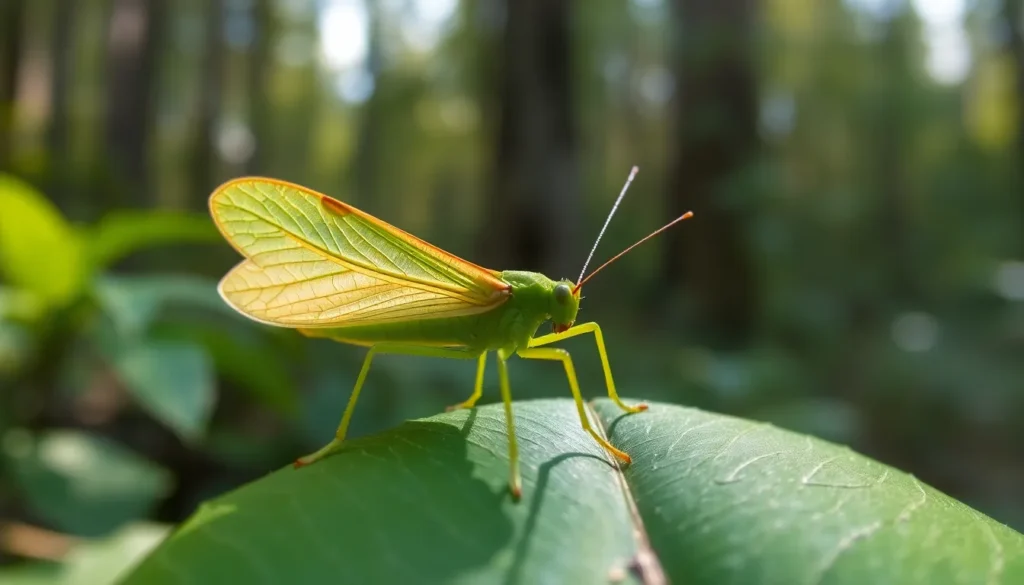
Their green, leaf-like wings help them blend into foliage, protecting them from predators. - Katydids are primarily herbivorous but some are omnivorous.
While many feed on leaves, flowers, and fruit, some species also consume other insects. - They have long, threadlike antennae.
Their antennae often exceed their body length and are used for sensing the environment. - Katydids can be nocturnal or diurnal.
Although many are active at night, some species are active during the day. - They undergo incomplete metamorphosis.
Development includes egg, nymph, and adult stages, with nymphs resembling smaller adults without fully developed wings. - Katydids use their legs for jumping.
Their hind legs are adapted for leaping, similar to grasshoppers. - Some katydids are capable of flight.
Adults of many species have wings and can fly short distances. - Katydids communicate using sound and vibration.
Besides airborne sounds, some species use substrate vibrations to communicate through leaves or stems. - They play a role in food webs as both prey and predator.
Katydids are food for birds, bats, reptiles, and some mammals, while some species prey on smaller insects. - Katydid eggs are often deposited on plant stems or leaves.
The eggs have protective coatings to endure environmental conditions during development. - Some species mimic other insects or objects.
In addition to leaf mimicry, some katydids resemble sticks, bark, or even flowers to avoid detection. - They have auditory organs on their front legs.
Unlike many insects with ears on their heads, katydids have tympanal organs located on their forelegs to detect sound. - Katydid populations can be indicators of ecosystem health.
The presence and diversity of katydids may reflect habitat quality and biodiversity. - Some katydid species produce ultrasonic calls.
These high-frequency sounds may be used to communicate or avoid predators like bats. - Katydids are found on every continent except Antarctica.
Their distribution is broad, but they are most abundant in tropical forests. - Certain species of katydids are considered agricultural pests.
They may cause damage to crops and ornamental plants by feeding on foliage. - Katydids have inspired cultural references and folklore.
In some cultures, their calls are associated with seasonal changes or used in traditional stories.
Habitat and Behavior
Katydids inhabit a wide range of environments, primarily forests, grasslands, and shrublands, where vegetation is abundant. They are often found on leaves, branches, and flowers, blending seamlessly with their surroundings due to their leaf-like wing morphology. Most species are nocturnal, using their sound-producing abilities to communicate after dusk. Their diet mainly consists of plant material, though certain species display omnivorous behavior by preying on smaller insects. Katydids rely heavily on camouflage and their ability to jump or fly to avoid predators. Reproduction involves males producing calls to attract females, followed by egg-laying on plant surfaces where nymphs hatch and undergo several molts before reaching adulthood.
Why This Animal Matters
Katydids play essential roles in ecosystems as both herbivores and predators, influencing plant health and insect populations. They serve as prey for a variety of animals, contributing to food web dynamics. Their sensitivity to environmental changes makes them useful bioindicators for assessing habitat quality and biodiversity. Furthermore, katydids have cultural significance in various regions, often symbolizing natural cycles or inspiring folklore. Some species’ impact on agriculture highlights the need for understanding their biology for integrated pest management. Conservation of katydid habitats supports overall insect diversity and ecological balance.
Common Misconceptions
Misconception: Katydids are harmful to humans.
Correction: Katydids do not pose any direct harm to humans; they do not bite or sting and are generally harmless.
Misconception: All katydids look exactly like leaves.
Correction: While many katydids have leaf-like wings, their appearance varies widely, with some mimicking sticks, bark, or other natural elements.
Misconception: Katydids only eat plants.
Correction: Although mainly herbivorous, some katydid species are omnivorous and will feed on other insects.
Misconception: Katydids are the same as grasshoppers.
Correction: Katydids belong to a different family (Tettigoniidae) and have distinct characteristics such as longer antennae and different sound production methods compared to grasshoppers.
Misconception: Katydids are only found in tropical areas.
Correction: Katydids are found on most continents, including temperate zones, although they are more abundant in tropical regions.
FAQ
What do katydids eat?
Katydids primarily feed on leaves, flowers, and fruits, but some species are omnivorous and consume other insects as well.
How do katydids produce their distinctive sounds?
Male katydids produce sounds by rubbing their forewings together in a process called stridulation to attract females or communicate.
Are katydids harmful to humans?
Katydids are harmless to humans; they do not bite or sting and generally avoid human contact.






Leave a Reply