
Short Answer
21 Facts About Impalas
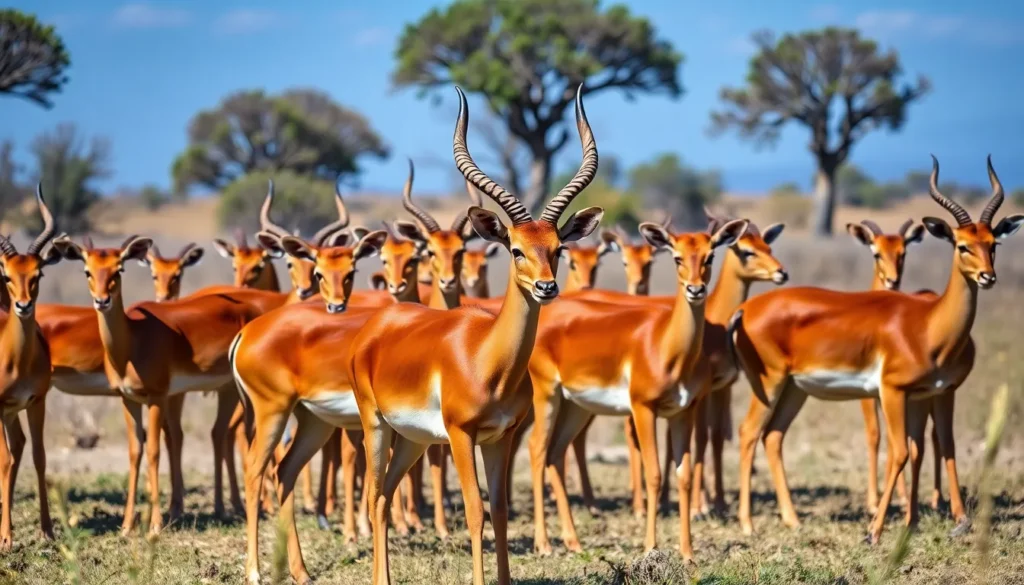
- Medium-sized Antelopes: Impalas are medium-sized antelopes weighing between 40 to 60 kilograms (88 to 132 pounds), making them one of the more agile and lightweight members of the Bovidae family.
- Scientific Name: The scientific name of the impala is Aepyceros melampus, which translates roughly to “high horn with black markings.”
- Two Subspecies: There are two recognized subspecies of impalas: the common impala (Aepyceros melampus melampus) and the black-faced impala (Aepyceros melampus petersi), which is rarer and found mainly in Namibia.
- Distinctive Coat: Their coat is a reddish-brown color with lighter underparts, and they have characteristic black markings on their tail and ears.
- Habitat Range: Impalas inhabit savannas, woodlands, and grasslands across eastern and southern Africa, including countries such as Kenya, Tanzania, Zimbabwe, and South Africa.
- Social Animals: Impalas are highly social and typically live in herds, which can range from small groups of females and young to larger bachelor groups of males.
- Territorial Males: During the breeding season, dominant males establish territories and gather female herds within them to mate.
- Speed and Agility: Impalas are capable of speeds up to 80 km/h (50 mph) and can leap distances of up to 10 meters (33 feet) in a single bound to evade predators.
- Acrobatic Defense: They exhibit a behavior known as “pronking,” where they leap high with stiff legs, which may confuse predators or signal alertness.
- Diverse Diet: Impalas are mixed feeders, grazing on grasses during the wet season and browsing shrubs and bushes during the dry season to adapt to seasonal changes.
- Water Dependency: While impalas can survive for periods without water, they generally remain close to water sources to hydrate regularly.
- Predators: Their main predators include lions, leopards, cheetahs, wild dogs, and crocodiles.
- Vocalizations: Impalas communicate using a variety of sounds, including snorts, whistles, and grunts, which serve as alarm calls or social signals.
- Reproductive Cycle: Gestation lasts about six to seven months, usually resulting in a single calf that remains hidden for several weeks after birth to avoid predation.
- Lifespan: In the wild, impalas typically live around 10 to 12 years, though they may live longer in captivity.
- Horn Structure: Only males have horns, which are lyre-shaped, ridged, and can grow up to 36 centimeters (14 inches) long.
- Antipredator Strategy: When threatened, impalas often run in a zigzag pattern to escape predators and use their agility to jump into dense thickets.
- Role in Ecosystems: As herbivores, impalas play a critical role in shaping vegetation and serving as prey for large carnivores, maintaining ecological balance.
- Population Status: Currently, impalas are classified as Least Concern by the IUCN, with stable populations due to their adaptability and presence in protected areas.
- Cultural Significance: In some African cultures, impalas are symbols of grace and agility and feature in traditional stories and folklore.
- Conservation Challenges: Habitat loss and fragmentation pose localized threats, but conservation efforts including national parks help sustain impala populations.
Habitat and Behavior
Impalas are native to eastern and southern Africa, occupying diverse habitats such as savannas, open woodlands, and grassland-woodland mosaics. They are highly adaptable, able to survive in areas with seasonal rainfall by switching their diet between grazing and browsing. Impalas are social creatures, generally forming herds composed of females and their offspring, while males may form separate bachelor groups or control territories during the mating season. Their behavior includes remarkable agility and speed, which are essential for evading a variety of predators. They communicate through vocalizations and body signals, and males assert dominance through territorial displays and occasional fights using their horns. Water availability influences their movement patterns, usually keeping them within reasonable distance to drinking sources.
Why This Animal Matters
Impalas play a vital ecological role as both herbivores and prey. By feeding on grasses and shrubs, they influence vegetation structure and nutrient cycling within their habitats. Their presence supports predator populations such as lions, leopards, and wild dogs, contributing to ecosystem stability. Beyond ecology, impalas hold cultural significance in various African communities, symbolizing traits such as swiftness and alertness. Conservation-wise, impalas serve as indicators of healthy savanna ecosystems and benefit from protected areas that help preserve biodiversity. Monitoring impala populations provides insights into the health of their habitats and the effectiveness of conservation efforts.
Common Misconceptions
Misconception: Impalas are solitary animals.
Correction: Impalas are social animals that typically live in herds, which provide protection and social structure.
Misconception: Both male and female impalas have horns.
Correction: Only male impalas have horns; females lack horns entirely.
Misconception: Impalas can survive long periods without water.
Correction: While impalas can endure short dry spells, they generally require regular access to water sources.
Misconception: Impalas are forest animals.
Correction: Impalas prefer open savannas, woodlands, and grasslands rather than dense forest environments.
Misconception: Impalas are endangered.
Correction: Impalas are currently listed as Least Concern due to stable populations across their range.
FAQ
Where do impalas live?
Impalas are native to eastern and southern Africa, inhabiting savannas, open woodlands, and grasslands.
Do female impalas have horns?
No, only male impalas have horns. Female impalas lack horns entirely.
How do impalas avoid predators?
Impalas rely on speed, agility, and acrobatic leaps to escape predators, often running in zigzag patterns and hiding in dense vegetation.




Leave a Reply