
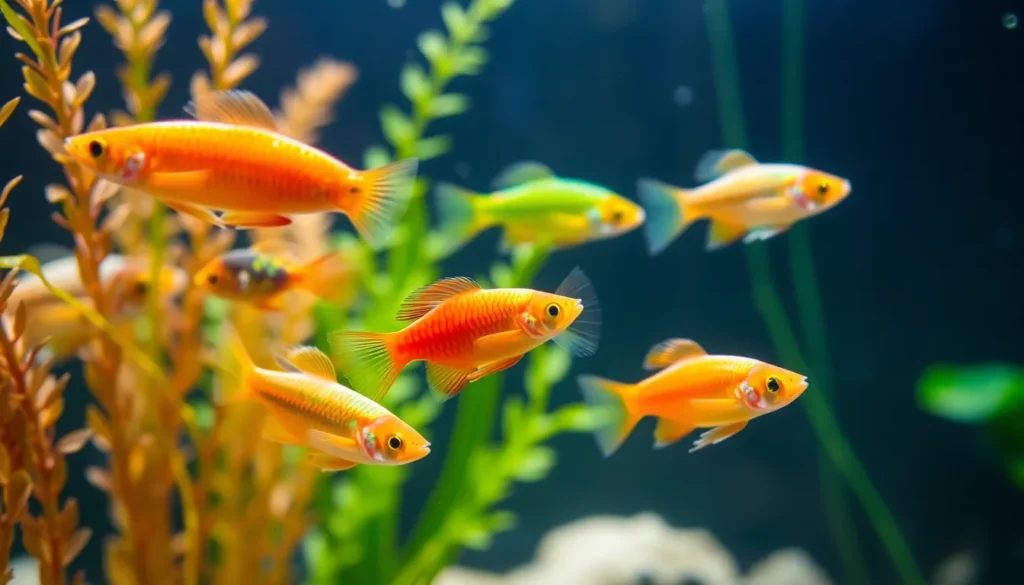
Short Answer
21 Facts About Mollies
- Mollies belong to the Poecilia genus. They are part of the Poeciliidae family, which includes other livebearing fish such as guppies and platies.
- They are livebearers. Unlike many fish that lay eggs, mollies give birth to free-swimming young, known as fry.
- Native range is primarily in North and Central America. Mollies inhabit coastal waters, rivers, and freshwater bodies in the southeastern United States, Mexico, and parts of Central America.
- Mollies can tolerate a wide range of salinity. They are euryhaline fish, capable of living in both freshwater and brackish water environments.
- There are several popular varieties of mollies. These include the sailfin molly, black molly, and dalmatian molly, each with distinct color patterns and fin shapes.
- Mollies are omnivorous. Their diet in the wild consists of algae, detritus, small invertebrates, and plant matter.
- They prefer warm water temperatures. Optimal temperatures for mollies range between 24°C and 28°C (75°F to 82°F).
- Mollies exhibit sexual dimorphism. Males are usually smaller and have a modified anal fin called a gonopodium, which is used during reproduction.
- They have a relatively short lifespan. Mollies typically live two to three years in captivity under good care conditions.
- Mollies can be prolific breeders. Females can store sperm and give birth to multiple broods from a single mating.
- In captivity, mollies require well-maintained water conditions. Poor water quality can lead to stress and disease.
- They are social fish. Mollies often swim in groups and display hierarchical behaviors.
- Mollies contribute to controlling algae in aquariums. Their natural grazing habits help reduce algae growth.
- They are prey for larger fish and birds in the wild. Mollies play an important role in local food webs.
- Mollies have been used in scientific research. Their reproductive biology and adaptability are studied in ecology and evolutionary biology.
- They can hybridize with closely related species. This has implications for both natural populations and aquarium breeding.
- Mollies show variation in coloration due to selective breeding. Aquarium strains often have enhanced colors not typically seen in the wild.
- They prefer habitats with abundant vegetation. Plants provide shelter and breeding sites.
- Mollies have a high tolerance for different pH levels. They can thrive in waters with pH ranging from 7.0 to 8.5.
- They are considered hardy fish for beginners. Due to their adaptability and ease of care, mollies are commonly recommended for novice aquarists.
- Mollies have been introduced outside their native range. In some locations, they are considered invasive species due to their ability to compete with native fish.
Habitat and Behavior
Mollies naturally inhabit slow-moving freshwater and brackish water environments such as streams, ponds, and coastal lagoons. They favor areas with dense aquatic vegetation that offers protection from predators and suitable sites for breeding. As omnivores, mollies forage on algae, small invertebrates, and organic detritus. Their ability to tolerate a wide range of salinity levels enables them to survive in both freshwater and brackish conditions. Behaviorally, mollies are active, social fish that often form shoals. Males display courtship behaviors using their elongated fins to attract females. In captivity, mollies require stable water parameters, a balanced diet, and sufficient space to exhibit natural behaviors.
Why This Animal Matters
Mollies play a significant ecological role as both consumers of algae and prey for larger aquatic and avian predators, contributing to the balance of freshwater ecosystems. Their adaptability to varying environmental conditions makes them useful indicators of habitat health. Culturally, mollies are popular in the aquarium trade due to their hardiness and attractive appearances, supporting economic activity in the pet industry. From a conservation perspective, understanding mollies’ biology aids in managing invasive populations and preserving genetic diversity within native habitats. Additionally, mollies serve as model organisms in scientific studies of reproduction, hybridization, and environmental adaptation.
Common Misconceptions
Misconception: Mollies are strictly freshwater fish.
Correction: Mollies are euryhaline and can tolerate both freshwater and brackish water environments.
Misconception: Mollies lay eggs like most fish.
Correction: Mollies are livebearers, giving birth to fully developed fry instead of laying eggs.
FAQ
Are mollies suitable for beginner aquarists?
Yes, mollies are considered hardy and adaptable, making them suitable for beginners. They require stable water conditions, a balanced diet, and moderate tank size to thrive.
Can mollies live in saltwater?
Mollies cannot live in full marine saltwater but can tolerate brackish water, which has lower salinity than seawater.
How often do mollies reproduce?
Female mollies can give birth approximately every 4 to 6 weeks and can store sperm to fertilize multiple broods from a single mating.

Leave a Reply