
Short Answer
21 Facts About Camouflage in Octopuses
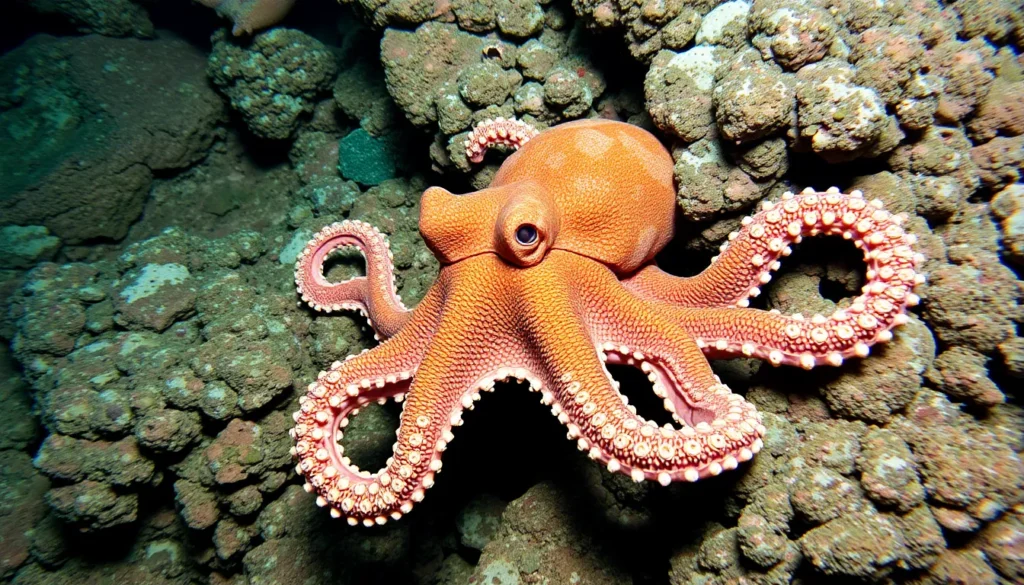
- Complex Skin Structure: Octopuses have specialized skin cells called chromatophores, iridophores, and leucophores that enable rapid color changes.
- Chromatophores: These pigment-containing cells expand or contract to show different colors like red, yellow, and brown.
- Iridophores and Leucophores: These cells reflect and scatter light, producing iridescent and white effects that enhance camouflage.
- Texture Change: Octopuses can alter their skin texture using muscular hydrostats to mimic surfaces such as rocks, coral, or sand.
- Fast Color Change: Octopuses can shift their appearance in less than a second to avoid predators or communicate.
- Camouflage for Hunting: They use camouflage to stealthily approach prey without detection.
- Environmental Matching: Octopuses assess their surroundings visually to match colors and patterns precisely.
- Dynamic Camouflage: Their camouflage is not static but adapts continuously as they move through different environments.
- Communication Use: Besides concealment, color changes serve as signals to other octopuses during mating or territorial displays.
- Brain Control: The camouflage system is controlled directly by the octopus’s brain rather than reflexive processes.
- Camouflage and Intelligence: Their ability to camouflage is linked to their high intelligence and complex nervous system.
- Predator Avoidance: Effective camouflage helps them evade predators like sharks, dolphins, and larger fish.
- Deceptive Displays: Some species use camouflage to mimic dangerous animals or objects, deterring threats.
- Color Vision: Octopuses are colorblind, yet they achieve precise color matching, possibly by detecting contrast or polarization of light.
- No Protective Shell: The reliance on camouflage compensates for their lack of a hard protective shell.
- Camouflage in Different Species: Various octopus species have different camouflage capabilities suited to their habitats.
- Camouflage During Rest: Octopuses maintain camouflage even while resting to avoid detection.
- Learning and Adaptation: Octopuses can learn to improve their camouflage efficiency based on experience.
- Camouflage and Regeneration: After injury and regeneration, octopuses retain their camouflage abilities.
- Camouflage Limits: Camouflage is less effective in open water where backgrounds are uniform and movement is more visible.
- Scientific Study: Researchers study octopus camouflage to inspire advances in materials science and robotics.
Habitat and Behavior
Octopuses inhabit diverse marine environments, including coral reefs, rocky shores, and ocean floors globally. They are generally solitary creatures, using their camouflage to avoid predators and stealthily hunt prey such as crabs, fish, and mollusks. Their ability to rapidly change color and texture allows them to blend into complex habitats and adapt to various lighting conditions. They are nocturnal hunters, often resting during the day while maintaining camouflage. Their behavior includes problem-solving, exploration, and escape tactics, with camouflage playing a critical role in all these activities.
Why This Animal Matters
Octopuses play a vital role in marine ecosystems as both predators and prey, helping maintain balanced populations of various species. Their camouflage abilities contribute to their survival and reproductive success, influencing food webs. Furthermore, the study of octopus camouflage has cultural significance in many societies due to their mysterious and remarkable nature. Scientifically, understanding their camouflage mechanisms offers insights into neurobiology, adaptive evolution, and biomimicry technologies, including dynamic camouflage materials and soft robotics.
Common Misconceptions
Misconception: Octopuses change color only for camouflage.
Correction: While camouflage is a primary use, octopuses also change color for communication, mating displays, and warning signals.

Misconception: Octopuses have perfect color vision to match their environment.
Correction: Octopuses are believed to be colorblind but use other visual cues such as light polarization and contrast to mimic their surroundings effectively.
Misconception: Camouflage in octopuses is purely a reflexive, automatic process.
Correction: Camouflage is under direct control of the octopus’s brain and involves complex cognitive processing to assess and adapt to the environment.
FAQ
How do octopuses change their color so quickly?
Octopuses change color rapidly by expanding or contracting chromatophores—pigment-filled sacs in their skin—along with iridophores and leucophores that reflect and scatter light. These changes are controlled directly by neural signals from their brain, allowing near-instantaneous color shifts.
Why do octopuses need camouflage?
Camouflage helps octopuses avoid predators by blending into their surroundings, making them less visible. It also aids in hunting, allowing them to stealthily approach prey without detection. Additionally, color changes serve communication roles within species.
Are octopuses the only animals that use camouflage?
No, many animals use camouflage, including other cephalopods like cuttlefish and squid, as well as reptiles, amphibians, insects, and fish. However, octopuses are among the most versatile due to their ability to change both color and skin texture dynamically.

Leave a Reply