
Short Answer
21 Facts About Gibbons
- Smallest of the Lesser Apes
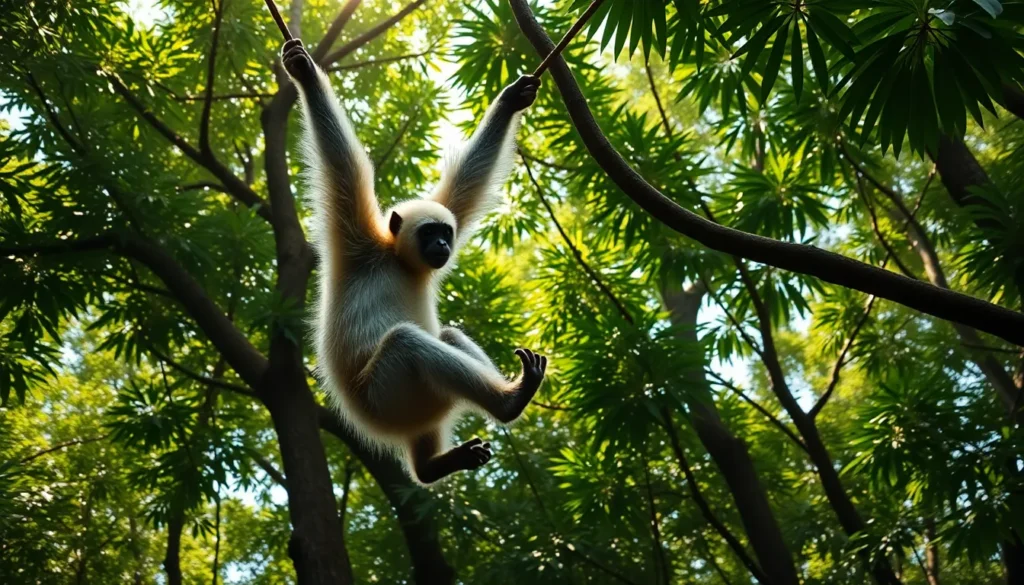
Gibbons belong to the family Hylobatidae and are considered the smallest apes, distinct from the great apes like chimpanzees and gorillas. - Exceptional Brachiators
Gibbons move through trees by brachiation, swinging from branch to branch using their long arms, enabling speeds up to 35 miles per hour. - Monogamous Pair Bonds
Most gibbon species form monogamous pairs, maintaining lifelong bonds with their mates and jointly defending their territory. - Territorial Vocalizations
Gibbons produce loud, complex songs that serve to mark territory boundaries and strengthen pair bonds. - Native to Southeast Asia
Their range includes countries such as Thailand, Malaysia, Indonesia, and parts of southern China and Myanmar. - Diverse Species
There are about 20 recognized species of gibbons, varying in size, color, and vocal patterns. - Diet Primarily Frugivorous
Gibbons mainly eat fruit but also consume leaves, flowers, and insects. - Highly Agile and Adapted for Arboreal Life
Their lightweight bodies, long arms, and hook-shaped hands help them navigate high canopies effectively. - Distinctive Call Patterns
Each species has unique calls, and duets between mates are common, used for communication and bonding. - Absence of Tail
Unlike monkeys, gibbons lack tails, a characteristic feature of apes. - Long Lifespan
In the wild, gibbons can live up to 25-30 years, and longer in captivity. - Low Reproductive Rate
Females typically give birth to one offspring every two to three years, which contributes to their vulnerability. - Social Structure
Beyond the bonded pair, gibbons are relatively territorial and avoid large groups. - Highly Visual Species
Gibbons have excellent vision, which aids in navigation and social signaling in dense forests. - Vulnerable Conservation Status
Many gibbon species are threatened or endangered due to habitat loss and hunting. - Important Seed Dispersers
By consuming fruit and excreting seeds, gibbons help maintain forest diversity and regeneration. - Sexual Dimorphism Varies by Species
In some species, males and females differ in coloration, while in others, both sexes look similar. - Gibbons Have a Unique Wrist Adaptation
Their ball-and-socket wrist joint allows for greater flexibility necessary for brachiation. - Gibbons Can Live in a Range of Forest Types
They inhabit tropical rainforests, seasonal forests, and sometimes mountainous forests. - Cultural Significance
In some Southeast Asian cultures, gibbons appear in folklore and traditional stories symbolizing agility and freedom. - Research Importance
Gibbons provide valuable insight into primate evolution, social behavior, and locomotion.
Habitat and Behavior
Gibbons are primarily arboreal primates inhabiting the dense tropical and subtropical forests of Southeast Asia. They prefer the upper canopy layers where they find abundant fruit, their primary food source. Their unique mode of locomotion, brachiation, allows them to swing rapidly and effortlessly through trees, covering large distances with minimal energy expenditure. Gibbons live in small family groups typically consisting of a monogamous pair and their offspring, defending territories through vocal calls and physical displays. Their vocal duets are not only territorial signals but also strengthen pair bonds. Gibbons exhibit diurnal activity patterns and spend most of their time feeding, resting, and moving through the forest canopy.
Why This Animal Matters
Gibbons play a crucial ecological role as seed dispersers, facilitating forest regeneration and biodiversity. Their presence indicates healthy forest ecosystems, making them important bioindicators. Conservation of gibbons is vital due to their vulnerability from habitat destruction, hunting, and the illegal pet trade. Culturally, gibbons hold symbolic meaning in various Southeast Asian traditions and contribute to local ecotourism economies. Scientifically, studying gibbons enhances understanding of primate evolution, especially the divergence between lesser and great apes, as well as primate locomotion and social systems.
Common Misconceptions
Misconception: Gibbons are monkeys.
Correction: Gibbons are apes, not monkeys. Unlike monkeys, they lack tails and have different skeletal structures, particularly adapted for brachiation.
Misconception: All gibbons are the same species.
Correction: There are about 20 distinct species of gibbons, each with unique physical and vocal characteristics.
FAQ
What is the primary diet of gibbons?
Gibbons primarily eat fruit, supplemented by leaves, flowers, and insects, making them mostly frugivorous.
How do gibbons move through the forest?
Gibbons use brachiation, swinging from branch to branch using their long arms, which allows fast and efficient movement through the canopy.
Are gibbons endangered?
Many gibbon species are classified as vulnerable, endangered, or critically endangered due to habitat loss, hunting, and the illegal pet trade.


Leave a Reply