
Short Answer
21 Facts About Quails
- Quails are small to medium-sized birds. They typically range from 5 to 14 inches in length, depending on the species.
- There are over 130 species of quail worldwide. They are primarily native to the Americas, Africa, and Asia.
- Quails belong to the family Phasianidae. This family also includes pheasants, partridges, and turkeys.
- Quails are ground-dwelling birds. They spend most of their time on or near the ground, where they forage for food and nest.
- Many quail species are known for their distinctive calls. These calls serve to communicate within coveys (groups) and to alert of danger.
- Quails have a unique method of flight. They typically fly in short bursts at high speed, often to escape predators.
- They are omnivorous. Their diet includes seeds, insects, and small invertebrates.
- Quail eggs are small and speckled. They are often used in culinary dishes around the world.
- Quails are popular game birds. They have been hunted for food and sport for centuries.
- Some species of quail form monogamous pairs. However, social structures vary widely among species.
- Quails are known for their rapid reproduction. Many species can produce multiple broods per year under favorable conditions.
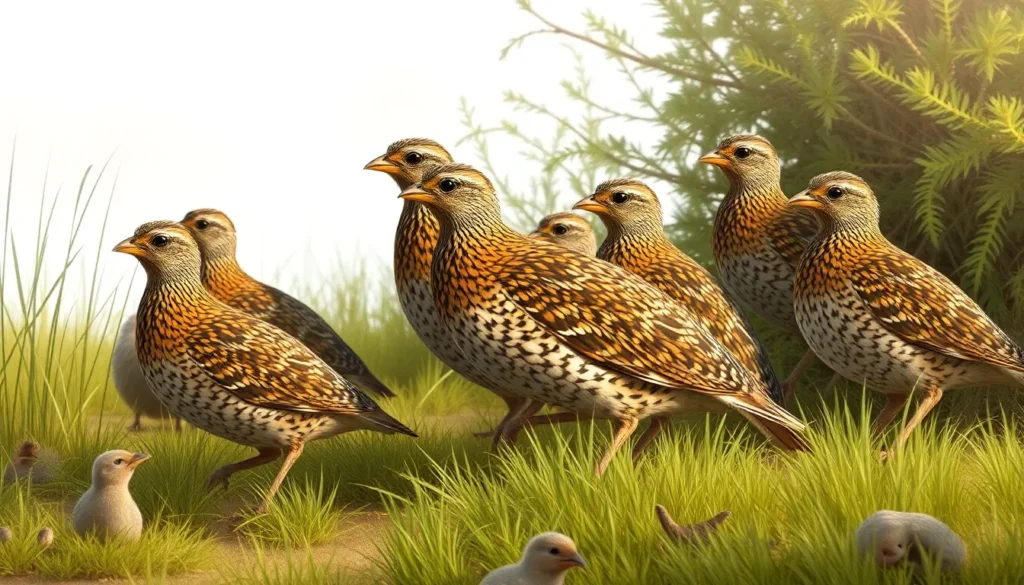
- Quails use camouflage to avoid predators. Their plumage often mimics their environment, such as dry grass or leaf litter.
- The California quail is the official state bird of California. It is known for its distinctive forward-drooping plume.
- Quails have been domesticated in some regions. Domesticated quails are often raised for eggs and meat.
- Quail chicks are precocial. This means they are relatively mature and mobile shortly after hatching.
- Quail populations are affected by habitat loss. Urbanization and agriculture reduce their natural habitats.
- Quails play a role in seed dispersal. By consuming seeds and excreting them, they contribute to plant propagation.
- Some quail species are migratory. They move seasonally to find suitable feeding and breeding grounds.
- Quails have been featured in folklore and symbolism. In some cultures, they represent fertility and protection.
- Quails have distinct social behaviors. Many species form coveys during non-breeding seasons for protection and foraging efficiency.
- Conservation efforts exist for certain quail species. Some species are threatened or endangered and benefit from habitat preservation programs.
Habitat and Behavior
Quails inhabit a variety of environments, including grasslands, woodlands, deserts, and agricultural fields. Their preference for dense ground cover helps them avoid predators and find food. Behaviorally, quails are mostly terrestrial and rely on short bursts of flight to escape threats. They are social birds, often forming coveys that forage together and provide collective vigilance. Breeding behaviors vary by species, but many quails build simple nests on the ground and exhibit rapid chick development to reduce vulnerability. Their adaptability to different habitats has allowed some species to thrive even in human-altered landscapes, though habitat destruction remains a significant threat.
Why This Animal Matters
Ecologically, quails are important as both prey and seed dispersers, contributing to the balance of their ecosystems. Their diet helps control insect populations, and their seed consumption aids in plant distribution. Culturally, quails have significance in hunting traditions and culinary practices worldwide. Conservation-wise, quail species can act as indicators of habitat health, with declining populations signaling environmental issues. Efforts to preserve quail habitats and populations not only benefit these birds but also support broader biodiversity and ecosystem stability.
Common Misconceptions
Misconception: Quails can fly long distances like migratory birds.
Correction: While some quail species undertake seasonal movements, quails generally fly only short distances in rapid bursts and are not long-distance migratory birds.
Misconception: All quail species look the same.
Correction: There is significant variation in size, coloration, and behavior among the over 130 quail species worldwide.
Misconception: Quail eggs are poisonous.
Correction: Quail eggs are safe to eat and are considered a delicacy in many cultures.
Misconception: Quails are solitary birds.
Correction: Most quails are social and often form coveys, especially outside of the breeding season.
FAQ
What do quails eat?
Quails are omnivorous and eat a variety of seeds, insects, and small invertebrates depending on availability and species.
Are quails good pets?
Quails are sometimes kept as pets or for eggs, but they require specific care, including secure enclosures and proper diet.
How do quails protect themselves from predators?
Quails rely on camouflage to blend into their environment and use quick, short flights to escape predators. They also often stay within groups to increase vigilance.

Leave a Reply