
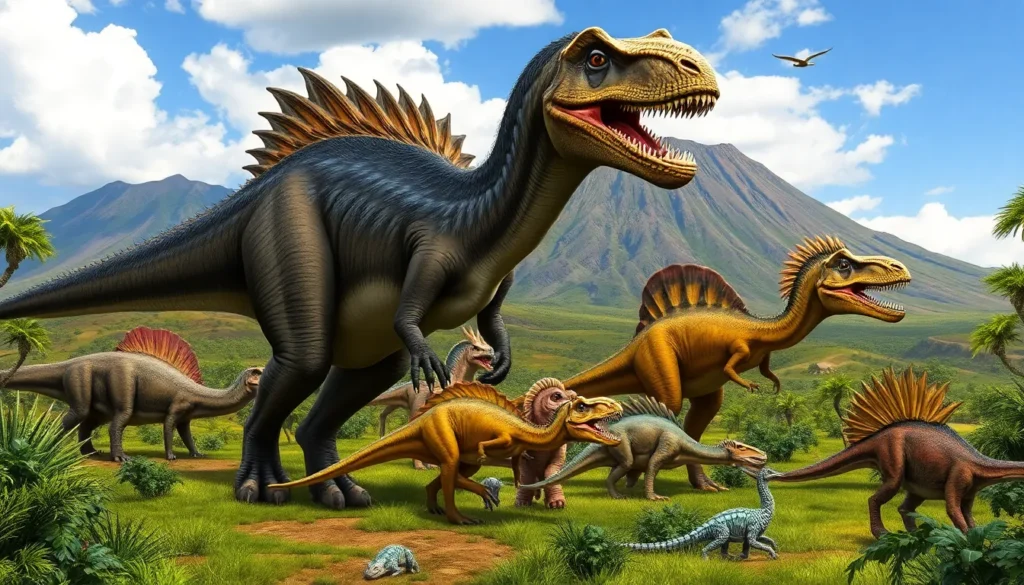
Short Answer
21 Facts About Dinosaurs
- Dinosaurs lived during the Mesozoic Era.
They thrived approximately between 230 and 65 million years ago, spanning the Triassic, Jurassic, and Cretaceous periods. - Dinosaurs are divided into two main groups.
These groups are the Saurischia (lizard-hipped) and Ornithischia (bird-hipped), based on differences in their pelvic structures. - Birds are considered modern dinosaurs.
Scientific consensus supports that birds evolved from theropod dinosaurs, making them the only surviving dinosaur lineage. - Many dinosaurs had feathers.
Fossil evidence, especially from theropods, shows the presence of feathers, which may have been used for insulation, display, or flight. - Not all dinosaurs were gigantic.
While some species like Argentinosaurus were enormous, many were small, some comparable in size to modern birds or mammals. - Dinosaurs were primarily terrestrial animals.
They occupied a wide range of habitats but were mostly land dwellers, with no evidence of fully aquatic dinosaurs. - Some dinosaurs were herbivores, others carnivores.
Diet varied widely, with species adapted for eating plants, meat, or both. - Theropods were mostly carnivorous.
This group includes famous predators like Tyrannosaurus rex and Velociraptor. - Hadrosaurs are known as “duck-billed” dinosaurs.
They had specialized teeth for chewing plants and often lived in herds. - Some dinosaurs had elaborate crests or horns.
These features likely served for species recognition, sexual selection, or defense. - Dinosaurs laid eggs.
Fossils show nests and eggs, indicating that many species cared for their young. - The Cretaceous-Paleogene extinction event ended the non-avian dinosaurs.
This mass extinction about 66 million years ago is often linked to an asteroid impact and volcanic activity. - Fossilization of dinosaurs is a rare process.
It requires specific conditions, which is why only a small fraction of dinosaurs that lived are known from fossils. - Some dinosaurs had complex social behaviors.
Evidence from trackways and nesting sites suggests group living and parental care. - Dinosaurs’ metabolic rates are debated.
Research continues on whether they were cold-blooded, warm-blooded, or somewhere in between. - Dinosaurs show a wide range of locomotion.
Some were bipedal, others quadrupedal, and some could switch between modes. - Fossils have been found on every continent.
This indicates dinosaurs had a global distribution during the Mesozoic Era. - Scientific understanding of dinosaurs has changed significantly.
New fossil discoveries and technologies frequently update knowledge about their appearance and behavior. - Dinosaurs influenced popular culture extensively.
They have been featured in literature, films, and museums, shaping public interest in paleontology. - Some dinosaurs had keen senses.
Evidence suggests good vision, hearing, and smell in various species. - Research on dinosaurs continues worldwide.
Paleontologists keep uncovering new species and refining the understanding of dinosaur biology and evolution.
Habitat and Behavior
Dinosaurs inhabited diverse terrestrial environments across all continents, including forests, floodplains, deserts, and coastal regions during the Mesozoic Era. Their behavior ranged widely, from solitary to social species, with evidence of herding, nesting, and possible parental care. Many were highly adapted to their ecological niches, exhibiting specialized diets and locomotion. Some species were fast runners, while others moved slowly but had defensive adaptations. Their survival strategies included camouflage, display features, and possibly vocal communication. Despite their diversity, no evidence supports aquatic lifestyles for true dinosaurs, though some contemporaneous reptiles occupied marine habitats.
Why This Animal Matters
Dinosaurs are crucial to understanding Earth’s biological and evolutionary history, representing a dominant group that shaped terrestrial ecosystems for over 160 million years. Their fossils provide insight into prehistoric life, extinction events, and evolutionary transitions, including the origin of birds. Dinosaurs have significant cultural importance, inspiring scientific research, education, and popular media worldwide. Studying dinosaurs also informs conservation biology by illustrating past biodiversity changes and mass extinctions, helping scientists understand current environmental challenges.
Common Misconceptions
Misconception: All dinosaurs were giant and slow.
Correction: Dinosaurs varied greatly in size and speed, ranging from small, agile species to large, slow-moving ones.
Misconception: Dinosaurs and humans coexisted.
Correction: Dinosaurs went extinct about 66 million years before humans appeared.
Misconception: Dinosaurs were all cold-blooded like modern reptiles.
Correction: Scientific evidence suggests a range of metabolic rates, with some dinosaurs possibly warm-blooded or exhibiting intermediate metabolic traits.
FAQ
When did dinosaurs live?
Dinosaurs lived during the Mesozoic Era, approximately from 230 million years ago until their extinction about 66 million years ago.
Are birds dinosaurs?
Yes, modern birds are considered avian dinosaurs that evolved from theropod ancestors, making dinosaurs a group that includes both extinct species and living birds.
What caused the extinction of non-avian dinosaurs?
The leading theory for the extinction of non-avian dinosaurs is the Cretaceous-Paleogene event, linked to a large asteroid impact and subsequent environmental changes.






Leave a Reply