
Short Answer
21 Facts About Cuckoo Brood Parasitism
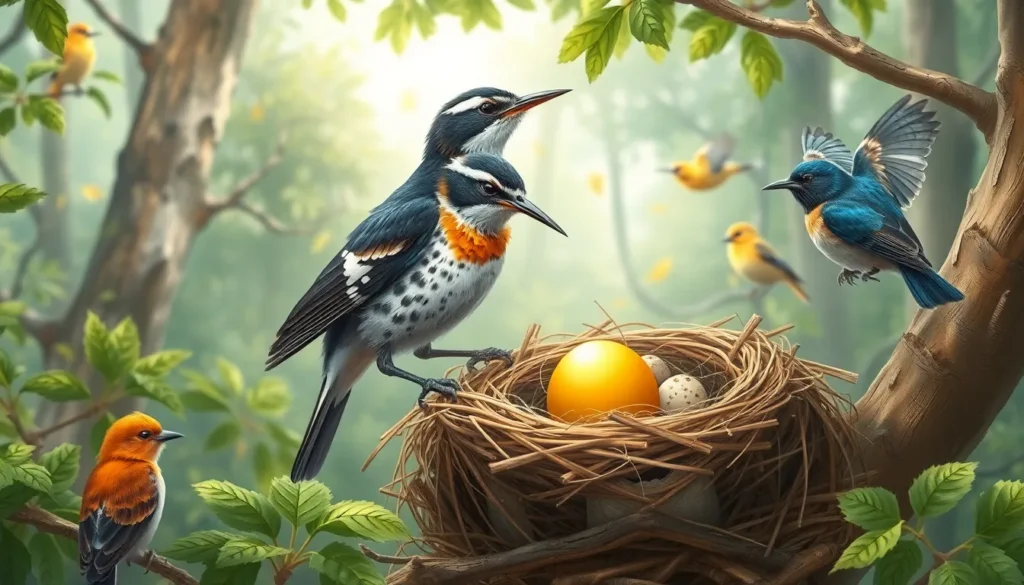
- Definition: Cuckoo brood parasitism refers to the behavior of some cuckoo species laying their eggs in the nests of other bird species, leaving the host birds to incubate and raise the cuckoo chicks.
- Evolutionary Strategy: This reproductive strategy evolved as a way to save energy and resources since the parasitic cuckoo avoids parental care duties.
- Host Species Diversity: Cuckoos parasitize a wide variety of bird species, often selecting hosts that are smaller and unable to defend their nests effectively.
- Egg Mimicry: Many cuckoo species have evolved eggs that closely mimic the appearance of their host’s eggs to reduce the chances of rejection.
- Egg Laying Speed: Female cuckoos can lay their eggs very quickly, sometimes in less than 10 seconds, to avoid detection by the host bird.
- Chick Behavior: Cuckoo chicks often hatch earlier than the host’s eggs and may push the host’s eggs or chicks out of the nest to monopolize parental care.
- Host Recognition: Some host species have developed the ability to recognize and reject cuckoo eggs, leading to an evolutionary arms race.
- Impact on Host Population: Brood parasitism can negatively affect host bird populations by reducing their reproductive success.
- Variation Among Cuckoo Species: Not all cuckoo species are brood parasites; some raise their own young.
- Geographical Distribution: Brood parasitic cuckoos are found primarily in Europe, Asia, Africa, and Australia.
- Host Specificity: Some cuckoo species specialize in parasitizing a single host species, while others are generalists.
- Learning and Memory: Female cuckoos memorize the specific characteristics of their host species’ nests and eggs.
- Male Cuckoo Role: Male cuckoos do not participate in raising offspring and focus on defending territories and mating.
- Impact on Ecosystems: Brood parasitism influences bird community dynamics and can affect biodiversity.
- Parasitic Chick Growth: Cuckoo chicks often grow faster than host chicks due to preferential feeding by foster parents.
- Sound Mimicry: Some cuckoo chicks imitate the begging calls of multiple host chicks to maximize feeding.
- Host Nest Selection: Cuckoo females carefully select host nests at the right stage of incubation for laying their eggs.
- Parental Investment Shift: Brood parasitism shifts parental investment from the parasite to the host species.
- Co-evolution: The interaction between cuckoos and their hosts is a notable example of co-evolutionary adaptation.
- Brood Parasitism Beyond Cuckoos: Although cuckoos are the most famous brood parasites, other birds like cowbirds and honeyguides also exhibit this behavior.
- Research Importance: Cuckoo brood parasitism is widely studied to understand evolutionary biology, behavioral ecology, and host-parasite interactions.
Habitat and Behavior
Cuckoos that practice brood parasitism inhabit diverse environments ranging from woodlands and forests to grasslands and farmlands. They are most commonly found across Europe, Asia, Africa, and Australia. These birds exhibit secretive and quick behaviors when locating suitable host nests. Female cuckoos carefully observe potential host species to ensure their eggs will be accepted. After laying an egg, the cuckoo typically leaves the host to incubate and care for the chick. The parasitic chick usually hatches earlier, often ejecting host eggs or chicks to monopolize parental care. This behavior ensures the cuckoo chick receives all the food and attention from the foster parents, facilitating its growth and survival.
Why This Animal Matters
Cuckoo brood parasitism plays a significant ecological role by influencing host species’ reproductive strategies and population dynamics. The evolutionary arms race between cuckoos and their hosts illustrates complex co-evolutionary processes. Additionally, cuckoos contribute to biodiversity by affecting the distribution and behavior of various bird species. From a scientific perspective, studying cuckoo parasitism provides insights into behavioral ecology, evolutionary biology, and adaptation. Culturally, cuckoos have been referenced in folklore and literature across many societies, often symbolizing deceit or trickery due to their parasitic breeding method. Conservation relevance varies by species, with some cuckoo populations threatened by habitat loss and environmental changes.
Common Misconceptions
Misconception: All cuckoos are brood parasites.
Correction: While many cuckoo species are brood parasites, some cuckoos raise their own young without parasitizing other birds.
Misconception: Cuckoo chicks always push host eggs out of the nest.
Correction: Although many cuckoo chicks do eject host eggs or chicks, some parasitic chicks coexist with host young depending on the species and situation.
Misconception: Host birds always reject cuckoo eggs.
Correction: Not all host species recognize or reject cuckoo eggs; success depends on egg mimicry and host discrimination ability.
Misconception: Brood parasitism is harmful only to the host species.
Correction: Brood parasitism impacts both the host and parasite populations, influencing ecological balances and evolutionary trajectories.
Misconception: Male cuckoos help raise the parasitic chicks.
Correction: Male cuckoos do not participate in parental care; all care is provided by the unwitting host birds.
FAQ
What is cuckoo brood parasitism?
It is a reproductive strategy where cuckoos lay their eggs in the nests of other bird species, relying on those hosts to incubate and raise their chicks.
How do cuckoos avoid detection by host birds?
Many cuckoo species lay eggs that closely mimic the color, size, and pattern of the host’s eggs, reducing the chance that hosts will recognize and reject them.
Do all cuckoo species practice brood parasitism?
No, only certain species of cuckoos are brood parasites. Others raise their own offspring without parasitizing other birds.

Leave a Reply