
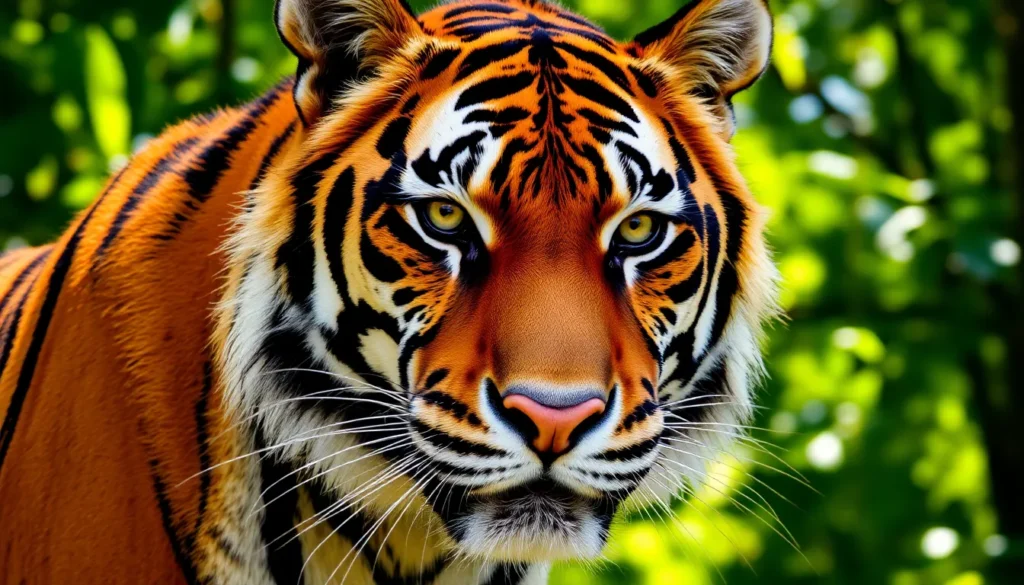
Short Answer
21 Facts About Bengal Tigers
- Scientific Classification: The Bengal tiger is scientifically known as Panthera tigris tigris, one of the six extant tiger subspecies.
- Geographic Range: Bengal tigers primarily inhabit India, but also Bangladesh, Nepal, Bhutan, and Myanmar.
- Population Estimates: Approximately 2,500 Bengal tigers remain in the wild, making them the most numerous tiger subspecies.
- Physical Size: Male Bengal tigers typically weigh between 180 to 258 kg (400 to 570 lbs), with females being smaller, averaging 100 to 160 kg (220 to 350 lbs).
- Distinctive Coat: Their orange coat with black stripes provides camouflage in dense forests and grasslands.
- Stripe Patterns: Each tiger’s stripe pattern is unique, similar to human fingerprints.
- Territorial Behavior: Bengal tigers are solitary and territorial animals, with males having larger territories overlapping with several females.
- Diet and Hunting: Their diet consists mainly of ungulates such as deer, wild boar, and buffalo, hunted primarily at night.
- Swimming Abilities: Bengal tigers are strong swimmers and often enter water bodies to cool off or cross rivers.
- Communication: They communicate through vocalizations such as roars, growls, and chuffing sounds.
- Reproductive Cycle: Female Bengal tigers have a gestation period of about 3.5 months and typically give birth to 2-4 cubs.
- Lifespan: In the wild, Bengal tigers live around 8-10 years, while in captivity they can live up to 20 years.
- Conservation Status: The Bengal tiger is classified as Endangered by the IUCN due to habitat loss and poaching.
- Protected Areas: They are protected in numerous reserves and national parks across their range, including India’s Sundarbans and Ranthambore.
- Ecological Role: As apex predators, Bengal tigers help maintain healthy populations of prey species, balancing ecosystems.
- Cultural Significance: Bengal tigers are national animals of India and Bangladesh and feature prominently in local folklore and symbolism.
- Poaching Threats: Tigers face poaching for their skins, bones, and other body parts used in traditional medicine.
- Human-Wildlife Conflict: Encroachment and habitat fragmentation often lead to conflicts with humans, sometimes resulting in retaliatory killings.
- Genetic Diversity: Bengal tigers show relatively high genetic diversity compared to some other tiger subspecies.
- Adaptability: They inhabit a range of environments from mangrove swamps to grasslands and tropical forests.
- Research and Monitoring: Camera traps and tracking collars are commonly used to study Bengal tiger populations and behavior.
Habitat and Behavior
Bengal tigers occupy diverse habitats across the Indian subcontinent, including tropical and subtropical forests, grasslands, and mangrove swamps such as the Sundarbans. They are solitary animals that establish and defend large territories, with males typically occupying larger ranges that overlap with multiple females. Bengal tigers are primarily nocturnal hunters, relying on stealth and power to ambush prey. They are adept swimmers, which helps them navigate their often-waterlogged environments. Their diet consists mainly of medium to large ungulates, but they can also prey on smaller mammals, birds, and reptiles. Bengal tigers communicate using vocalizations, scent markings, and visual signals. Reproduction occurs year-round, with females raising cubs alone until they are old enough to survive independently.
Why This Animal Matters
The Bengal tiger plays a crucial ecological role as an apex predator by controlling prey populations and maintaining ecosystem balance. Their presence indicates a healthy habitat, as they require large, undisturbed territories and abundant prey. Culturally, Bengal tigers hold significant symbolic value in many South Asian cultures, representing strength and power. They are also a vital part of wildlife tourism, which can support conservation efforts and local economies. However, their endangered status highlights the challenges of habitat destruction, poaching, and human-wildlife conflict. Protecting Bengal tigers and their habitats helps conserve broader biodiversity and ensures ecological resilience in the regions they inhabit.
Common Misconceptions
Misconception: Bengal tigers are man-eaters and frequently attack humans.
Correction: While tiger attacks on humans do occur, they are relatively rare and usually result from habitat encroachment or injured animals unable to hunt natural prey.
Misconception: All tigers are the same and interchangeable.
Correction: Bengal tigers are a distinct subspecies with unique genetic, morphological, and behavioral traits different from other tiger subspecies.
Misconception: Tigers only live in dense jungles.
Correction: Bengal tigers inhabit a variety of landscapes, including grasslands, wetlands, and mangrove forests, showing adaptability to different environments.
Misconception: Tigers are solitary and never interact.
Correction: While primarily solitary, Bengal tigers interact during mating, maternal care, and occasionally in overlapping territories.
Misconception: Bengal tigers can be easily domesticated or kept as pets.
Correction: Bengal tigers are wild apex predators requiring extensive space and specialized care; they are not suitable as pets and keeping them is illegal in most places.
FAQ
Where are Bengal tigers found?
Bengal tigers are primarily found in India, with smaller populations in Bangladesh, Nepal, Bhutan, and Myanmar.
What do Bengal tigers eat?
They mainly prey on large ungulates such as deer, wild boar, and water buffalo, but can also hunt smaller animals.
Why are Bengal tigers endangered?
Bengal tigers face threats from habitat loss, poaching, and human-wildlife conflict, leading to their classification as Endangered.





Leave a Reply