
Short Answer
21 Facts About Bee Waggle Dance
- Discovered by Karl von Frisch: The bee waggle dance was first decoded in the 1940s by Austrian ethologist Karl von Frisch, who won a Nobel Prize for this work.
- Communication through movement: The dance involves a bee shaking its body and moving in a figure-eight pattern to communicate.
- Distance indication: The duration of the waggle part of the dance correlates with the distance to the food source.
- Directional information: The angle of the waggle run relative to the vertical comb indicates the direction of the food relative to the sun.
- Uses the sun as a compass: Bees adjust their dances based on the sun’s position, even on cloudy days.
- Intensity signals quality: The vigor and repetition of the dance can indicate the quality or abundance of the resource.
- Communication is within the hive: The dance occurs inside the hive, where other bees observe and interpret it.
- Different dances for different purposes: Besides the waggle dance, bees also perform a round dance indicating nearby food sources.
- Scientific confirmation: Experiments using artificial feeders have confirmed the accuracy of the waggle dance in directing bees.
- Use in navigation: Bees rely on the dance to efficiently find new sources of nectar and pollen.
- Variation by species: While the waggle dance is typical of honeybees (Apis mellifera), other bee species may use different communication methods.
- Learning component: Young bees learn to interpret dances through experience and observation.
- Environmental sensitivity: Factors like wind and terrain affect the accuracy of the dance’s conveyed information.
- Vibration signals: Bees produce vibrations during the waggle dance that may help transmit information.
- Complex social behavior: The waggle dance is an example of sophisticated social communication in insects.
- Energy efficient: The dance allows bees to conserve energy by directing others rather than searching randomly.
- Role in colony survival: Efficient foraging communication aids in the colony’s food collection and overall health.
- Non-verbal symbolic language: It is considered one of the few examples of symbolic communication in non-human animals.
- Adaptation over time: The dance has evolved to maximize information transfer in a compact and effective manner.
- Influences hive decision-making: The waggle dance can affect which food sources the colony prioritizes.
- Subject of ongoing research: Scientists continue to study the nuances and neural mechanisms behind the waggle dance.
Habitat and Behavior
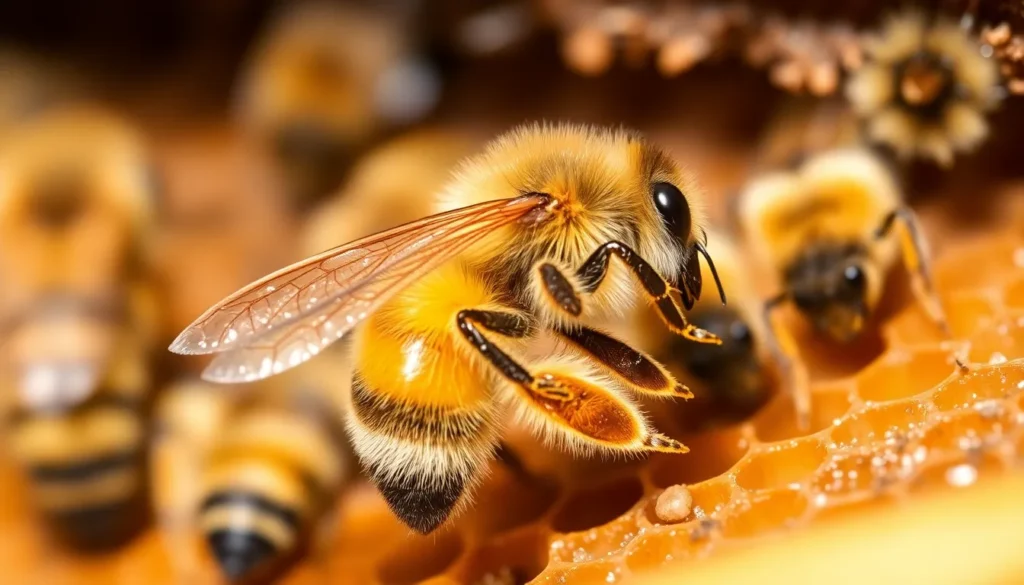
Honeybees, the primary users of the waggle dance, typically inhabit temperate and tropical regions worldwide. They live in colonies consisting of a queen, workers, and drones, often nesting in hollow trees or human-made hives. The waggle dance is performed inside the hive on vertical comb surfaces. Worker bees forage for nectar and pollen and use the dance to inform others about the location of valuable resources. This behavior helps optimize foraging efficiency and ensures the colony’s survival by efficiently exploiting available food sources.
Why This Animal Matters
Honeybees play a critical ecological role as pollinators of many plant species, including important agricultural crops. The waggle dance is fundamental to their ability to effectively communicate and coordinate foraging. This communication method enhances the colony’s capacity to gather resources, supporting not only the bees themselves but also broader ecosystems and human food production. Additionally, the waggle dance is a key subject in the study of animal behavior, communication, and cognition, offering insights into the complexity of insect societies.
Common Misconceptions
Misconception: The waggle dance only shows direction.
Correction: The waggle dance conveys both direction and distance to the resource, as well as the quality of the food source.
Misconception: All bees perform the waggle dance.
Correction: The waggle dance is specific to honeybees; many other bee species use different communication methods.
Misconception: The waggle dance is instinctive and not learned.
Correction: While largely innate, bees improve their interpretation of the dance through experience.
Misconception: The dance is a simple movement without complexity.
Correction: The waggle dance is a highly sophisticated form of symbolic communication involving multiple parameters.
FAQ
What is the bee waggle dance?
The bee waggle dance is a form of communication used by honeybees to inform other members of the colony about the location, distance, and quality of food sources through specific movements inside the hive.
How do bees use the waggle dance to indicate direction?
Bees perform the waggle run at an angle relative to the vertical comb to indicate the direction of the food source relative to the sun's position.
Can all bee species perform the waggle dance?
No, the waggle dance is specific to honeybees. Other bee species may use different methods of communication.





Leave a Reply