
Short Answer
21 Facts About Army Ants
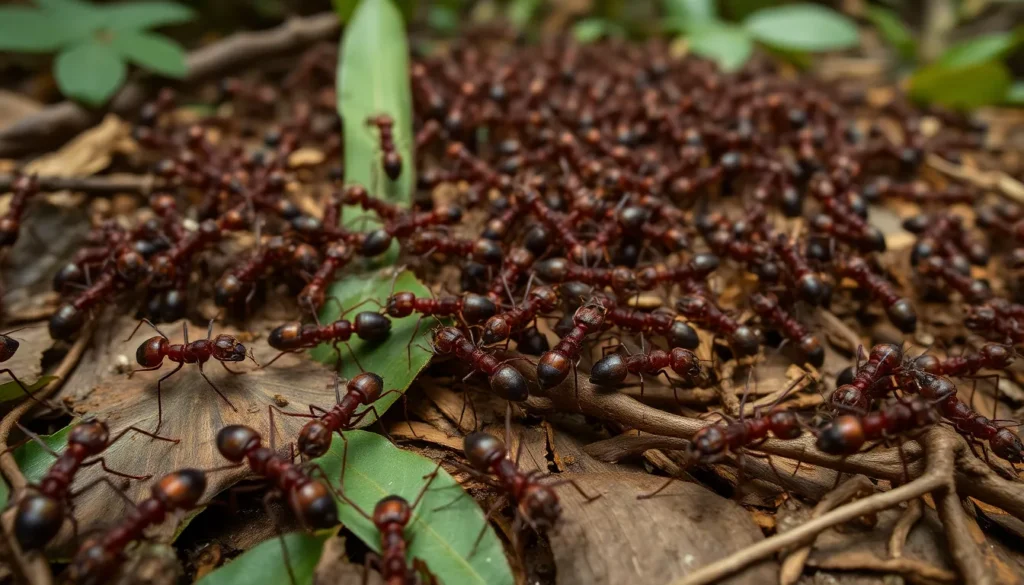
- Army ants are known for their aggressive and coordinated foraging raids. These ants move in large groups to overwhelm prey, often consuming insects and other small animals en masse.
- They belong primarily to the subfamily Dorylinae. This group includes various species distributed mainly in tropical regions of Africa, Asia, and the Americas.
- Army ants do not build permanent nests. Instead, they form temporary living nests called bivouacs from their own bodies, which protect the queen and young.
- Their colonies can number in the hundreds of thousands. Such large populations enable them to conduct highly effective raids.
- They are nomadic, moving frequently in search of food. This lifestyle contrasts with many other ants that establish fixed nests.
- Army ants play a major role in their ecosystems as predators. Their raids help regulate populations of other insects and small animals.
- Some species exhibit a reproductive cycle alternating between nomadic and stationary phases. This cycle is linked to the queen laying eggs and raising larvae.
- They communicate primarily through pheromones. Chemical trails guide other ants during raids and relocations.
- Army ants’ mandibles are highly adapted for hunting and carrying prey. Their strong jaws can subdue animals much larger than individual ants.
- They cooperate in carrying large prey back to the bivouac. This teamwork is critical for feeding the colony’s queen and larvae.
- Army ants have a significant impact on the behavior of other animals. Birds, such as antbirds, often follow raids to catch insects fleeing the ants.
- They are blind or have very limited vision. Army ants rely heavily on chemical and tactile signals for navigation and communication.
- The queen is the largest member of the colony. Her primary role is reproduction, producing thousands of eggs during her lifetime.
- Army ants’ raids can travel hundreds of meters in a single day. This extensive movement helps in exploiting available prey resources.
- They have been observed to exhibit complex social behaviors. This includes division of labor among workers, soldiers, and reproductive individuals.
- Some species have specialized soldier ants with enlarged heads and powerful mandibles. These soldiers protect the colony during raids and bivouac formation.
- Army ants influence nutrient cycling in tropical forests. By preying on insects and other small animals, they affect decomposition and soil processes.
- Their aggressive foraging can temporarily clear large areas of insects. This can have cascading effects on local biodiversity.
- Despite their fierce reputation, army ants are preyed upon by other animals. Some birds, reptiles, and mammals have adapted to feed on them or their larvae.
- Army ant species vary widely in size, color, and behavior. These differences reflect adaptations to diverse environments and prey types.
- Research on army ants provides insight into social insect evolution and collective behavior. Their complex societies make them important subjects in biology and ecology.
Habitat and Behavior
Army ants predominantly inhabit tropical and subtropical forests, where warm and humid conditions support their nomadic lifestyle. They are found across Central and South America, Africa, and parts of Asia. These ants do not construct permanent nests; instead, they create temporary bivouacs by linking their bodies together to protect the queen and brood during rest periods. Their behavior is characterized by coordinated group foraging raids that can involve thousands to hundreds of thousands of individuals. These raids are highly organized and use pheromone trails for navigation and communication. Army ants are mostly blind and rely on chemical and tactile signals to maintain colony cohesion. Their nomadic phases allow them to exploit new food sources, while stationary phases focus on brood rearing. This cyclical pattern helps sustain the colony’s growth and survival in dynamic environments.
Why This Animal Matters
Army ants play a crucial ecological role as keystone predators in tropical ecosystems. Their large-scale predation helps control populations of various insects and small invertebrates, maintaining a balance in forest biodiversity. The intense disturbance caused by their raids influences the behavior of other animals, such as birds and small mammals, which have evolved to exploit the ants’ activity. Moreover, army ants contribute to nutrient cycling by facilitating decomposition processes through their predation and movement. From a scientific perspective, army ants offer valuable insights into social organization, collective behavior, and evolutionary biology. Their complex social structures and division of labor make them model organisms for studying cooperation and communication among social insects. While not generally threatened, understanding army ants is important for conserving tropical biodiversity and ecosystem health.
Common Misconceptions
Misconception: Army ants have venomous stings that are deadly to humans.
Correction: Most army ants do not have stings; instead, they use powerful mandibles to bite. While bites can be painful, they are generally not dangerous to humans.
Misconception: Army ants can attack and kill large animals or humans.
Correction: Army ants primarily prey on insects and small animals. Although their coordinated raids are aggressive, they do not pose a significant threat to large animals or people.
Misconception: Army ants are a single species.
Correction: The term “army ants” refers to several species across different genera within the subfamily Dorylinae, each with unique characteristics and behaviors.
Misconception: Army ants build permanent nests like other ants.
Correction: Army ants are nomadic and do not build fixed nests; they use bivouacs made from their own bodies to shelter the colony temporarily.
Misconception: Army ants are solitary hunters.
Correction: Army ants are highly social and hunt in large, coordinated groups rather than alone.
FAQ
What do army ants eat?
Army ants primarily feed on other insects, small invertebrates, and sometimes small vertebrates, capturing prey during their coordinated raids.
Are army ants dangerous to humans?
While army ants have powerful mandibles and can bite, they are not typically dangerous to humans and do not possess venomous stings.
How do army ants communicate during raids?
Army ants communicate mainly through pheromone chemical trails and tactile signals to coordinate movement and hunting.

Leave a Reply