
Short Answer
21 Facts About Anteaters
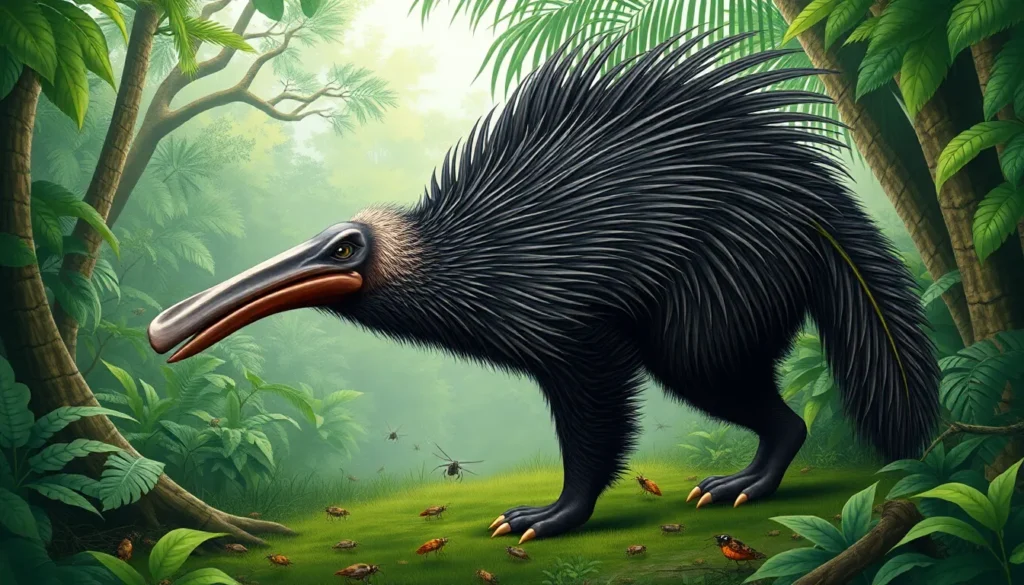
- Specialized Diet: Anteaters primarily feed on ants and termites, using their long sticky tongues to collect insects from nests.
- Distinctive Tongue: Their tongues can extend up to 60 cm (24 inches) and are covered in sticky saliva to trap insects efficiently.
- Unique Snout: Anteaters have elongated snouts that house their long tongues and lack teeth entirely.
- Four Species: There are four recognized species: the giant anteater, silky anteater, northern tamandua, and southern tamandua.
- Giant Anteater Size: The giant anteater is the largest, reaching up to 2 meters (6.5 feet) in length, including its bushy tail.
- Strong Forelimbs: Anteaters have powerful forelimbs with large curved claws used to tear open insect nests.
- Slow Metabolism: They have a low metabolic rate, which suits their low-energy insect diet.
- Solitary Animals: Anteaters are generally solitary except during mating or a mother caring for her young.
- Good Swimmers: Despite their terrestrial lifestyle, some anteater species are capable swimmers and can cross rivers.
- Communication: Anteaters primarily use scent marking and body language to communicate.
- Limited Defense: Their main defense is their strong claws, which can be used to fend off predators like jaguars or pumas.
- Slow Movement: Anteaters typically move slowly to conserve energy, but can run quickly when threatened.
- Reproduction: Usually, a female anteater gives birth to a single offspring after a gestation period of about six months.
- Long Lifespan: In the wild, anteaters can live up to 14 years, with longer lifespans reported in captivity.
- Habitat Variety: Anteaters inhabit a range of environments including grasslands, rainforests, and savannas across Central and South America.
- Climbing Ability: Smaller species like the tamanduas are adept climbers, often searching for ants in trees.
- Low Body Temperature: Their body temperature is lower than most mammals, averaging around 32.7 °C (90.9 °F).
- Evolutionary Relatives: Anteaters belong to the order Pilosa, closely related to sloths.
- Conservation Status: Some anteater species face threats from habitat loss and are listed as vulnerable or near threatened by the IUCN.
- Ecological Role: By controlling insect populations, anteaters play a vital role in maintaining ecosystem balance.
- Distinctive Appearance: Their unique combination of long snouts, bushy tails, and curved claws make them easily recognizable among mammals.
Habitat and Behavior
Anteaters are native to Central and South America, ranging from southern Mexico to northern Argentina. They inhabit diverse environments including tropical rainforests, savannas, grasslands, and dry forests. Their behavior is largely solitary, with individuals maintaining territories marked by scent glands. Anteaters are primarily terrestrial, though smaller species like tamanduas are semi-arboreal, capable of climbing trees to access insect nests. They rely heavily on their keen sense of smell to locate food, as their eyesight is relatively poor. Anteaters use their strong forelimbs and sharp claws to break into ant and termite mounds, then rapidly flick their long tongues to consume thousands of insects daily. They have a slow metabolism, which conserves energy given their low-calorie diet. Anteaters are generally non-aggressive but can defend themselves effectively using their claws. Reproduction involves a single offspring, which the mother carries on her back until it can survive independently.
Why This Animal Matters
Anteaters are important ecological agents because they regulate populations of ants and termites, which can otherwise become pests harmful to vegetation and human structures. Their feeding habits help maintain balanced insect communities, contributing to soil aeration and nutrient cycling. Culturally, anteaters have been featured in indigenous folklore and continue to fascinate scientists and wildlife enthusiasts due to their unusual adaptations. From a conservation perspective, anteaters face threats from habitat destruction, road accidents, and hunting in some areas. Protecting anteater species helps preserve biodiversity and the health of ecosystems where they play a critical role.
Common Misconceptions
Misconception: Anteaters eat only ants.
Correction: While ants are a major part of their diet, anteaters also consume termites and occasionally other small insects.
Misconception: Anteaters are aggressive animals.
Correction: Anteaters are generally shy and non-aggressive but will use their claws defensively if threatened.
Misconception: Anteaters have teeth.
Correction: Anteaters lack teeth entirely and rely on their long sticky tongue to capture and swallow prey.
Misconception: All anteaters are large and terrestrial.
Correction: Smaller species like the silky anteater and tamanduas are arboreal and much smaller than the giant anteater.
FAQ
Do anteaters have teeth?
No, anteaters do not have teeth. Instead, they use their long sticky tongues to collect ants and termites, swallowing them whole.
Where do anteaters live?
Anteaters are native to Central and South America and inhabit environments such as tropical rainforests, savannas, and grasslands.
How do anteaters protect themselves from predators?
Anteaters use their powerful forelimbs and large curved claws to defend themselves against predators. Despite their generally docile nature, these claws can inflict serious damage if necessary.



Leave a Reply