
Short Answer
The Great Pyramid of Giza, a monumental testament to ancient ingenuity, continues to captivate the imaginations of scholars and enthusiasts alike. Rising majestically from the arid sands of the Egyptian desert, it embodies the quintessence of ancient architectural prowess and the complexities of a civilization long past. Herein, we delve into twelve astonishing facts that illuminate the grandeur and mystery of this iconic structure.
1. A Colossal Undertaking
The Great Pyramid, constructed around 2580–2560 BC, is believed to have been built over a span of approximately 20 years. This gigantic engineering feat required the meticulous organization of around 2.3 million blocks of limestone and granite, weighing between 2.5 to 15 tons each. Such a monumental endeavor presupposes not only an advanced understanding of mathematics and physics but also an extraordinary workforce, possibly comprising thousands of laborers, skilled craftsmen, and architects.
2. An Astronomical Alignment
One of the most perplexing aspects of the Great Pyramid is its precise alignment with the cardinal points of the compass. The pyramid’s sides are closely oriented to true north, south, east, and west, with a remarkable accuracy of only 0.067 degrees off from true north. This celestial orientation indicates that the ancient Egyptians possessed a formidable knowledge of astronomy, allowing them to harmonize their architectural marvel with the cosmos.
3. Size and Scale
Standing originally at 146.6 meters (481 feet), the Great Pyramid was the tallest man-made structure in the world for over 3,800 years until the completion of Lincoln Cathedral in the 14th century. Even today, at a revised height of 138.8 meters (455 feet), it remains an imposing edifice. The sheer volume of the structure, approximately 2.6 million cubic meters, illustrates the Egyptians’ ambition and sophistication in construction techniques.
4. A Complex Interior
The intricate interior of the Great Pyramid is a labyrinth of chambers and passageways. It comprises three primary chambers: the King’s Chamber, the Queen’s Chamber, and the Grand Gallery. The King’s Chamber, constructed entirely from granite, is home to a massive granite sarcophagus believed to have housed the body of Pharaoh Khufu, the pyramid’s namesake. The precise purpose of the Queen’s Chamber remains elusive, inciting speculation and intrigue among Egyptologists.
5. Advanced Engineering Techniques
The construction of the Great Pyramid necessitated revolutionary engineering techniques that were centuries ahead of their time. Multiple theories have emerged regarding how the massive stones were transported and assembled. Some hypotheses suggest a system of ramps, while others posit innovative use of levers. The simplicity and ingenuity of these strategies highlight the ancient Egyptians’ mastery over their environment.
6. The Enigmatic Capstone
Originally adorned with a capstone, or pyramidion, the apex of the Great Pyramid once shone brightly, likely gilded in gold or electrum, reflecting sunlight in a dazzling display. Today, the absence of this capstone adds an air of mystery. Scholars speculate its loss could be linked to natural erosion, theft, or structural modifications throughout the centuries.
7. Geological Marvel
The Great Pyramid is predominantly made from local limestone, but also incorporates granite sourced from Aswan, situated approximately 800 kilometers (497 miles) to the south. The transportation of these heavy materials is an engineering marvel in itself. Additionally, recent geological studies suggest that the bedrock upon which the pyramid stands played a critical role in its durability and structural integrity over millennia.
8. A Historical Indicator
The Great Pyramid served not only as a tomb for Pharaoh Khufu but also as a symbolic representation of the pharaoh’s divine status and power. Its construction marked the apex of the Third Dynasty, encapsulating the peak of Old Kingdom Egypt. As such, it stands as a vital historical indicator of socio-political structures and the evolution of religious ideologies in ancient Egypt.
9. Mystical Numerical Significance
The dimensions of the Great Pyramid embody an array of mathematical ratios and proportions believed to hold esoteric significance. The ratio of the pyramid’s perimeter to its height approximates the mathematical constant pi (π), leading to conjectures that the ancient Egyptians possessed advanced mathematical knowledge. Such numerical symbolism often incites discussions on the spiritual beliefs that permeated ancient Egyptian culture.
10. The Pyramid’s Illumination
Visitors to the Great Pyramid often remark on its ethereal presence under the glow of the moonlight, but historical accounts indicate that it was once encased in gleaming white Tura limestone, a feature that would have reflected sunlight brilliantly during the day. This reflective surface not only enhanced its visual magnificence but may also have served a ritualistic purpose, symbolizing the sun god Ra.
11. The Sphinx Connection
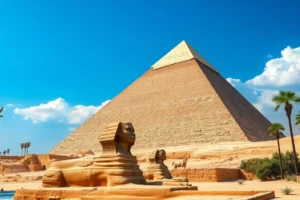
Lurking at the base of the Great Pyramid is the Great Sphinx of Giza, a monumental limestone statue. With its lion’s body and human head, it is often presumed to guard the pyramids—particularly Khufu’s. Like a sentinel overlooking the necropolis, the Sphinx enhances the mystery surrounding the pyramid’s construction and its significance within the broader context of Egyptian mythology and funeral practices.
12. A UNESCO World Heritage Site
Designated a UNESCO World Heritage Site in 1979, the Great Pyramid continues to be a focal point for archaeological research and preservation efforts. The recognition underscores its global importance, as it stands not only as a monument to ancient Egypt but also as a shared heritage of human achievement and aspiration.
In conclusion, the Great Pyramid of Giza is far more than a mere relic of antiquity; it is a multifaceted symbol of human tenacity, cultural depth, and architectural brilliance. These twelve facts only scratch the surface of the rich tapestry of history that envelops this extraordinary edifice. As we ponder its mysteries, the Great Pyramid continues to inspire both reverence and curiosity, standing proudly as a testament to a civilization that sought to touch the divine.
FAQ
What is the Great Pyramid of Giza?
The Great Pyramid of Giza is a monumental tomb built for Pharaoh Khufu, part of a complex of pyramids located on the Giza Plateau in Egypt.
How was the Great Pyramid constructed?
The Great Pyramid was constructed using approximately 2.3 million blocks of limestone and granite, with advanced engineering techniques and a large workforce.
Why is the Great Pyramid aligned with cardinal points?
The pyramid’s precise alignment with the cardinal points indicates the ancient Egyptians’ advanced knowledge of astronomy.




Leave a Reply