
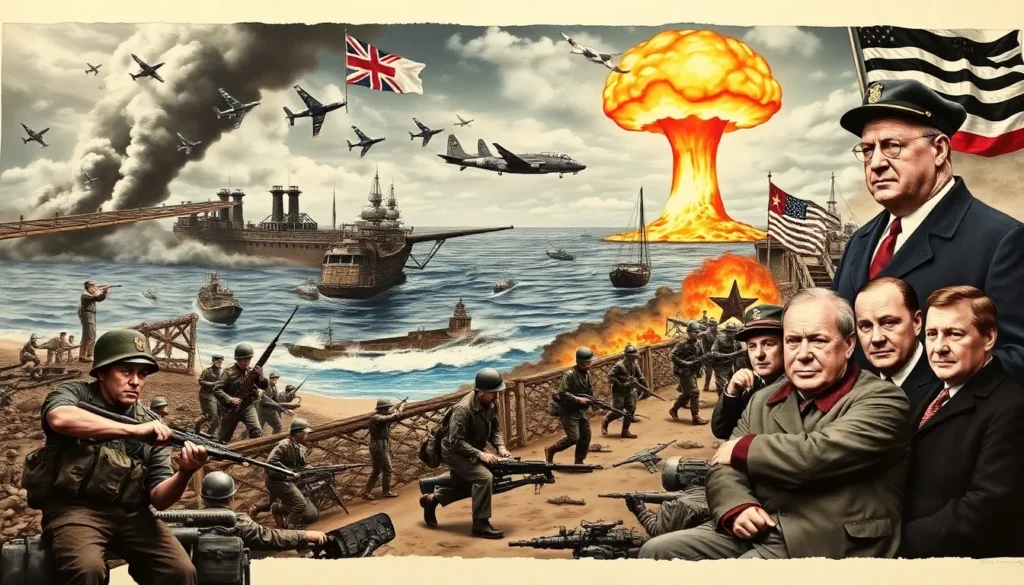
Short Answer
21 Facts About World War II
1. The war lasted six years
World War II began on September 1, 1939, when Germany invaded Poland, and ended on September 2, 1945, with Japan’s formal surrender, lasting nearly six years.
2. It involved over 30 countries
More than 30 nations participated directly, and many others were affected indirectly by the war’s global reach.
3. The Axis and Allies were the main opposing sides
The Axis Powers mainly included Germany, Italy, and Japan, while the Allies consisted of the United States, Soviet Union, United Kingdom, China, and others.
4. The war resulted in an estimated 70-85 million deaths
This number includes military personnel and civilians, making it the deadliest conflict in human history.
5. The Holocaust was a major atrocity
During the war, Nazi Germany systematically murdered six million Jews and millions of other minorities in concentration camps.
6. The United States entered the war after Pearl Harbor
On December 7, 1941, Japan attacked the US naval base at Pearl Harbor, prompting the US to join the Allies.
7. The D-Day invasion was a turning point
On June 6, 1944, Allied forces launched a massive amphibious assault on Normandy, France, marking a significant step towards defeating Nazi Germany.
8. Women played crucial roles
Women served as nurses, factory workers, and in auxiliary military units, significantly contributing to the war effort.
9. The atomic bombs ended the war in the Pacific
The US dropped atomic bombs on Hiroshima and Nagasaki in August 1945, leading to Japan’s surrender.
10. Technology advanced rapidly
The war accelerated developments in radar, jet engines, rockets, and computing technology.
11. The United Nations was created post-war
To prevent future global conflicts, the United Nations was established in 1945 as an international peacekeeping organization.
12. The war changed global power dynamics
It marked the decline of European colonial empires and the rise of the US and Soviet Union as superpowers.
13. The Battle of Stalingrad was one of the deadliest battles
This 1942-1943 battle marked a decisive Soviet victory and a turning point on the Eastern Front.
14. Propaganda was widely used
Both sides used propaganda to boost morale, recruit soldiers, and demonize the enemy.
15. The Blitz was a major bombing campaign
From 1940-1941, Germany conducted extensive bombing raids on London and other British cities.
16. Codebreaking was vital
Allied cryptologists, such as those at Bletchley Park, decrypted Axis codes, notably the German Enigma cipher.
17. The war affected civilians deeply
Millions were displaced, suffered shortages, or endured atrocities during occupations and battles.
18. The Pacific Theater was vast and complex
Fighting involved numerous island campaigns and naval battles across the Pacific Ocean.
19. The war led to major social changes
Post-war, many countries saw shifts in civil rights, gender roles, and decolonization efforts.
20. War crimes trials were held after the war
The Nuremberg and Tokyo Trials prosecuted Axis leaders for crimes against humanity.
21. The war influenced culture and memory
World War II has been extensively studied, depicted in films, literature, and remains a significant subject of historical analysis.
History / Background
World War II was a global conflict that emerged from unresolved issues following World War I, economic instability, and the rise of totalitarian regimes in Germany, Italy, and Japan. The Treaty of Versailles, which ended World War I, imposed harsh penalties on Germany, contributing to political and economic unrest. The 1930s saw aggressive expansion by Axis powers, including Germany’s invasion of neighboring territories and Japan’s incursions in Asia. The war officially began when Germany invaded Poland, prompting Britain and France to declare war. The conflict soon expanded as countries across Europe, Asia, Africa, and the Americas became involved either through alliances or colonial ties. It was characterized by massive military campaigns, technological innovation, and significant civilian impact.
Importance and Impact
World War II fundamentally reshaped global politics, economics, and societies. It ended the dominance of traditional European powers and led to the emergence of the United States and the Soviet Union as superpowers, initiating the Cold War. The war spurred technological and industrial advances, including the development of nuclear weapons and modern computing. It also led to the establishment of international institutions like the United Nations aimed at promoting peace and cooperation. The war’s human cost and the Holocaust highlighted the need for human rights protections and influenced post-war international law. Additionally, it accelerated decolonization as many countries sought independence from weakened European empires.
Why It Matters
Understanding World War II is vital for comprehending contemporary international relations, global conflicts, and the evolution of modern society. The war’s lessons about the dangers of totalitarianism, the importance of diplomacy, and the consequences of unchecked aggression remain relevant. It informs discussions on military strategy, human rights, and international cooperation. Moreover, the memory of the war shapes national identities and cultural narratives worldwide, underscoring the importance of peace and the prevention of genocide and war crimes.
Common Misconceptions
World War II was fought only in Europe.
The war was truly global with major theaters in Europe, the Pacific, Africa, and Asia.
The United States was involved from the start.
The US entered the war in late 1941 after the attack on Pearl Harbor.
The atomic bombings were the sole reason Japan surrendered.
While significant, Japan’s surrender was influenced by multiple factors, including Soviet entry into the war against Japan.
The Holocaust only targeted Jews.
The Holocaust also targeted Roma, disabled individuals, political prisoners, and other minority groups.
World War II ended immediately after Germany’s surrender.
The war continued in the Pacific until Japan’s surrender in September 1945.
FAQ
When did World War II start and end?
World War II started on September 1, 1939, with Germany's invasion of Poland and ended on September 2, 1945, with Japan's formal surrender.
Which countries were involved in World War II?
Over 30 countries were involved, primarily divided into the Axis Powers (Germany, Italy, Japan) and the Allied Powers (United States, Soviet Union, United Kingdom, China, among others).
What was the significance of the D-Day invasion?
D-Day, on June 6, 1944, was a crucial Allied amphibious invasion of Normandy, which marked the beginning of the liberation of Western Europe from Nazi control.





Leave a Reply