
Short Answer
21 Facts About Bees
- Bees are critical pollinators. They facilitate the reproduction of many flowering plants by transferring pollen from one flower to another, supporting biodiversity and agriculture.
- There are over 20,000 known bee species. These range from solitary bees to highly social species like the honeybee.
- Honeybees communicate through a dance. The “waggle dance” conveys information about the direction and distance to food sources.
- Bees have five eyes. They possess two large compound eyes and three smaller ocelli that help with navigation and detecting light intensity.
- Only female bees collect pollen and nectar. Male bees, or drones, primarily exist to mate with queens and do not forage.
- Bee colonies have a caste system. This system includes a queen, worker females, and drones, each with distinct roles.
- Bees produce honey by converting nectar. They use enzymes to break down nectar sugars and evaporate water to create honey, which serves as food storage.
- Some bees are solitary rather than social. Solitary bees do not form hives but instead build individual nests for their offspring.
- Bee stings are a defense mechanism. Honeybee workers sting to defend the hive, but stinging usually results in their death due to the barbed sting.
- Bees can see ultraviolet light. This ability helps them locate nectar guides on flowers that are invisible to humans.
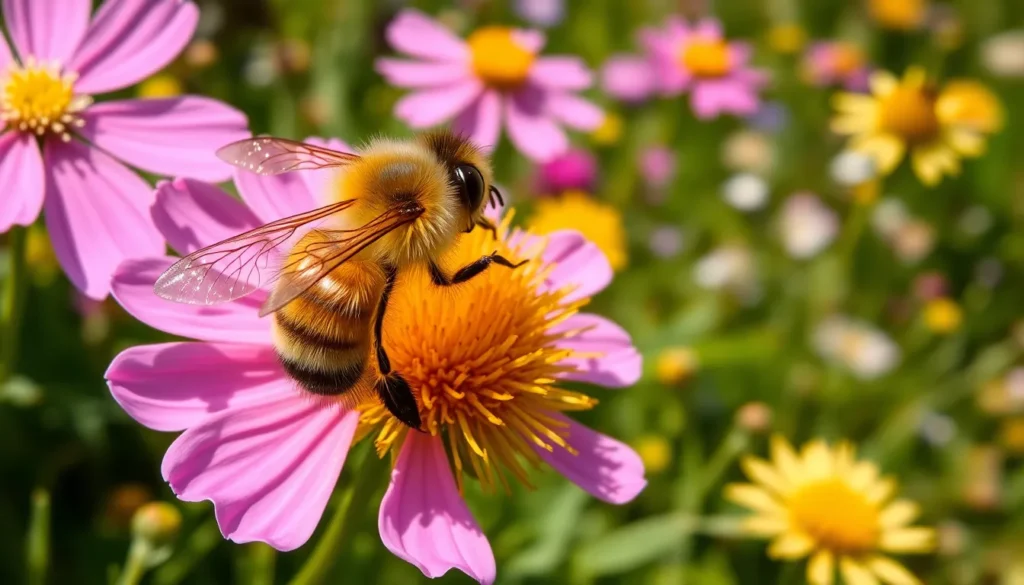
- Bees have specialized body parts for pollen collection. Their legs often have structures called pollen baskets or scopae to carry pollen efficiently.
- Bees contribute significantly to global food production. Many crops depend on bee pollination to increase yield and quality.
- Colony Collapse Disorder (CCD) threatens bee populations. CCD is a phenomenon where worker bees abruptly disappear, endangering hive survival.
- Bees have been kept by humans for thousands of years. Beekeeping dates back to ancient civilizations for honey, wax, and pollination services.
- Some bees engage in “buzz pollination.” By vibrating their flight muscles, they dislodge pollen from certain flowers that do not release pollen easily.
- Bee larvae are fed royal jelly to become queens. This nutritious secretion determines whether a female larva develops into a queen or a worker.
- Bees can fly at speeds up to 15 miles per hour. Their flight efficiency is remarkable given their small size and rapid wing beats.
- Bees have a highly developed sense of smell. They use olfaction to detect flowers, hive mates, and pheromones within the colony.
- Environmental factors impact bee health. Pesticides, habitat loss, and climate change affect bee populations worldwide.
- Bees are found on every continent except Antarctica. Their adaptability allows them to thrive in diverse ecosystems from forests to deserts.
- Honeybees can recognize human faces. Studies show they can learn to identify and remember individual human faces, an uncommon ability among insects.
Habitat and Behavior
Bees inhabit a wide range of environments, including meadows, forests, deserts, and urban areas. Social species, such as honeybees and bumblebees, typically build nests or hives in protected locations like hollow trees, underground cavities, or man-made hives. Solitary bees often burrow into soil or use hollow stems to lay eggs. Their behavior varies widely; social bees work cooperatively within colonies, performing tasks like foraging, nest maintenance, and defending the hive. Solitary bees operate independently, focusing on nesting and provisioning their offspring. Many bees are active during the day and rely on floral resources for nectar and pollen. Seasonal cycles influence their activity, with many species undergoing diapause or hibernation in colder climates.
Why This Animal Matters
Bees are essential contributors to ecosystem health and agriculture. Their pollination services support the reproduction of a vast number of flowering plants, which in turn sustain wildlife and contribute to food production. Approximately one-third of the food consumed by humans depends on pollinators like bees. Beyond agriculture, bees contribute to the maintenance of natural habitats and biodiversity. Culturally, bees have symbolized industry, cooperation, and fertility across many societies. Conservation efforts have grown in response to declining bee populations, recognizing their ecological role and the threats posed by pesticides, habitat loss, and diseases. Protecting bees is thus critical for environmental sustainability and global food security.
Common Misconceptions
Misconception: All bees produce honey.
Correction: Only certain species, such as honeybees, produce honey. Many bee species do not produce honey at all.

Misconception: Bees die every time they sting.
Correction: Honeybee workers typically die after stinging due to their barbed stinger getting lodged, but many other bee species have smooth stingers and can sting multiple times without dying.
Misconception: Bees are aggressive and prone to sting humans unprovoked.
Correction: Bees are generally non-aggressive and sting mainly in defense of their hive or when threatened.
Misconception: All bees live in hives.
Correction: Many bee species are solitary and do not form colonies or hives.
Misconception: Wasps and bees are the same.
Correction: Although related, bees and wasps differ in behavior, diet, and biology; bees primarily forage for pollen and nectar, while many wasps are predators or scavengers.
FAQ
Why are bees important to the environment?
Bees are critical pollinators that help plants reproduce by transferring pollen. This process supports biodiversity, ecosystem health, and agriculture, affecting the production of many fruits, vegetables, and nuts.
Do all bees produce honey?
No, only certain species, such as the honeybee, produce honey. Many other bee species do not make or store honey.
Can bees sting multiple times?
Honeybee workers generally die after stinging because their barbed stinger gets stuck in the skin. However, many other bee species have smooth stingers and can sting multiple times without dying.





Leave a Reply