
Short Answer
21 Facts About Marsupial Reproduction
- Short Gestation Periods
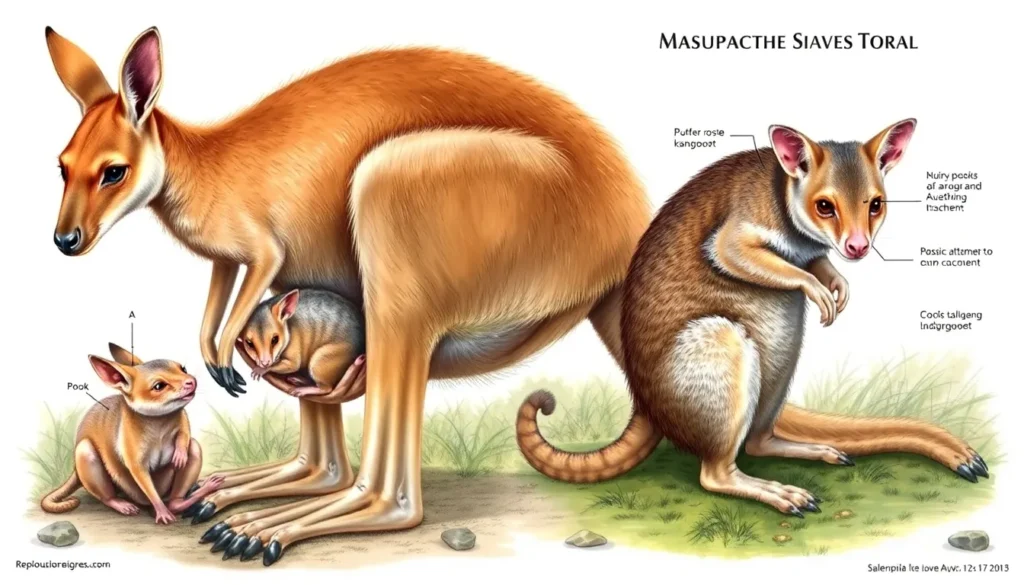
Marsupials typically have very short gestation periods compared to placental mammals, often lasting only a few weeks before the underdeveloped young are born. - Pouch Development
Many marsupials possess a pouch (marsupium) where the neonates continue their development after birth, attaching to a nipple inside the pouch. - Altricial Newborns
Newborn marsupials are highly altricial, meaning they are born extremely undeveloped and rely heavily on maternal care for growth and survival. - Attachment to Nipples
After birth, the young marsupial crawls to and permanently attaches to a nipple inside the pouch, receiving nutrition and protection. - Multiple Stages of Lactation
Marsupials produce different types of milk during the development of their young, adjusting nutrient composition as the offspring mature. - Embryonic Diapause
Some marsupials can delay the development of an embryo until environmental conditions are favorable, a process known as embryonic diapause. - Sexual Maturity Timing
Marsupials generally reach sexual maturity at a younger age compared to many placental mammals, facilitating faster reproductive cycles. - Reproductive Anatomy Variations
Female marsupials often have two lateral vaginas and two uteri, while males may have a bifurcated penis, adapting to their unique reproductive processes. - High Neonatal Mortality
Due to their underdeveloped birth state, marsupial young face high mortality risks without the protection of the pouch and maternal care. - Multiple Offspring Development
Some species can simultaneously support offspring at different developmental stages, such as one in the pouch and another embryo in diapause. - Pouch Variability
Not all marsupials have well-developed pouches; some possess a simple fold of skin or no pouch at all, relying on alternative care strategies. - Seasonal Breeding
Many marsupials breed seasonally, timing births to coincide with optimal environmental conditions for offspring survival. - Male Reproductive Strategies
Male marsupials often display competitive behaviors during the breeding season, including physical contests and territorial marking. - Short Lactation Periods
Compared to placental mammals, marsupials may have shorter lactation periods, with young becoming independent relatively quickly once they leave the pouch. - Maternal Energy Investment
The energy investment in marsupial reproduction is focused heavily on postnatal care rather than gestation, due to the short prenatal development. - Unique Sperm Morphology
Marsupial sperm cells have unique shapes and motility patterns adapted to their reproductive tract structure. - Delayed Implantation
In some species, fertilized eggs do not immediately implant in the uterus, allowing timing flexibility for offspring development. - Reproductive Lifespan
Marsupials can have varied reproductive lifespans, with some small species breeding for only a few years while larger species reproduce for longer periods. - Multiple Mating Partners
Polyandry and polygyny occur in various marsupial species, influencing genetic diversity and reproductive success. - Adaptation to Environmental Stress
Marsupial reproductive strategies, including diapause and pouch protection, help them cope with fluctuating environmental conditions. - Evolutionary Significance
The distinct reproductive system of marsupials provides insights into mammalian evolution, representing an intermediate stage between egg-laying and placental mammals.
Habitat and Behavior
Marsupials are primarily native to Australia and nearby islands, with some species in the Americas. They inhabit diverse environments ranging from forests and grasslands to arid deserts. Marsupials exhibit varied behaviors linked to their reproductive strategies, such as nesting, pouch care, and territoriality during mating seasons. Their reproductive adaptations, like the pouch and embryonic diapause, allow them to survive in unpredictable climates and resource-scarce habitats by timing offspring development according to environmental conditions.
Why This Animal Matters
Marsupials play a crucial ecological role as both predators and prey in their ecosystems, helping maintain biodiversity and ecological balance. Their unique reproductive traits provide valuable scientific insights into mammalian development and evolutionary biology. Furthermore, marsupials hold cultural significance in Indigenous Australian cultures and contribute to global biodiversity. Conservation efforts are important as many marsupial species face threats from habitat loss, introduced predators, and climate change, impacting their reproductive success and long-term survival.
Common Misconceptions
Misconception: All marsupials have pouches.
Correction: While many marsupials have well-developed pouches, some species have only skin folds or no pouch at all, relying on other means to protect and nurture their young.
Misconception: Marsupials reproduce like placental mammals.
Correction: Marsupial reproduction is distinct, involving short gestation, birth of highly underdeveloped young, and extended pouch development, unlike the longer gestation and in-utero development seen in placental mammals.
FAQ
How long is the gestation period of marsupials?
Marsupial gestation periods are generally very short, often lasting only a few weeks, after which the undeveloped young are born and continue development in the mother's pouch.
Do all marsupials have pouches?
No, while many marsupials have pouches to protect their young, some species have only skin folds or no pouch at all and rely on alternative methods of care.
What is embryonic diapause in marsupials?
Embryonic diapause is the ability of some marsupials to temporarily pause the development of an embryo, allowing the timing of birth to coincide with favorable environmental conditions.


Leave a Reply