
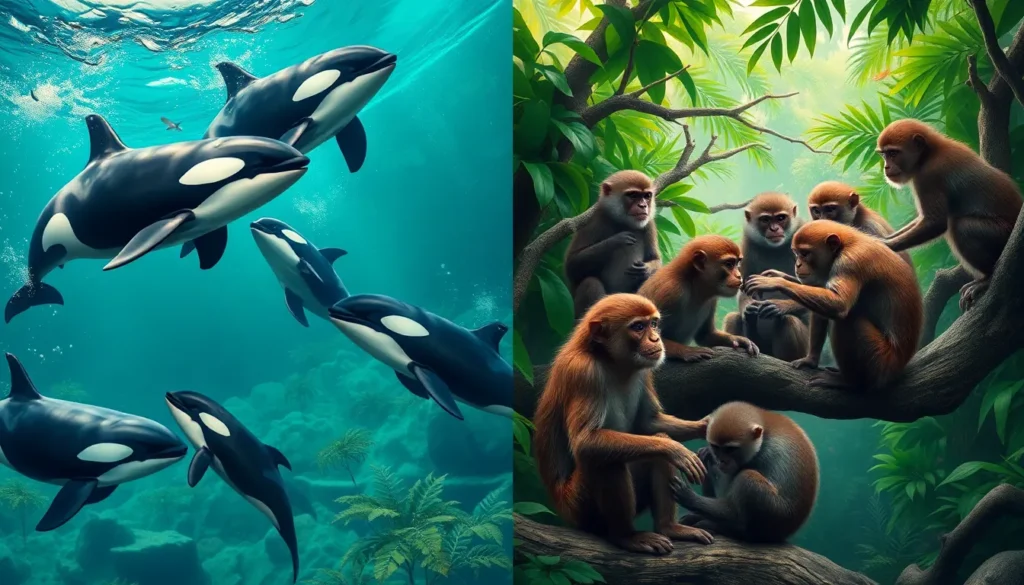
Short Answer
21 Facts About Animal Culture: Orcas and Monkeys
- Orcas have distinct dialects. Different pods of orcas use unique sets of calls and vocal patterns, which function as cultural markers distinguishing groups.
- Tool use in monkeys varies by group. Some monkey populations use stones to crack nuts, while others use sticks to extract insects, showing learned behavior differences.
- Orca hunting techniques are culturally transmitted. Specific hunting strategies, such as beaching to catch seals, are taught within orca pods.
- Monkeys demonstrate social customs. Grooming patterns and social hierarchies differ between troops, influenced by cultural transmission.
- Orcas display maternal teaching. Mothers instruct calves in vital survival skills, including vocalizations and hunting methods.
- Monkeys engage in cultural food preferences. Some groups prefer certain fruits or insects not eaten by others, learned through social learning.
- Orca pods remain stable culturally and socially. Pods often consist of matrilineal family units that maintain cultural traditions over decades.
- Monkeys use unique communication signals. Vocalizations and gestures can vary regionally, reflecting cultural divergence.
- Orcas can mimic sounds from their environment. They sometimes imitate noises from boats or other animals, illustrating vocal learning.
- Tool use in monkeys is largely absent in some species. This indicates that not all monkey cultures exhibit tool-related behaviors.
- Orcas have culturally distinct dietary habits. Resident orcas primarily eat fish, whereas transient orcas hunt marine mammals, reflecting cultural specialization.
- Monkeys demonstrate cultural innovation. New behaviors occasionally arise, such as using leaves as umbrellas, which can spread through groups.
- Orca cultural traits can influence population structure. Different cultural groups rarely interbreed, maintaining cultural boundaries.
- Monkeys exhibit cultural variation in mating rituals. Some troops show specific courtship behaviors passed down socially.
- Orcas participate in cultural play behaviors. Playful activities vary between pods and are part of social learning.
- Monkeys show cultural transmission of alarm calls. Specific calls warning about predators differ among groups.
- Orca culture affects conservation strategies. Protecting culturally distinct pods is important for preserving behavioral diversity.
- Monkeys are studied to understand the evolution of human culture. Their cultural behaviors provide insight into the origins of social learning.
- Orca cultural behaviors can be disrupted by environmental changes. Noise pollution and habitat loss may interfere with vocal traditions.
- Monkeys’ cultural knowledge supports survival in changing environments. Learning new food sources or behaviors aids adaptation.
- Both orcas and monkeys exemplify non-human culture as a complex phenomenon. Their behaviors challenge the idea that culture is uniquely human.
Habitat and Behavior
Orcas (Orcinus orca), also known as killer whales, inhabit a wide range of marine environments, from polar regions to tropical seas. They live in stable social groups known as pods, often organized around maternal lines, and exhibit complex vocal and social behaviors. Orcas are apex predators with diverse diets and hunting techniques that vary culturally between populations.
Monkeys are a diverse group of primates found primarily in tropical and subtropical regions across Africa, Asia, and the Americas. Their behaviors include social grooming, tool use, communication through vocalizations and gestures, and complex social structures. Cultural behaviors among monkeys differ between species and populations, often influenced by environmental factors and social learning.
Why This Animal Matters
Orcas play a critical ecological role as apex predators, influencing marine food webs and ecosystem health. Their culturally distinct populations highlight the importance of preserving behavioral diversity, which has implications for conservation management.

Monkeys contribute to forest ecology through seed dispersal and insect control. Their cultural behaviors offer valuable insight into primate cognition, social learning, and the evolutionary roots of human culture. Understanding monkey culture aids in their conservation and enriches knowledge about animal intelligence.
Common Misconceptions
Misconception: Animal culture is just instinctive behavior.
Correction: Animal culture involves learned behaviors transmitted socially, not purely instinctual actions.
Misconception: Only humans have culture.
Correction: Many animal species, including orcas and monkeys, exhibit complex cultural traits passed between individuals and generations.
Misconception: All monkeys use tools.
Correction: Tool use varies widely among monkey species and populations, with some showing no evidence of such behaviors.
Misconception: Orca pods are interchangeable groups.
Correction: Orca pods are culturally unique and stable social units with distinct dialects and behaviors.
Misconception: Animal culture has no impact on conservation.
Correction: Recognizing cultural diversity in animals is important for effective conservation planning and protecting behavioral diversity.
FAQ
What defines animal culture?
Animal culture refers to behaviors and knowledge that are learned socially and transmitted across generations, rather than inherited genetically.
How do orcas demonstrate culture?
Orcas show culture through distinct vocal dialects, hunting techniques, and social structures unique to specific pods.
Do all monkeys use tools?
No, tool use varies among monkey species and populations; some monkeys do not use tools at all.

Leave a Reply