
Short Answer
21 Facts About Warble Flies
- Warble flies belong to the genus Hypoderma. These flies are part of the Oestridae family, commonly known as bot flies, and are notable for their parasitic larvae.
- They primarily parasitize large mammals. Their larvae typically infest animals such as cattle, deer, and horses.
- The adult warble fly does not feed. Adult warble flies have reduced mouthparts and live only to reproduce.
- Warble fly larvae develop under the skin of their hosts. After eggs hatch, larvae burrow into the skin, creating lumps called ‘warbles.’
- Warble fly infestation is known as myiasis. This is a condition caused by fly larvae feeding on living tissue.
- The larvae migrate through the host’s body. After penetrating the skin, larvae travel through connective tissue before settling under the skin to mature.
- Warble flies have a one-year life cycle. Most species lay eggs in summer, with larvae maturing under the skin for several months before emerging.
- Infestations can cause economic losses in livestock. Damage to hides, reduced weight gain, and secondary infections affect cattle and other farm animals.
- Warble flies are found mainly in the Northern Hemisphere. They are common in Europe, Asia, and North America, particularly in temperate regions.
- Control measures include insecticides and pasture management. Effective treatments target larvae or adult flies to reduce infestations.
- Warble fly larvae can cause significant discomfort to their hosts. The warbles are painful and can lead to irritation and stress in infested animals.
- Some warble fly species are host-specific. For example, Hypoderma bovis primarily targets cattle, while others may infest deer or horses.
- Warble flies have a complex mating behavior. Adults emerge simultaneously and have a short lifespan dedicated to reproduction.
- Larvae breathe through a small hole in the warble. This opening allows the larvae to obtain oxygen while protected under the skin.
- Warble flies have been known since ancient times. Historical records describe cattle infestations consistent with warble fly larvae.
- Some wild animals can serve as reservoirs for warble flies. Deer and other wildlife can maintain populations even if livestock are treated.
- Warble fly larvae are sometimes used in forensic entomology. Their development stages can help estimate time of death in investigations.
- Warble flies do not transmit diseases directly. However, secondary infections from larval wounds can cause complications.
- Climate change may affect warble fly distribution. Warmer temperatures could shift their habitat range and influence infestation patterns.
- Warble flies are part of a broader group of parasitic flies. They share similarities with other bot flies and flesh flies in their life cycles.
- Eradication programs have been successful in some regions. Coordinated control efforts have reduced infestations in parts of Europe and North America.
Habitat and Behavior
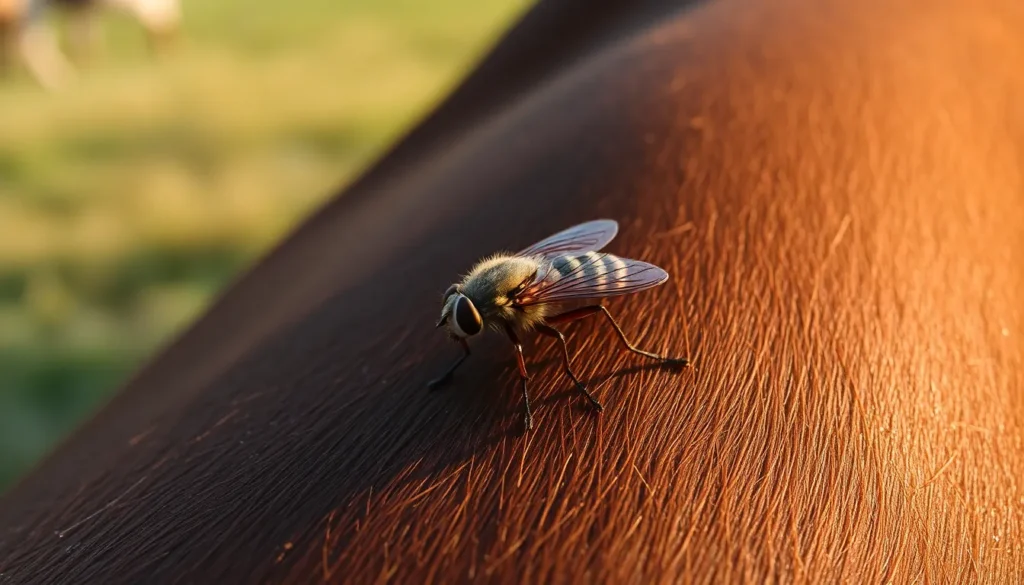
Warble flies inhabit temperate regions primarily in the Northern Hemisphere, where their preferred hosts—such as cattle, deer, and horses—are present. They thrive in rural and pastoral environments where livestock are abundant. The adult flies emerge during warm months, often in summer, and have a brief lifespan focused on mating and egg-laying. Females lay eggs on the hairs of host animals, and upon hatching, larvae penetrate the skin to begin their development under the host’s hide. The larvae migrate through the host’s tissues before settling beneath the skin, where they form characteristic swelling called warbles. After completing development, larvae exit the host to pupate in the soil. This parasitic behavior allows warble flies to exploit their hosts for nourishment while completing their complex life cycle.
Why This Animal Matters
Warble flies play a significant ecological and economic role. Ecologically, they influence host animal behavior and health, sometimes impacting population dynamics in wild and farmed animals. Economically, infestations can lead to considerable losses in livestock industries due to damaged hides, decreased weight gain, and reduced milk production. Additionally, warble flies have a cultural presence, having been recognized in historical texts for centuries. From a conservation perspective, understanding warble fly biology aids in managing their populations and protecting livestock health. Their role in forensic entomology also illustrates their importance in scientific fields beyond agriculture.
Common Misconceptions
Misconception: Warble flies bite humans and lay eggs under human skin.
Correction: Warble flies primarily target large mammals such as cattle and deer. They do not typically infest humans, and their larvae do not develop under human skin.

Misconception: Warble flies directly transmit infectious diseases.
Correction: While warble fly larvae can cause wounds that may become infected, the flies themselves are not known to directly transmit infectious diseases to their hosts.
Misconception: Warble flies are harmful only because of the larvae.
Correction: The adult warble flies do not feed or cause damage; it is the larval stage that causes parasitic harm to hosts.
FAQ
What is a warble fly?
A warble fly is a type of parasitic fly whose larvae develop under the skin of mammals, causing characteristic lumps called warbles.
Do warble flies harm humans?
Warble flies rarely infest humans and primarily target large mammals such as cattle and deer. Human infestation is extremely uncommon.
How can warble fly infestations be controlled?
Control methods include the use of insecticides, timely treatment of livestock, and pasture management to reduce exposure to adult flies.




Leave a Reply