
Short Answer
21 Facts About Honey Bees
- Honey bees communicate through a “waggle dance.” This dance conveys information about the direction and distance of food sources to other bees in the hive.
- Honey bees have five eyes. They possess two large compound eyes and three smaller ocelli eyes that help with navigation and detecting light intensity.
- Only female honey bees can sting. Male honey bees, called drones, do not have stingers.
- A single honey bee produces about 1/12th of a teaspoon of honey in its lifetime. This demonstrates the collective effort bees invest in honey production.
- Honey bees are capable of recognizing human faces. Studies have shown they can learn and remember individual human faces in experimental settings.
- Honey bee colonies consist of a queen, workers, and drones. The queen lays eggs, workers perform various tasks, and drones mate with queens from other colonies.
- Worker bees have specialized roles that change as they age. Younger workers tend to hive maintenance, while older workers forage for food.
- Honey bees regulate hive temperature. They maintain a consistent temperature around 35°C (95°F) to ensure brood development.
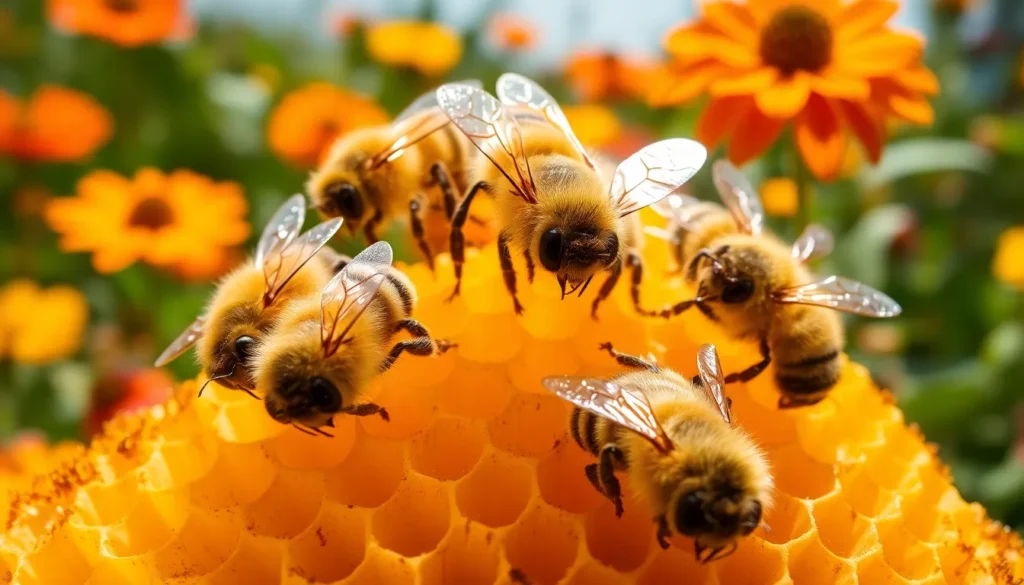
- Honey bees have branched hairs on their bodies. These hairs help collect and transport pollen efficiently.
- Honey bees are native to Eurasia and Africa but have been introduced worldwide. They have adapted to various climates outside their original range.
- Honey bees can fly at speeds up to 15 miles per hour. Their wings beat approximately 200 times per second.
- Honey bees produce beeswax to build their honeycombs. This wax is secreted from glands on the worker bees’ abdomen.
- Honey bees are vital pollinators for many crops. They contribute significantly to agricultural productivity and biodiversity.
- Honey bees have a complex social structure with division of labor. This social organization enhances colony survival and efficiency.
- Honey bees use nectar as an energy source and pollen as protein. Both are essential for colony health and development.
- The queen bee can live for several years, while worker bees live only a few weeks to months. The queen’s longevity supports colony stability.
- Honey bees can sting only once and then die. Their stinger is barbed and remains in the skin of the target.
- Honey bees exhibit a phenomenon called ‘swarming’ to reproduce colonies. This involves the queen and part of the workers leaving to form a new hive.
- Honey bees have been kept by humans for thousands of years for honey and wax. Beekeeping practices date back to ancient civilizations.
- Honey has natural preservative properties, allowing it to last indefinitely under proper conditions. Archaeologists have found edible honey in ancient tombs.
- Honey bees face threats from habitat loss, pesticides, diseases, and climate change. These challenges have led to declines in some bee populations globally.
Habitat and Behavior
Honey bees (genus Apis) are found worldwide, primarily in temperate and tropical regions. They typically build their nests in hollow trees, rock crevices, or man-made hives. Their social colonies consist of thousands of individuals cooperating to maintain the hive. Worker bees perform roles such as foraging, nursing larvae, hive cleaning, and defending the colony. Honey bees forage for nectar and pollen from flowers, which they use as food sources. They communicate the location of resources through their unique waggle dance. Temperature regulation inside the hive is critical, achieved by fanning their wings or clustering together to generate heat. Swarming is a natural reproductive behavior where a new queen and a portion of workers leave to establish a new colony. Honey bees are diurnal, active during the day and returning to the hive at night.
Why This Animal Matters
Honey bees are among the most important pollinators globally, supporting the reproduction of numerous wild plants and agricultural crops. Their pollination services are essential for food production, affecting fruits, vegetables, nuts, and seeds. Beyond agriculture, honey bees contribute to biodiversity and the maintenance of healthy ecosystems. Culturally, honey bees have been significant for humans for millennia, providing honey, beeswax, and propolis. Honey bee products have uses in food, medicine, and industry. Conservation of honey bees is critical due to their decline from multiple stressors, including habitat destruction, pesticide exposure, diseases such as Varroa mite infestations, and climate change. Protecting honey bees supports food security and ecological balance.
Common Misconceptions
Misconception: Honey bees are aggressive and will attack humans unprovoked.
Correction: Honey bees are generally non-aggressive and sting only in defense of the hive or when threatened.
Misconception: All bees can sting multiple times.
Correction: Honey bees can sting only once because their barbed stinger gets lodged in the skin, resulting in their death.
Misconception: Honey bees are the only important pollinators.
Correction: While honey bees are crucial, many other insects, birds, and animals also contribute significantly to pollination.
Misconception: The queen bee controls the hive through aggression.
Correction: The queen’s primary role is reproduction; colony coordination is largely maintained through pheromones and worker behaviors.
Misconception: Honey bees can survive well without human intervention.
Correction: Many honey bee populations require management to combat diseases and environmental challenges, especially in agricultural settings.
FAQ
How do honey bees communicate with each other?
Honey bees use a specialized behavior called the waggle dance to communicate the location of food sources to other members of the colony. The dance conveys direction and distance relative to the sun.
Why are honey bees important for agriculture?
Honey bees pollinate a wide variety of crops, improving yields and quality. Their role in transferring pollen is essential for the production of many fruits, vegetables, nuts, and seeds.
Can honey bees sting multiple times?
No, honey bees can only sting once. Their stinger is barbed and remains lodged in the skin of the target, causing the bee to die after stinging.






Leave a Reply