
Short Answer
21 Facts About Fijian Crested Iguanas
- Endemic Species: The Fijian crested iguana is endemic to Fiji, meaning it is found nowhere else in the world.
- Scientific Name: Its scientific name is Brachylophus vitiensis, placing it within the family Iguanidae.
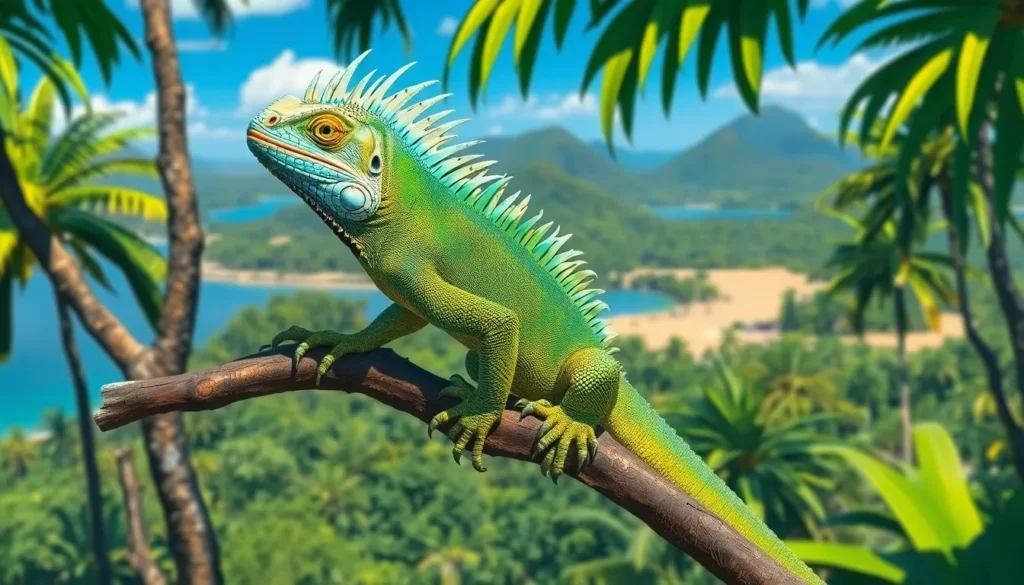
- Distinctive Crest: It has a prominent crest that runs from the neck down the back, made up of spiny scales.
- Coloration: Males are usually bright green with blue and white stripes, while females tend to be more muted in color.
- Size: Adult Fijian crested iguanas typically measure about 24 to 30 centimeters in length, excluding the tail.
- Diet: These iguanas are primarily herbivorous, feeding on leaves, flowers, and fruit.
- Diurnal Activity: They are active during the day and rest at night.
- Arboreal Lifestyle: They spend most of their time in trees and shrubs.
- Reproduction: Females lay clutches of eggs, usually between 2 to 5 eggs per clutch.
- Hatchling Appearance: Young iguanas resemble adults but are smaller and have less pronounced crests.
- Temperature Regulation: As ectotherms, they rely on external heat sources to regulate their body temperature.
- Social Behavior: They are generally solitary but may tolerate others during breeding seasons.
- Predators: Natural predators include birds of prey and introduced species like cats and mongooses.
- Conservation Status: Classified as Critically Endangered by the IUCN due to habitat loss and invasive predators.
- Habitat Preference: Found mainly in coastal forests and dry tropical forests on Fijian islands.
- Population Fragmentation: Their populations are fragmented across several small islands, limiting gene flow.
- Conservation Efforts: Protected areas and captive breeding programs are in place to help conserve the species.
- Evolutionary Significance: They represent one of the few iguana species found outside the Americas, showing unique evolutionary history.
- Behavioral Adaptations: They exhibit territorial behavior, especially males defending their area.
- Importance to Ecosystem: As herbivores, they contribute to seed dispersal and vegetation dynamics.
- Discovery and Study: The species was first described scientifically in 1989, highlighting its relatively recent recognition by science.
Habitat and Behavior
The Fijian crested iguana inhabits the dry and coastal forests of several small islands in Fiji, including the island of Yadua Taba, which hosts a significant population. Its arboreal nature means it spends much of its time in trees, where it can feed on a variety of leaves, flowers, and fruits. As a diurnal reptile, it is active during daylight hours, basking in the sun to regulate body temperature. Males are territorial and use their crests and coloration to display dominance during mating seasons. The species’ survival is closely tied to the health of its forest habitat, which has been threatened by human activities and invasive species like rats, cats, and mongooses that prey on iguanas or their eggs.
Why This Animal Matters
Ecologically, the Fijian crested iguana plays an important role in its environment by aiding in seed dispersal and influencing plant community dynamics through selective feeding. Its status as a critically endangered species highlights broader issues of island ecosystem vulnerability, invasive species impact, and habitat destruction. Culturally, the iguana is part of Fiji’s natural heritage and biodiversity, symbolizing the unique wildlife of the Pacific islands. Conservation of this species serves as a flagship effort for preserving Fiji’s native forest ecosystems and raising awareness about the importance of protecting island biodiversity.
Common Misconceptions
Misconception: Fijian crested iguanas are aggressive and dangerous to humans.
Correction: These iguanas are generally shy and non-aggressive toward people, preferring to flee rather than confront threats.
Misconception: All iguanas are native to the Americas.
Correction: While most iguanas are native to the Americas, the Fijian crested iguana is an exception, native to the Pacific island of Fiji, reflecting a unique evolutionary lineage.
Misconception: The Fijian crested iguana can survive in any environment.
Correction: This species requires specific forest habitats and cannot thrive outside its native environment, making habitat protection critical for its survival.
FAQ
Where are Fijian crested iguanas found?
They are found exclusively on several small islands in Fiji, primarily in dry coastal forests.
Why are Fijian crested iguanas endangered?
Their populations are threatened by habitat destruction and invasive predators such as cats, rats, and mongooses.
What do Fijian crested iguanas eat?
They are primarily herbivores, feeding on various leaves, flowers, and fruits found in their forest habitats.


Leave a Reply